arrow-double-right arrow-noline-right arrow-lrg-left arrow-lrg-right arrow-med-down arrow-med-left arrow-med-right arrow-med-up arrow-sml-right checkmark close close-sml contact-card event-clock linkedin menu minus outbound-link phone plus print search-lrg search-sml twitter Winthrop-mark

Forget Prince; Minnesota Opens Courts to Hulk Hogans of the World with Revenge Porn Civil Action

October 19, 2017—Recently, I attended the University of Minnesota’s celebration of “40 Years of Gopher Justice,” an event honoring the institution’s University Student Legal Service (“USLS”), a non-profit organization that provides UMN students with free legal services. The celebration included a panel on a contemporary topic in student advocacy: “revenge porn.” The topic isn’t relevant just for students, though. One may recall that just last year Hulk Hogan successfully sued the now-defunct gossip news site Gawker for its dissemination of a sex tape depicting him and another woman. Hulk Hogan eventually settled the case with Gawker for $31M.

Hulk Hogan testifies in his suit against Gawker. Image credit: Slate.

The USLS celebration panel hosted three experts on revenge porn, including two attorneys knowledgeable about Minnesota’s new suite of civil and criminal remedies that went into effect in late-summer 2016. See Minn. Stat. §§ 604.31 (civil)617.261 (criminal). In response to my question about the civil action, one of the attorneys remarked that he believed the Minnesota law created a “copyright” to one’s image, enabling that person to prevent unwanted dissemination and exploitation of pictures and recordings depicting the person in a sexual way. For the sake of persons hoping to prevent and recover damages for unwanted dissemination under Minnesota’s new law, I hope he’s incorrect; after all, the Copyright Act preempts all state laws that overlap with federal protections over the subject matter of copyright, see 17 U.S.C. § 301(a)—which includes photographs and videos, see 17 U.S.C. § 102(a)(5)-(6).

In order to bring a civil action for non-consensual dissemination of private images (the “revenge porn civil action”) in Minnesota, (1) the defendant must have disseminated a private image without the plaintiff’s consent, (2) the image must have been of a sexual character, (3) the plaintiff must have been identifiable in the image, and (4) the image must have been obtained or created under circumstances in which the plaintiff had a reasonable expectation of privacy. See § 604.31, subd. 1. If these four elements are shown, the plaintiff may recover general and special damages, including financial losses resulting from the dissemination of an image and damages for mental anguish, disgorgement of profits made from dissemination, civil penalties, and attorneys’ fees. See § 604.31, subd. 3. See the Minnesota Senate’s overview of this law for more general information about the revenge porn civil action.

What’s interesting about this cause of action is that it’s a blend of both (1) the right to privacy and (2) an intellectual property right called the right of publicity. Right to privacy claims (for invasion of privacy) typically remedy the unjustified exploitation of one’s personality and injury to privacy interests that are emotive or reputational. Right of publicity claims, on the other hand, combat the unauthorized use of one’s identity in commercial advertising and compensate persons for the value of the commercial use of that identity and/or reductions in the value of the cultivated identity. Minnesota’s revenge porn civil action appears to be a specific hybrid of both kinds of claims; it protects both privacy and property interests in a person’s identity and provides relief in the form of both reputational and economic damages, as well as injunctive relief.

Coincidentally, when Minnesota passed its revenge porn bill in 2016, it was also considering the codification of the right of publicity under a bill entitled the “Personal Rights In Names Can Endure” (“PRINCE”) Act. But the bill’s sponsor later pulled his draft after critics expressed concerns about the bill’s broad language. One commentator questioned whether such a bill was necessary in light of Hulk Hogan’s victory. Minnesota’s revenge porn civil action arguably combined two separate claims into one, but it also expanded the scope of recovery under either claim so as to now include multiple forms of relief.

Whether the revenge porn civil action will be utilized to any significant degree is as of yet uncertain. The USLS celebration panelists noted—and a brief case search confirms—that courts have yet to extensively apply and interpret the law. From the face of the law, though, it appears that Minnesota is now a hospitable forum for victims of revenge porn, especially celebrities with economically-valuable identities. And due to the state’s broad remedial scheme, I would not be surprised if we eventually see large cases like Hulk Hogan’s in Minnesota courts.

Former Rutgers Player Sues Alma Mater Over Nickname

October 16, 2017—Moving along from Steve’s post on our alma mater of the University of Iowa, a former Rutgers football player has a more negative view of his former school. A few years ago, the Rutgers football program started allowing position groups to choose a nickname. The wide receivers are known as “Flight Crew,” the defensive linemen as “Rude Boyz,” and the offensive line was formerly known as “Soul Train.” Apparently the steam ran out though and the group chose a new name this year: “Rare Breed.” The players and the coaches use the name in social media like Facebook and Twitter. While Wild Turkey appears unconcerned, the new moniker has ruffled the feathers of John Ciurciu, a former Rutgers fullback who has now filed a trademark infringement complaint in the New Jersey U.S. District Court.

Ciurciu founded Rare Breed after he moved on from his playing career. According to the complaint, the company sells a variety of clothing and football gear, becoming popular among high school, college and professional football players. The complaint counts Adrian Peterson and Brian Cushing among NFL players that wear the brand. The company also designs custom apparel for student athletes at Coastal Carolina College. The company owns registered trademarks for the RARE BREED mark in standard character form as well as part of a design mark. The registered design mark is shown below on the left, and the image displayed on Rutgers social media on the right.

The complaint alleges that the use of the image above as well as the use of the hashtags in social media are all instances of trademark infringement and unfair competition. Rare Breed had earlier sent cease and desist letters to Rutgers. The university’s attorney responded by stating that the coaches had been directed to remove the images and hashtags from their social media. While some of the images were removed, some remained. Rare Breed sent a second letter and again the university’s attorney stated that the coach had been directed to remove the use.

It is worth noting that Rutgers has not sold any goods with the image above. However it seems that Rare Breed is concerned that players, especially recruits, might mistakenly believe that the team is sponsored by Rare Breed. The concern seems plausible, even if Rare Breed doesn’t have the same widespread recognition as bigger companies like Adidas or Nike. While we have to wait and see whether Rare Breed can prevail on its claims, one thing is certain. In the age of recruiting via social media, counsel for colleges and universities should discuss intellectual property and other social media issues with their football programs. The Rare Breed – Rutgers dispute is an excellent Exhibit #1. Without proper guidance, lawsuits like this will be anything but rare.

An Iowa Rivalry Mixes Football, Farming, and Trademark Disputes

September 7, 2017—It sure feels like fall already. Apart from the fifty degree walk with my dog this morning, we’re now entering the second week of college football. Regular readers might have noticed that our blog has a couple of Iowa Hawkeye fans among the writers (Exhibits 12, and 3). This week Iowa takes on their in-state rival, the Iowa State Cyclones. Without a professional sports team in Iowa, the college teams are the big draws throughout the state. While the rest of the country probably couldn’t care less, the game is a pretty big deal to native Iowans. For that reason, the rivalry creates some strong (and often pointless) arguments. The most recent argument involves two competing slogans around the state’s ties to agriculture that, at least according to some fans, border on trademark infringement.

Although I’m sure you came here for an Iowa history lesson, I’ll keep the background brief. Beginning in the late 1970s running into the mid 1980s, farmers began suffering significant economic problems. Oil prices and interest rates rose, while export volume and prices for farm commodities fell. Farmers’ debt rose, with significant numbers of foreclosures. It was against this backdrop that Hayden Fry, then head coach of the Iowa Hawkeye football team, created the slogan “America Needs Farmers,” or ANF for short. The ANF logo was placed on the Hawkeye helmets (image below):

More than thirty years later, the logo still appears on Hawkeye helmets, as well as in pretty impressive card stunts on select game days:

Like all “awareness” promotions, the ANF program has its detractors. The program is run in partnership with the Iowa Farm Bureau, which assists in the sale of a wide variety of merchandise. A portion of all the proceeds goes to Iowa’s food banks.

Some Iowa State Cyclone fans feel that the awareness and food bank donations are insufficient support for farmers. As one of the world’s top agricultural schools, the fans felt that Iowa State does a lot more to help farmers than the University of Iowa. A few years ago this led to one fan site to create the phrase “Actually Helping Farmers,” or AHF. It seemed that not much came from the phrase, until earlier this summer when second-year head coach Matt Campbell latched onto the #AHF acronym in a tweet, raising the ire of an Iowa Hawkeye fan site. Even making the Des Moines television broadcast.

Some fans have suggested that the dispute may cross the line into trademark infringement. I’ll set aside the importance of deciding which school helps farmers more (spoiler: there is nothing important about doing that), but I couldn’t not leap at a chance to spend my blog post writing about trademarks and my alma matter.

While there are only so many letters in the alphabet (26, to be exact), acronym marks are still subject to trademark protection. So does the University of Iowa have a case? It isn’t clear what exactly Iowa State is using the AHF acronym for, if anything. The coach’s inclusion of AHF as a hashtag in a tweet is unlikely to be actionable. The acronym seems to have been used for primarily for merchandise like t-shirts. For our sake, let’s assume Iowa State were to begin using AHF in the same way: a sticker on its helmets, widespread merchandising on everything from tree ornaments to window blinds. Would that create a problem, are the acronyms sufficiently similar?

Acronym marks are not given the same level of protection is non-acronym, inherently distinctive terms. However a party can assert an acronym mark against a third-party for use of similar acronym, even if a letter is different (they can even win, too!). For example, courts have found that VDS was confusingly similar to VCDS, both for video duplication services; CSC was found confusingly similar to CCC, both for electric wiring components; and I.A.I. was found confusingly similar to ISI, both for printed publications in similar scientific fields. As one court reasoned, ” it is more difficult to remember a series of arbitrarily arranged letters than it is to remember figures, syllables, or phrases, and that the difficulty of remembering such multiple-letter marks makes the likelihood of confusion between such marks, when similar, more probable.” Dere v. Inst. for Sci. Info., Inc., 420 F.2d 1068 (CCPA 1970).

As a result, the fact that ANF and AHF have different middle letters does not mean that there is no likelihood of confusion. The marks could, in fact, be confusingly similar depending upon the overall context in which they appear. But a lawsuit seems unlikely, as neither school likely wants to get dragged into a dispute over helping farmers. It’s not the best public relations event. Plus, we haven’t even touched on the possibility that Iowa State might prevail on an argument that the use of AHF is a parody. Although I haven’t considered the legal support for a parody claim, Iowa State has some experience in parody, having pretended to be a real football team for the last three decades.

Yet when the fourth quarter hits zero, I’d expect this debate to die down – until September 2018, that is.

Go Hawks!

Game Over for Nestlé? Atari Sues Over “Breakout” Kit-Kat Ads

August 23, 2017—For most of us, video games and candy go together perfectly, but that doesn’t mean they always get along. In fact, last week the “original” video game company, Atari Interactive, sued food and candy behemoth Nestlé in California federal court. What put Atari on tilt? It was Nestlé’s incorporation of the game play, layout, and namesake of Atari’s classic Breakout video game into a KitKat advertising campaign.

I’ll forgive those readers who are not well-versed in classic video games. Not everyone could be as interesting as I am, having built a vintage video game collection that included more than 700 games across the Intellivision, Atari 2600, NES (Nintendo), SNES (Super Nintendo), Sega Genesis, and other platforms—side note to self from 10 years ago, don’t fall for that “we need more space, you never play them, and wouldn’t you rather have money?” argument. Breakout was essentially a single player version of Pong, whose game play screen is shown in the image below:

Image courtesy of Atari Interactive, via its complaint.

If it isn’t obvious from the screenshot, the goal of the game is to eliminate all of the colored blocks in the wall at the top of the screen. The player moves the spaceship at the bottom to bounce back the bouncing ball until breaks all of the breaks in the wall. Once that happens, you move on to the next stage, where you do it again. Exciting, right?

Nestlé had the clever idea to create an advertising campaign based on the Breakout game where, instead of colored bricks, it used KitKat slabs (I believe that’s the culinary term for a KitKat portion). An example of Nestlé’s online advertising was included in the complaint and is reproduced below.

At the moment, the Nestlé television commercial featuring the “game” is still accessible on YouTube.

In the complaint (available here), Atari asserts a number of claims including trademark infringement, copyright infringement, false designation of origin, dilution, and unfair competition. Will any of these claims hold up? I’d say the copyright infringement claim has a fair shot. Atari’s claim of incurring actual damages seems like a stretch though. In fact, Nestlé could plausibly argue that the advertisement increased demand for the Breakout game. If you don’t mind a little armchair quarterbacking, maybe some discovery on whether downloads of Breakout games increased shortly after Nestlé’s campaign began?

Setting that issue aside, Nestlé seems likely to win in the court of public opinion as the average member of the public is likely to think “what’s the big deal?” Yet in Atari’s defense, the company owns significant rights in numerous, valuable game franchises with extensive merchandising value. I’m never a fan of slippery slope arguments, but there is a reasonable concern here as to the effect of such use on merchandising rights. And with all that as a back drop, I’d say the chances of a quick settlement are high.

In the meantime, I’ll be scouring eBay for some good deals on Atari 2600s.

Trick or Trademark? Mars Says Hershey’s Can’t Own “SCARY” Candy

July 7, 2017—Sandwiched between 90 degree days in a Minnesota summer, the idea of Halloween wasn’t on my radar – until I learned about the latest dispute between candy giants Mars and Hershey’s.

Mars and its subsidiary own many well-known candy brands, including M&Ms, Snickers, Twix, Skittles, Life Savers, and others. Not to be outdone, Hershey’s maintains its own stable of popular brands in addition to Hershey’s brand, including Kisses, Reese’s, Twizzlers, and others. Even though the parties are major competitors, it appears the two bonbon behemoths don’t frequently compete in proceedings at the Trademark Trial and Appeal Board, except for extensions of time to oppose and a handful of oppositions settled quickly.

In light of the history, Hershey’s may have been spooked when it first learned that Mars filed a Notice of Opposition last month against Hershey’s’ new application to register the mark SCARY in connection with “Candy.” The Notice of Opposition (available here) claims that the term SCARY is “highly descriptive” and “generic” in connection with candy, especially candy sold or promoted during the Halloween season. Mars alleges that “SCARY is like ‘HAUNTED’ ‘SPOOKY’ or ‘BOO,’ only SCARY is more frequently used.” In light of this, Mars alleges that “SCARY is no more capable of being a trademark for candy than is TRICK OR TREAT.”

Mars’s arguments have some bite. I don’t recall the specific brands from my candy hauls on the streets of my Iowa hometown, but I remember a lot of Halloween imagery: ghosts, pumpkins, monsters, and others. Yet, I’m not sold on the idea that SCARY is descriptive, let alone generic, for candy. To be descriptive, a term must immediately describe “an ingredient, quality, characteristic, function, feature, purpose, or use of the specified goods or services” (according to the Trademark Manual of Examining Procedure). Scary doesn’t seem like it describes the candy, but instead merely the marketing used to advertise the candy. Establishing that SCARY is generic is even more difficult, because “generic terms are terms that the relevant purchasing public understands primarily as the common or class name for the goods or services” (TMEP). If there is a genus specifically for candy marketed for trick or treating, the genus is probably “Halloween Candy,” not “Scary Candy.”

A claim that might have a better chance of success, however, is that the term SCARY does not function as a trademark, but instead is understood by consumers as conveying information about the goods. Consumers might perceive the term scary as indicating the candy is meant for use in the Halloween season, or that the term SCARY is somehow ornamental or informational. Unfortunately, Hershey’s filed the application on an intent-to-use basis, so Hershey’s has not yet used the mark. As a result, it is difficult to evaluate whether Hershey’s’ use constitutes use as a trademark.

While Mars has a colorable claim, I don’t see SCARY as crossing the line into the descriptive category of the marks. I think SCARY is likely used by a number of third-parties, but I think this means that consumers perceive SCARY (and similar variations) as being a weak designation of source, but not necessarily descriptive. Notwithstanding, Mars has legitimate concerns. If Hershey’s obtains a registration, Hershey’s could take a broad view of the scope of its rights, seeking to prevent others from using SCARY or similar terms, even against third-parties who may be making a non-trademark use in connection with Halloween candy. For example, Mars uses the term SPOOKY on the candy below:

Mars might be fighting to protect itself and others in the industry from the potential of Hershey’s wielding a SCARY registration as a sword to unfairly inhibit competitors from using certain Halloween imagery. This goal seems reasonable under the circumstances, even if the claim of “mere descriptiveness” has some weaknesses. It would not be the first time a trademark owner relied on a registration to push competitors away from non-infringing uses.

Notwithstanding Mars’s good intentions, it might be difficult for Mars to claim a “white hat” in this battle, at least with a straight face. Mars owns its own registration for SPOOKY SHAPES for “candy” (disclaiming SHAPES). With that in mind, Mars might be wishing it hadn’t alleged that “SCARY is like . . . SPOOKY” in the Notice of Opposition. If SCARY is like SPOOKY, then it is hard to see why Mars’s use of SPOOKY is a legitimate trademark use, but Hershey’s’ use of SCARY is not. While the statement doesn’t prevent Mars from prevailing, it does suggest that the purported harm to the industry may be exaggerated. But who knows, perhaps Mars has a few tricks up its sleeve.

Is Foster’s Australian for False Advertising?

June 29, 2017—While trademark infringement is the headliner for claims brought under the Lanham Act, the law also precludes false advertising and unfair competition. Most states also have laws addressing deceptive trade practices addressing similar misconduct by advertisers. Recently, one consumer sued MillerCoors under these laws, claiming he had been deceived into purchasing Fosters beer, thinking the beer was made in Australia.

Image result for fosters beer

The plaintiff pointed to the red kangaroo and star constellation prominently displayed on the front of the can. The red kangaroo is closely associated with Australia and you may recognize the star constellation from the Australian flag (below):

Image result for australian flag

The plaintiff also pointed to the history of Fosters beer. It was first brewed in Australia in 1887, and first exported to the U.S. in 1972, in large 25.4 ounce containers “shaped like motor oil cans.” Into the late aughts, however, the Fosters beer sold in the U.S. was brewed stateside at Oil Can Breweries in either Albany, Georgia or Fort Worth, Texas. Yet television commercials maintained similar themes, such as the “Fosters: Australian for Beer Commercials.” Compare this 1996 commercial with this 2011 commercial. If you watched them both, you likely noticed the word “Imported” disappeared from the front of the can between 1996 and 2011.

Notwithstanding the imagery, MillerCoors prevailed on a Motion to Dismiss. The company pointed to the disclaimer on the side of the can, which states that the beer is “Brewed and packed under the supervision of Foster’s Australia Ltd, Melbourne Australia by Oil Can Breweries, Albany GA and Fort Worth TX.”  The court found this to be a sufficient disclaimer under the circumstances and, in light of the commercial context, no consumer would be reasonably deceived into thinking the beer was imported from Australia.

The Fosters decision is the latest in a trend of victories for beer companies battling consumers who claim that the beer deceptively suggests that the beer is actually imported from another country. Red Stripe and Sapporo both prevailed in overcoming lawsuits alleging the companies’ advertising deceived consumers into thinking their beer was imported from Jamaica and Japan respectively.

Image result for red stripe bottleImage result for sapporo bottle

Not all breweries have been as lucky, however. The makers of Kirin and Beck’s both settled lawsuits that resulted in payouts to consumers. And even though Red Stripe prevailed, consumers can perhaps claim a moral victory with the company’s decision to move operations back to Jamaica.

USPTO Proposes Cheaper, Faster Cancellation Option

May 24, 2017—The U.S. Patent and Trademark Office register contains a lot of dead weight. In order to obtain a trademark registration and maintain the registration, the owner must use the mark in U.S. interstate commerce (as always, with a few limited exceptions). What constitutes dead weight? Usually marks that are currently registered, but not actually used in commerce. These registrations could be identified in a preliminary clearance search by your attorney, causing you to choose a different name rather than the one you really want. The registration might be cited against your application, forcing you to choose whether you’d like to embark in a Petition for Cancellation of the registration, or just move on to a new name. If you or a client has ever found yourself in one of these positions, the USPTO is considering expanding the available options to remedy the situation and is seeking public comments.

Uncle Sam TTAB Poster

There is a need for a streamlined procedure for cancellation of registrations for claims of non-use or abandonment. With the ease of online filing, the number of trademark registrations has risen significantly, issuing at a rate 4,500 per week.  Beginning in 2015, the USPTO also began issuing to owners courtesy reminders informing them that the maintenance and renewal windows are now open. To be honest, it’s pretty easy to file a trademark application, obtain a registration, and maintain a registration. You can do it all electronically through the USPTO website.

Yet, it is also very easy to do it incorrectly, rendering that Certificate of Registration to be a worthless piece of paper – that’s where we attorneys add value. For example, an attorney can help determine whether a mark is actually used in commerce at the right time. The USPTO doesn’t have the time or resources to investigate whether a mark is in use, so the fact that the USPTO accepted a specimen does not provide any cover. To obtain the registrations, Applicants and registrants need only click a box acknowledging that the mark is in use, and provide a sample (aka, specimen) of how the mark is used in commerce. Even if the USPTO accepts the specimen and issues a Certificate of Registration, that registration could be cancelled if the mark was not used in commerce at the relevant date.

The risk of doing it incorrectly doesn’t stop third-parties from continuing to register marks that have questionable claims of “use in commerce.” There’s a vast array of individuals and entities with dead weight registrations. The first group that comes to mind are the registrations that you know aren’t used just based on looking at the registration. For example, the individual that claims to provide space travel services and owns dozens of registrations for various FUTURE trademarks in connection with a wide variety of goods and services, including space travel services and manufacture of space vehicles. As you might guess, the specimen that was accepted by the USPTO is, at best, questionable:

future - edited

Then there are the “Golden Ticketers.” These are people and entities that seem to have a plan to later sell or license one of their many marks that, again, have questionable claims to use in commerce. These commonly happen when a well-known brand has a new product, or may need to rebrand, for example, the Washington Redskins. There are a number of trademark registrations for a various WASHINGTON ___ marks with dubious claims to use in commerce, like the WASHINGTON ARROWSAMERICANSFOUNDERSNATIVESPANDASMONUMENTSVETERANSRED-TAILED HAWKS, and the WASHINGTON FEDERALS. Most are registered in connection with “Providing a website featuring information relating to the sport of football.” And as you can tell from the owner’s website, it is technically in use:

arrows

It provides helpful information regarding the sport of football, including pertinent details like “The team with the most points at the end of the game wins.”

In light of this, the USPTO has good reason to implement a new method of challenging registrations for non-use. While I encourage everyone to read the Notice in full,  here are the highlights:

  • The new procedures are limited solely to claims of abandonment, or non-use for some or all of the goods/services at the time the declaration of use in commerce was filed (application date for a 1a application, or the Statement of Use for a 1b application)
  • The Petitioner must include evidence supporting the claim of abandonment with the Petition
    • Evidence might include a declaration detailing searches for use of the mark
  • The Respondent must include evidence to rebut the claim in its answer
  • If requested and upon a showing of good cause, the TTAB will grant very limited discovery
    • The Respondent can also challenge the Petitioner’s standing and request limited discovery on this issue
  • The proceeding is designed to move fast:
    • Limited or no discovery
    • Abbreviated schedule
    • No oral hearing
    • Only one extension request per party
    • Estimated time from start to finish would be 70 days in the event of default, or 170 days for a contested Petition
  • No counterclaims would be allowed
  • After reviewing the Answer, the Petitioner could choose to convert the proceeding to a full cancellation (the Respondent does not have the option, though)

Overall, the proposed procedure could be a valuable tool, at least in those situations where non-use and abandonment are clear, or the mark has not been used for three years or more. However, where the period of non-use is less than three years, the petitioner would normally need to establish that the respondent had an intent not to resume use of the mark. The limited discovery granted by the TTAB would likely require some testimony on behalf of respondent with respect to intent to resume use. Regardless, if the TTAB implements the new rules, practitioners would have a cheaper, more time effective tool to clear the way for their client’s trademarks.

If you have any comments on the new rules, be sure to provide them ahead of the August 14, 2017 deadline to [email protected].

Welcome to the (Courthouse) Hotel California

May 4, 2017—While it may be a lovely place, the Eagles are not too keen on a small hotel in Todos Santos, Mexico and its use of the name HOTEL CALIFORNIA. After opposing the hotel’s trademark application last January, the band earlier this week sued the hotel in federal court in California for trademark infringement and unfair competition (complaint).

Hotel California

The hotel was purportedly named the Hotel California back in the 1950s, decades before the Eagles recorded their hit song of the same name. Legends of the hotel as the inspiration of the song have swirled for years, but it is possible those “legends” have been planted, or at least encouraged, by the hotel’s new owners that purchased the hotel in 2001.

In fact, for decades the hotel has gone by a number of names other than the Hotel California. However, according to the Eagles, the promotion of the “rumored” connection to the Eagles’ hit increased significantly under new ownership.

The complaint raises a number of interesting trademark issues. For example, to what extent may a band claim trademark rights in a song title? Can a third-party be sued in the U.S. for conduct that occurs exclusively in a foreign country? We discussed some of these issues in our previous article discussing the Notice of Opposition filed with the Trademark Trial and Appeal Board by the Eagles back in January.

But speaking of the Notice of Opposition, the timeline also raises an interesting issue and an important practice tip for attorneys and businesses alike. The Baja California hotel has been operating for over a decade under a new ownership. On November 16, 2015, however, the company chose to file a trademark application for the HOTEL CALIFORNIA covering numerous items across six classes of goods. This was followed by an opposition by the Eagles, and then this lawsuit.

A federal trademark registration is a valuable piece of intellectual property. It provides significant statutory benefits to the owner and can be used as a sword and a shield in litigation. It is almost always preferable to have a registration for your trademarks. But one time where federal registration should not be sought is where the likelihood of waking a sleeping giant is high.

Would the Eagles have ever objected to Baja California’s use of the HOTEL CALIFORNIA name if Baja California had never filed its trademark application? Possibly not. By filing a trademark application, the applicant is staking a claim to use the mark in the U.S., potentially throughout the entirety of the country. While a senior user might be comfortable with an isolated or geographically remote use, filing a trademark application raises the stakes significantly.

Perhaps it was inevitable for the Eagles to object. Or it is possible that Baja California recently expanded its advertising or increased its activities in some way, or would have done so in the future. However, this situation is a reminder for attorneys and businesses alike to consider the rights of third-parties before filing trademark applications. If there is a significant risk of a third-party objecting (and you have no real defense), it may be preferable to fly under the radar rather than risk being sued.

While the Slants are in the Spotlight, Chief Wahoo is on Deck

April 20, 2017—Throughout the past decade, attorneys, judges, plaintiffs, and defendants have invested thousands of hours in the fight over offensive trademarks. Most of the public is aware of the controversy surrounding the Washington Redskins, who continue to be embroiled in litigation that is currently pending with the Federal Court of Appeals for the Fourth Circuit. But even more important is the pending litigation at the Supreme Court, where the Asian-American band The Slants have challenged the constitutionality of the law that prevents the federal government from granting the benefits of federal registration to trademarks that disparage groups of people.

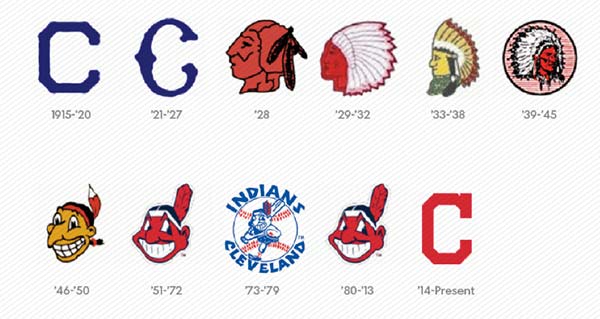
We’ve discussed the history and merits of the case at at length. I won’t get into the details in this post. However, with the Cleveland Indians in town to play the Minnesota Twins, I was reminded that the Cleveland organization seemed to be escaping the glare of the media attention that had been focused on the Redskins and the Slants. Apart from the name of the team itself, Cleveland’s logos throughout only seem to worsen the potential to disparage or offend Native Americans. For reference, the logos and years of use are reproduced below:

Indians Logos

The Supreme Court heard oral arguments in the Slants case (In re Tam) on January 18th. But while we await a decision from the Court, the Cleveland Indians provide us with a reminder that, regardless of what a court may say, the court of public opinion may have the final word. In fact, we have learned over the last two weeks that Major League Baseball’s Commissioner Rob Manfred has been in discussions with the Cleveland organization regarding the “Chief Wahoo” logo since the end of the World Series. The Commissioner has publicly stated that he is pushing the team “to transition away” from the logo. Just last January, the MLB awarded Cleveland the right to host the 2019 All-Star game. With recent events in Charlotte and throughout the U.S., it’s hard not to wonder whether Chief Wahoo’s retirement date may already be set.

We’ll have to wait and see how the Supreme Court rules in In re Tam but, as with the case of the Cleveland Indians, not all trademark battles are won in the court of law.

Help! Someone Copied My Stuff!

CR Poster

March 22, 2017—At some point in this digital age, almost every individual or business in the creative space will discover that somebody has copied them. You may see it yourself, or you may get the stomach-dropping “Doesn’t this look an awful lot like…..” e-mail from a friend. It might be that potential client who said your design “was nice, but wasn’t for us.” It could be a big company with a new shirt/container/advertisement with a strikingly similar photograph. It could be a blog post that . . ., well, you get the idea. When you discover that someone copied something that you created, there are a lot of questions and it’s rarely as simple as “someone copied my stuff!” So here are a few things to consider as you decide on next steps.

First, does your work qualify for copyright protection? Any one who creates an original, creative work of authorship has a valid copyright interest as soon as the work is fixed in a tangible medium of expression. The bar for what is “creative enough” to qualify is low. Very low. Even the mere selection, arrangement, and display of facts in a graph or a telephone book may qualify as a creative work of authorship. However, there are some limitations. Copyright law only protects the expression of an idea, not the idea itself. So while a cookbook focused on chicken sandwiches would be protected, the underlying recipe (and sandwich) is not. Also, words and short phrases like book or movie tittles are not protected by copyright. But yes, the image you grabbed from a Google image search through likely is.

However, as long as you meet have a modicum of creativity, and as long as you didn’t copy someone else’s expression, you likely have a valid copyright. This is true even if you haven’t registered your copyright with the Copyright Office. However, a registration (or pending application to register) is generally a prerequisite for bringing a lawsuit, and can open up additional types of relief if the infringement occurred after the registration of the copyright.

Second, are you the owner of the work? Generally, the author is the owner, unless ownership has been transferred. For businesses, if an employee created the work within the scope of their employment, then the employer is likely the author. The work for hire doctrine can be tricky, so it is best to drill down and confirm ownership before asserting any claim of infringement. If you’re not the author, you may be able to contact the former employee, contractor, etc. and obtain an assignment of the copyright interest.

Third, is the “infringer” really infringing? Copyright law only protects the expression of a work, not the idea of a work. The James Bond franchise has a number of valuable copyright protected works: books, movies, characters, etc. While there are broad rights associated with the franchise, the copyright does not give the owner the ability to claim rights in the idea of a British secret agent. The tough part is locating the fine line between idea and expression. There also a question of  whether the “infringer” is making a legitimate “fair use” of the copyright work. Is the copy part of a social commentary on a relevant issue or topic, like gender stereotypes? Could creation of an online repository of shared links, images, and articles a la Pinterest qualify as a fair use? These are important questions to consider when deciding whether to pursue any further action.

Finally, what are your options? You could start with a short email or phone call. Third-parties may not realize something is protected. The “infringer” may happily stop selling/posting/distributing the copied work. An attorney can assist, providing you with talking points, ghost writing a letter, or if you prefer contact the alleged infringer directly. If the copy is on the internet, there is likely a method for you to request that the website/app/hosting service remove access to the infringing work through a Notice of Claimed Infringement. YouTubeFacebookeBay, and others all have online submission forms. Be aware, however, making wholly unreasonable claims of infringement could lead to the alleged infringer turning the tables.  Of course, a lawsuit is an (expensive) option but as noted above, a registration or pending application is necessary to bring  a lawsuit. If the work has value (economic or personal), you should consider applying to register the copyright to at least expand your response options, and your potential recovery.

Creative individuals and companies put a lot of time, effort, and money to create something that is valuable to them. When you discover that someone took a shortcut at your expensive, it can be personally offensive and you want to make it stop, now. The law provides an avenue for relief, but unfortunately it often may not provide you with the scope of protection you thought you had. So if you or a client runs across a copycat, hit the pause button. Someone may have “copied your stuff,” but they may not have committed copyright infringement.