arrow-double-right arrow-noline-right arrow-lrg-left arrow-lrg-right arrow-med-down arrow-med-left arrow-med-right arrow-med-up arrow-sml-right checkmark close close-sml contact-card event-clock linkedin menu minus outbound-link phone plus print search-lrg search-sml twitter Winthrop-mark

Don’t Forget About Domain Names

March 6, 2015—One aspect of intellectual property law that doesn’t get as much attention as it maybe should is domain names.  For those of you internet-savvy readers out there (who I assume is most of you), you already know that domain names provide the virtual address where customers and others can hopefully find your goods and services.  But did you know that there exists a Uniform Domain Name Dispute Resolution Policy (“UDRP”) which requires appropriate and specified treatment of trademark-based domain name disputes.  (See here.)  In pertinent part, the Rules provide:

You are required to submit to a mandatory administrative proceeding in the event that a third party (a “complainant”) asserts to the applicable Provider, in compliance with the Rules of Procedure, that

(i) your domain name is identical or confusingly similar to a trademark or service mark in which the complainant has rights; and

(ii) you have no rights or legitimate interests in respect of the domain name; and

(iii) your domain name has been registered and is being used in bad faith.

In the administrative proceeding, the complainant must prove that each of these three elements are present.

This process can provide a quick and relatively inexpensive process for recovering domain names that trademark holders believe could be infringing their rights.

Another thing that may not be known about domain names is that they can also be considered be “property” subject to attachment and garnishment by creditors in court proceedings.  That was the  result in a Minnesota Court of Appeals case that recently decided the issue for the first time.  See Sprinkler Warehouse, Inc. v. Systematic Rain, Inc., A14-1121 (Feb. 2, 2015).  This result appears to be uniform across all U.S. jurisdictions that have addressed the issue.

Domain names were seemingly more important prior to the proliferation of quick and accurate search engines.  Nowadays, people can start a Google search from their address bar and quickly find the site they are looking for without knowing the actual domain name.  However, these little online domiciles are still important markers as they are the primary business address in the virtual world.  There is significant value associated with these domain names, and it is important to keep that in mind.

All-Star Tips To Avoid Infringement Litigation

February 27, 2015—Shoes are always in the news. From a fashion standpoint, Nike has made headlines this week, with a re-release of the Classic Cortez running shoe (aka, the Forrest Gump shoe) along with the second edition of the LeBronald Palmer.  And yes, the LeBronald Palmer is exactly what it sounds like, LeBron James creating a shoe inspired by Arnold Palmer. Or possibly by an Arnold Palmer that kept James refreshed during his stay in Miami.  But for those of us who like our News of Shoes to have a legal bent, Converse is there to help.

In October of last year, Converse laced up an impressive number of lawsuits against more than 30 different retailers and manufacturers, including big names like Ralph Lauren, Wal-Mart, H&M and others. We discussed Converse’s use of International Trade Commission proceedings as part of this offensive back in October. Since that time Converse has been slowly reaching out-of-court settlements with the parties, including Ralph LaurenH&M (subscription required), Tory Burch, and others.

In an ideal world though, a company doesn’t need to file thirty lawsuits against its competitors in order to protect its brand. While the Converse example is a bit trickier because it involved protection of the trade dress of the All-Star shoe, here are three steps brand owners can take to help minimize the potential for infringement and counterfeits of their goods:

  1. Conduct a domestic trademark portfolio audit. Are all of your important trademarks protected in connection with all of the important goods? If you have well-known product lines, do you have registrations for these trademarks as well as the overall brand? If not, file new applications with the U.S. Patent and Trademark Office. It is possible others have developed, or could develop, legitimate and enforceable rights in confusingly similar marks.
  2. Record your U.S. registrations with the U.S. Customs and Protection Bureau. The cost is relatively cheap and the benefit can be substantial, especially if your products are susceptible to counterfeits (apparel, jewelry, and electronics in particular). If you have products manufactured abroad, you can provide this information and the Customs officials can identify questionable shipments at the ports – before they are distributed in the U.S.
  3. Conduct an international trademark audit. Do you sell your products overseas? Do you have registrations in these countries? Alternatively, if your products are manufactured overseas, do you have any protection in these countries? By protecting your trademarks in these countries, you can help prevent unauthorized products from leaving (or entering) these countries, too.

These three steps can’t prevent infringing products or counterfeits from ever entering the U.S. or other countries. Yet they can minimize the chances of a problem arising. In the unfortunate situation that the issue does arise, these actions will provide you with an expanded toolbox to address the issue with evidentiary presumptions in your favor and expanded remedies. In short, they’ll help you get off on the right foot.

Crafting an Effective Fair Use Defense

February 18, 2015—The beer industry is rife with trademark legal issues. We’ve discussed quite a few here, including disputes over brewery names, attempts to register as a trademark the design of a beer glass, or the longstanding issue of whether all alcoholic products are related for likelihood of confusion purposes.

Because of the importance of the beer industry in the trademark world, I am required to purchase and sample the numerous offerings of the local breweries here in Minnesota and Wisconsin. Last weekend, while on one of these work-related trips, something caught my eye at the store:

Craft Singles

These “singles” – also known as “bombers” – are 22 ounce bottles that are popular among smaller breweries.

For those who grew up in households of organic and unprocessed foods, the refrigerator plays off of the classic cheese slices shown below:

Kraft-American-Singles-x-600

Funny, I don’t remember my parents making me “grilled cheese product sandwiches,” but apparently, that’s what they were.

The use appears to be a parody of the Kraft Singles brand. While parody isn’t a defense to trademark, it is another way of saying that there is no likelihood of confusion. We’ve discussed other potential parodies here, such as the Subway parody of ZOMBIES eat flesh, Verizon’s parody of the De Beers shadow commercials, and others.

The analysis for a parody is largely the same as any other product: is the use of the mark likely to create confusion or mistake as to the source, sponsorship, or some other connection with the owner of the other mark. Although the marks are essentially identical, the goods appear unrelated. I am unaware of any evidence that consumers are apt to presume that beer and cheese, sorry, cheese product, emanate from the same source. Well, other than beer cheese soup as a “complementary use. ”

What do you think, effective parody? Cause for Kraft’s concern? Or do you just really want a beer and a grilled cheese right now?

Red Bull Strikes Again, but Is Old Ox Brewery a Matador in Disguise?

February 6, 2015—It’s no secret that Red Bull has a strong trademark enforcement strategy. Too strong, according to some. In its defense, IP counsel for Red Bull has stated that

With a brand as famous as Red Bull you can certainly imagine the type of coat-tailing that goes on by third parties and we invest a lot of time and money to stop such infringements as the brand is that important to the company.

I agree with the sentiment behind the statement. But sometimes the sentiment gets lost in translation. In 2014, Red Bull pursued legal action against a U.K. brewery that began selling beer under the brand Redwell. After a strong public reaction, the company clarified that:

Red Bull has all along been willing to allow Redwell to maintain its mark for beer so long as they do not use it for energy drinks.

Fair point, but I can’t help but wonder, was there ever any indication that Redwell might sell energy drinks? Do consumers expect producers of beer to also produce energy drinks (or vice versa)?

Fast forward and Red Bull finds itself in a similar situation. On Jan. 28, 2015 the company filed a Notice of Opposition to Old Ox Brewery’s application to register its OLD OX BREWERY mark in connection with beer, ale, lager, stout and porter. Red Bull claims that the OLD OX BREWERY mark is likely to create confusion with its RED BULL mark.

As a general rule, the two main factors in the analysis involves (1) the similarity of the overall commercial impression of the marks; and (2) the relatedness of the goods. Setting aside the issue of whether energy drinks are related to beer (which deserves an article all on its own), my initial reaction is that OLD OX BREWERY is simply too dissimilar to create a likelihood of confusion. Whether marks create an overall similar commercial impression depends on similarities between sight, sound, and meaning of the mark.

Other than the number of syllables, OLD OX doesn’t sound or look anything like RED BULL. Accordingly, Red Bull is relying heavily on the “meaning” of the marks. And that’s where things get interesting.

It certainly wouldn’t be the first time where the meaning of the marks trumped differences in sight and sound. Yet when this occurs, the goods are usually identical. For example, CYCLONE and TORNADO found confusingly similar in connection with wire fencing or PLEDGE and PROMISE found confusingly similar in connection with furniture wax.

So what is Red Bull’s argument for similarity in meaning? Paragraph 9 of the Notice of Opposition alleges that:

An “ox” and a “bull” both fall within the same class of “bovine” animals and are virtually indistinguishable to most consumers. In addition, an ox is a castrated bull.

Apparently, Red Bull has little faith in the ability of consumers to distinguish between various classes of bovine animals. That would include cows, bulls, oxen, yaks, bison, buffalo, steer, longhorns, and apparently antelopes (Wikipedia threw me a curveball there).

But Red Bull’s claim does not rest solely on the bovine nature of oxen and bulls, but also the fact that an ox is a castrated bull. The implied claim being that the image of a castrated bull creates the same commercial impression as the RED BULL mark. If that’s the case, I’d suggest sending those legal fees to the marketing department to fix that issue. I knew that Red Bull gave you wings, but I guess I never asked what they took in return.

In my mind, the shared similarity in meaning of a bovine animal does not overcome the stark differences in sight and sound between the marks.  In particular an old ox, having suffered through a particular medical procedure, doesn’t scream “energy drink,” but instead, the polar opposite of the commercial impression that Red Bull tries to create. But maybe I’m missing something, kind of like an old ox.

Brave New World

January 26, 2015—Tiffany & Co. made some waves over the past several weeks when it featured a same-sex couple in its “Will You?” engagement campaign.  Tiffany is the first “famous” brands to take this path, and they are undoubtedly hoping this campaign will pay high dividends after disappointing holiday sales.

Personally, I applaud Tiffany for taking a bold step in the advertising world.  Although, as the Wall Street Journal noted, the legalization of gay marriage in numerous states has created new opportunities for wedding related goods to be sold.  While somewhat ground breaking, this campaign was certainly sensible from an economic standpoint.

The question that it raises for me is whether we will shortly see more mainstream advertising catering to gay and lesbian consumers.  Of course, such advertising has taken place in publications catering to the LGBT community, but perhaps its time that such advertising start taking place in more of our everyday channels.  Regular print publications and television commercials could all start providing more inclusive campaigns.  Indeed, while the Tiffany ad seems to be garnering the most attention, there was a nice bit of publicity generated for a DirecTV Sunday Ticket ad which “apparently” featured a gay couple.  I say “apparently,” because you’d miss it if you weren’t paying attention.

I’m sure there are those out there that think catering explicitly to same sex couples and/or members of the LGBT community risks alienating more “conservative” consumers.  Admittedly, I think this could be an unfortunate problem that is difficult to quantify in advance.  But seriously, if the NFL and Sunday Ticket are comfortable with the idea, how bad could that downside really be.  I think advertisers need to be prepared to make that leap if they’re not already there.

Tacking: It’s Not Just for Judges Anymore

January 22, 2015—The U.S. Supreme Court doesn’t frequently take on trademark cases, so yesterday’s release of its decision in Hana Financial, Inc. v. Hana Bank should have been pretty exciting (available here). We discussed the case back in June when the Court granted certiorari, in a tone that may have suggested that the case didn’t involve the most thrilling of issues. In Hana, the Supreme Court was tasked with deciding if the issue of trademark tacking constitutes a question of law or a question of fact. Grab your popcorn.

While some may confuse the names, nobody is likely to confuse the Hana Bank Headquarters building (Image courtesy of Hana Financial Group, licensed via Wikimedia Commons)

The admittedly rare doctrine of “tacking” affects how the issue of priority is determined. Trademark rights are a bit like musical chairs: first person to sit gets the chair (except for intent-to-use applications, which are more like calling “shotgun” in your parents’ car, but you get the picture). Generally, the first person to use the mark gets priority over any subsequent, junior users.

Hana Financial first used its HANA FINANCIAL GROUP mark in the U.S. in 1994, it would normally have priority over Hana Bank, who began using the mark HANA BANK in the U.S. 2002.  However, Hana Bank had been using HANA WORLD CENTER since 2000, and HANA OVERSEAS KOREAN CLUB since 1994, all in the U.S. The company had been using the name Hana Bank in Korea (and in Korean) since 1991, but because trademark rights are territorial in nature, such use did not establish rights in the U.S.

The proposed jury instruction cited in the Supreme Court’s decision succinctly summarizes the legal standard for tacking:

A party may claim priority in a mark based on the first use date of a similar but technically distinct mark where the previously used mark is the legal equivalent of the mark in question or indistinguishable therefrom such that consumers consider both as the same mark. This is called ‘tacking.’ The marks must create the same, continuing commercial impression, and the later mark should not materially differ from or alter the character of the mark attempted to be tacked.

In crib-note form, tacking is allowed where the marks are the legal equivalents of the other and create the same, continuing commercial impression.

The jury concluded that Hana Bank could tack its use of HANA BANK, HANA WORLD CENTER, and HANA OVERSEAS KOREAN CLUB all back to 1994, establishing priority over Hana Financial Group.  The Ninth Circuit affirmed.  It noted that other courts could reach a different conclusion on the same facts, but that because the Ninth Circuit treats the issue as a question of fact, it was bound by the jury’s determination.

The Supreme Court quickly dismissed most of Hana Financial’s arguments simply by comparing tacking to the other issues that we task juries with deciding. Juries frequently apply law to fact in all types of criminal and civil cases. In fact, the Court reasoned, the issue of tacking falls uniquely within the scope of a jury’s knowledge. The Court concluded that “[a]pplication of a test that relies upon an ordinary consumer’s understanding of the impression that a mark conveys  falls comfortably within the ken of a jury.” Accordingly, in a brief 7 and 1/2 page decision, the Court resolved a 24-year circuit split.

Many commentators (ourselves included) wondered whether the Supreme Court would take the opportunity to resolve the related circuit split of whether the overall question of a likelihood of confusion is a question of fact or a question of law. The Court made no mention of the issue. However, it is hard to argue the Court’s reasoning does not apply with equal force to at least most of the factors considered in the likelihood of confusion analysis. The similarity of the marks, the relatedness of the goods, the likelihood of expansion, and the majority of the other factors all, in some way, are dependent upon how an ordinary consumer would see the marks and the goods. If the lower courts interpret the Hana decision as being persuasive for this issue too, then perhaps the Hana decision is more interesting than it first seems.

And if you’re still not sold, make sure to come back for the Supreme Court’s sequel, B&B Hardware: the Board Strikes Back (with res judicata). It’ll be a good one.

Unicorns and Beer: A Match Made in Portland

January 7, 2015—Hipsters and Portland go together like…. hipsters and Pabst Blue Ribbon (PBR). So naturally, when PBR decided to host a music festival, they chose Portland, Oregon. Unfortunately for PBR, some of their choices along the way have caused the city of Portland to schedule a vote to decide whether to sue them.

It turns out, the connection between PBR and Portland goes way back. Since the 1970s, PBR experienced a steady decline in popularity. But in the early 2000s, the beer’s sales began growing rapidly in certain urban areas, with the New York Times identifying Portland as the instigator. Supposedly, the popularity was due to certain consumers’ desire for a cheap, working class beer that didn’t try to buy their loyalty with gimmicks like “advertisements” and “commercials,” along with a heavy dose of 1970s nostalgia.

Portland shared a similar nostalgia for the past, too. Locals and visitors are likely to recognize the sign below as an iconic landmark for Portland:

Well, the sign is iconic, at least. It had been in the city for decades, but it used to read “Made in Oregon,” and before that, “White Stag Sportswear” (and before that, “White Satin Sugar”). In 2009, the sign was nearly shut off and dismantled, when it was purchased by the City of Portland. It didn’t take long for the city to begin monetizing the sign, granting licenses to use the sign – usually for a fee.

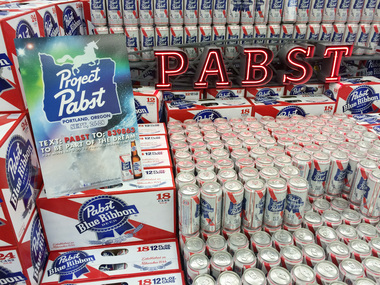
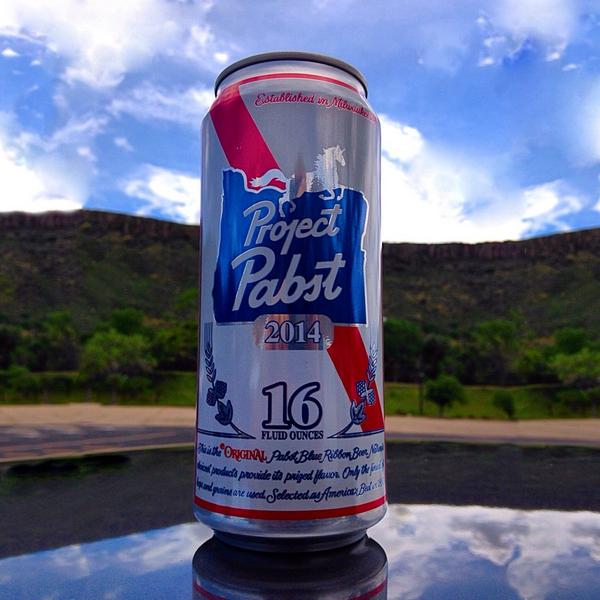
PBR decided that it too liked the sign and began the process of applying to license its use of the sign as part of its logo, shown below:

Unfortunately, the process failed and PBR abandoned its license application. Reportedly, the application was refused because Project Pabst’s product (beer) has age restrictions, in violation of the licensing guideline requiring goods licensing use of the sign to be available to all ages. PBR decided to use the logo anyway. The city sent PBR a letter telling them not to, but PBR apparently didn’t care. Maybe PBR thought that the city wouldn’t notice, that they’d only use it sparingly and fly under the radar. Maybe just on a sign in the local liquor store.

Maybe a barely noticeable sign on the front door to the festival.

Oh. Okay, but it’s not like PBR was printing the logo on actual cans.

Well, I guess at least once it got dark out nobody could see the logo anymore.

At least PBR wasn’t being sneaky.

Interestingly, it’s not just the city that PBR might need to worry about. Back when the city was deciding how to reword and redesign the sign, one clever resident proposed this design:

However, the creator of the unicorn sign suggests that PBR’s choice might simply be a coincidence in light of the rumor (fact?) that Portland was built on an ancient unicorn burial ground.

Setting aside the government cover-up of the unicorn burial ground, the city claims to have trademark rights in the sign, but it is unclear what type of goods or services in connection with which the city uses the supposed trademark. A recent demand letter sent to Uber declines to identify the goods or services.

However, the letter includes a copy of the city’s Oregon state trademark registration. Under “goods or services,” the registration lists:

The sign is a visual icon associated with Portland, and is seen all over the world when major events come to Portland.

I’m sure that isn’t a good. And it doesn’t sound like a service. I’ve heard Oregon is a pretty laid-back place, but I didn’t know that included the Secretary of State, too. If the city is ever forced to proceed to trial, it will be forced to articulate an actual good or service, at least for a trademark infringement claim. There is still some potential for claims of copyright infringement, unfair competition, and deceptive trade practices.

Unfortunately though, it doesn’t look like we’ll find out what goods or services Portland is selling any time soon. It appears that PBR and the city are on speaking terms again and my be reaching a settlement. Which is really too bad because now we may never learn the truth as to whether Portland really is built on a unicorn burial ground.

Lessons from Santa on Trademark Protection

December 26, 2014—Christmas may be over, but somewhere Santa is already back to work: making his list, and checking it twice. But don’t let Santa hog all of the good ideas, making a list is good advice for companies and their trademarks, too.

The Lanham Act provides a number of benefits for registering trademarks: constructive notice, nationwide rights, presumptions of validity, and others. These are excellent reasons to register your trademarks with the U.S. Patent and Trademark Office (USPTO). Another benefit that is not expressly enumerated, but perhaps just as important, is the ability to let the USPTO enforce your trademarks for you.

Yes, you read that right. If you have a trademark registration, the USPTO will do your work for you, at no extra charge! Of course, you can’t just call them up and ask them to do something. However, once you have an application on file, the USPTO will cite your application (and eventual registration) against any later-filed applications for confusingly similar marks (confusingly similar in the eyes of the particular trademark examiner).  In order to get the full advantage of this benefit, though, your registered rights should encompass all of your common law rights because the USPTO only considers active registrations and applications on file with the USPTO. It does not consider common law marks in the examination context.

For example, the Broadmoor, a resort near Colorado Springs, has been in business for nearly 100 years. The company registered its BROADMOOR mark in connection with hotel services, spa services, recreational services, and a number of other services as well. The company also sold a number of Broadmoor branded clothing items, but it did not register its BROADMOOR mark in connection with clothing.

In August of 2014, the company was surprised to learn that the J. Crew company had begun selling a line of Broadmoor clothing (website shown below).

Broadmoor sent a letter requesting J. Crew to cease use of the mark but, as you can see, J. Crew did not comply. As a result, Broadmoor filed a lawsuit alleging trademark infringement just last week. It’s also worth noting that the Broadmoor filed an application to register the BROADMOOR mark in connection with clothing last August, likely right before it sent its letter (better late than never!).

Luckily for the Broadmoor, J. Crew hadn’t applied to register the BROADMOOR mark in connection with its clothing items. Had this occurred, it is possible that the application would have been approved for registration, even though the marks and the goods are identical. But having an application or registration on file would likely have prevented J. Crew from obtaining a registration.

As we’ve mentioned previously though, the USPTO deals only with the right to register a mark, not the right to use a mark. Consequently, Broadmoor would still have had to take action to get J. Crew to cease using the BROADMOOR mark. But simply having a trademark registration on file may have been sufficient to avoid this issue. Many companies will perform preliminary clearance (or “knockout”) searches before adopting a mark for their collections to determine whether there are any obvious issues. While trademark law is often a gray area, it is difficult to disagree that a registration for BROADMOOR in connection with clothing would have constituted an obvious issue. Simply having a registration on file may have allowed the Broadmoor to avoid the problem entirely.

So take a cue from the man in red. Make a list of your trademarks, your goods, and your services. If you don’t have registrations to cover everything (at least the important stuff!), then you should strongly consider updating your trademark registration portfolio.

And it doesn’t even matter if you’ve been naughty or nice, the USPTO doesn’t care.

Did Sony Let the Terrorists Win?

December 19, 2014—Unless you’ve been living under a rock recently, you’ve probably heard about the hoopla caused by the new Seth Rogen and James Franco movie called The Interview.  The movie follows a plot to assassinate North Korean dictator Kim Jong-un.  According to recent reports, North Korea was behind a cyberattack against Sony which included theft of emails and the theft and release of various Sony movies.  A timeline of the hack is available here.

Earlier today, news reports broke indicating that Sony would be pulling its world wide release of the film.  An example is here.

Not surprisingly, many have decried Sony’s decision.  Many have referred to this as a “freedom of speech” issue.  That’s not entirely accurate because “freedom of speech” in the United States constitutional sense simply means that the government has limited abilities to sensor or punish speech.  People often fail to recognize that “freedom of speech” does not preclude private employers from punishing or firing you for things that are said or done at your job, nor does it preclude a film distribution company from pulling a plug on a film that, presumably, the film’s creators and actors would like to have shown.  After all, this is their expressive work and they probably believe the message is important.

So, even though Sony obviously has the right to pull the movie, should it have?  This is obviously a serious question, and its a topic that is substantially more serious than my ordinary posts.  Here at DuetsBlog, I expect we all believe in the importance of expression and the “marketplace of ideas.”  So when glorified cyber-bullying (albeit by a country that is potentially a nuclear power) pollutes that marketplace and stifles expression, I feel a profound sense of disappointment and loss.  At the end of the day, I don’t know whether Sony’s decision was “right” or “wrong,” but I do know which decision I would have preferred.

The College Football Playoff™ college football playoff

December 10, 2014—This past Sunday, the College Football Playoff Committee unveiled the four college football teams that will be participating the very first playoff in college football. The festivities begin Jan. 1, 2015, with Oregon battling Florida State in the Rose Bowl followed by Alabama and Ohio State duking it out in the Sugar Bowl. However, as the debate regarding who will win the college football playoff continues on television, in the comment sections of websites, and around the water cooler, a different type of college football debate has been ongoing at the U.S. Patent and Trademark Office (USPTO).

Despite the players and teams being a mere three weeks from taking the field, the application to register the COLLEGE FOOTBALL PLAYOFF mark is still on the bench. The application suited up back on March 28, 2013 but is still no closer to registration today. The application includes the following identification of services:

Entertainment services in the nature of television and radio sports programs featuring college football games, exhibitions and tournaments; entertainment services, namely, organizing and staging college football games, exhibitions and tournaments; and providing information, news and programming, scores, standings, statistics, and history, all in the field of the sport of football, via the internet

The examiner initially refused registration on the grounds that the mark was merely descriptive, but included a statement informing the applicant that the mark may be generic in connection with “organizing and staging college football games, exhibitions and tournaments.”

In response, BCS Properties (the applicant) claimed that COLLEGE FOOTBALL PLAYOFF was not descriptive but instead a suggestive mark. It made the oft-asserted but rarely successful argument that a component of the mark has multiple meanings and therefore consumers will need to exercise imagination, perception, and thought to determine the exact nature of the services. The applicant conceded that the Examining Attorney’s definition of “college” as “an undergraduate division of a school or university” was a possible definition, but argued that “college” can also be defined in other ways, including (1) a body of clergy living together and supported by a foundation; (2) a building used for an educational or religious purpose; and (3) a preparatory high school. The implied argument is that consumers encountering the COLLEGE FOOTBALL PLAYOFF mark won’t be certain whether these football tournaments involve university students, clergy roommates, buildings, or high school students. I don’t find this argument convincing, but maybe that’s just me.

The real emphasis of the response was on a claim of acquired distinctiveness. The applicant submitted numerous examples of news articles, websites, Facebook Groups, and evidence regarding viewership of the last BCS Championship Game (25.6 million viewers).

Overall, these are substantial numbers, but the Examining Attorney called an audible and denied the claim of acquired distinctiveness. Instead, the Examining Attorney issued a refusal on the basis that COLLEGE FOOTBALL PLAYOFF is a generic term for “college football tournaments.” Determining whether a mark is generic involves a two-step inquiry: (1) what is the genus of the services at issue; and (2) does the relevant public understand the designation primarily to refer to that genus of goods and/or services?

In support of the refusal, the Examiner relied upon the following:

  • The identification of services includes “college football” as part of the services;
  • Numerous news articles describe the mark as identifying a playoff system for college football; and
  • An article where the director of the College Football Playoff is quoted as stating: “We decided to call the playoff what it is – the College Football Playoff.

Because advertising and sales cannot turn turn a generic term into a trademark, the claim of acquired distinctiveness is moot if the term is generic. In the alternative, the Examiner maintained the merely descriptive refusal, noting that given the highly descriptive nature of the mark, the evidentiary burden to prove acquired distinctive is much greater than it might be for less descriptive marks.

After failing to move the chains with its first response, the applicant filed its second response. It argued that the genus of goods is not “college football playoffs” but instead simply “football.” It also argued that the public does not use the COLLEGE FOOTBALL mark to refer to “entertainment services.” Notably, the applicant provided no evidence to support this claim. With regard to potential acquired distinctiveness, the applicant submitted evidence that its twitter account had over 30,000 followers, its Facebook page had more than 200,000 fans, and noted the numerous news articles referencing the upcoming college football playoff. Besides, the applicant argued, third-parties could use a number of other names for a “college football series,” such as “Collegiate Football Tournament,” “College Football Showdown,” [and] “University Football Series.”

It was a good effort, but ultimately unsuccessful as the Examiner issued a final refusal on August 26, 2014. The examiner noted again that the phrase “college football” is in the identification of services and therefore the proper genus is not simply “football.” The Examiner also noted that the evidence supplied by the applicant makes clear that its mark will be used to identify “those college football games that come after the end of the regular scheduled season that will be used to determine the college football champion.” The examiner also rejected the evidence of acquired distinctiveness, stating that it merely showed that college football itself was popular, not that the mark had obtained acquired distinctiveness.

BCS Properties will have another shot at filing a response to try to change the examiner’s mind. Unfortunately though, the application may have been doomed as soon as the name was chosen. It seems like ages ago, but after the announcement of the new name, there were laughs had as to the less-than-creative name (for example, herehere, and here). Most of the chuckling was that the BCS paid a marketing firm to come up with the name (Premier Sports Management, for the curious). For what it’s worth, I don’t blame the marketing firm. As some of the articles point out, after the BCS era, the goal may have been to simply find a name that the public couldn’t trash.

But even though the hurdle was going to be high, the applicant got off to a false start by including the phrase “college football” in the actual identification of services. The fact that the applicant’s director was quoted as stating that the College Football Playoff name was chosen “because that’s what it is” certainly doesn’t help either.

Yet it isn’t a lost cause. These types of office actions require thoughtful and well-planned arguments, and that planning begins with the application (i.e., not digging yourself a hole). Trademark examination is a unique situation as it isn’t adversarial in the same sense of a lawsuit. Instead, the examiner is both the adversary and the judge. In light of this, organization and word choice can make or break a response, in part because trademark law requires a highly subjective analysis. It isn’t about “tricking” an examiner, it’s about defining and framing the legal inquiries and burdens in a way that makes sense with your particular facts.

The applicant has until February 6, 2015 to respond to the final office action. This gives the applicant additional time to gather evidence regarding public understanding and use of the claimed COLLEGE FOOTBALL PLAYOFF mark. However, I’ve got a feeling that even if BCS is unsuccessful at changing the examiner’s mind, the game will extend into overtime at the Trademark Trial and Appeal Board.