arrow-double-right arrow-noline-right arrow-lrg-left arrow-lrg-right arrow-med-down arrow-med-left arrow-med-right arrow-med-up arrow-sml-right checkmark close close-sml contact-card event-clock linkedin menu minus outbound-link phone plus print search-lrg search-sml twitter Winthrop-mark

Rise of the Game

July 8, 2016—Video games have been an existing and growing component of popular culture for my entire life.  I literally cut my teeth on the Atari 2600 while I was still a toddler.  From there I spread into bowling alley arcades, Nintendo, PC Games, Playstation, Nintendo 64, Playstation 2, Playstation 3, and Playstation 4.  Over that time, the gaming industry grew in popularity, volume, and innovation.

Over the past several years and over the following few years, there have been and are likely to be significant new developments that are going to expand the gaming industry even further.  Simply put, its an exciting time to be alive for a “gamer.”  So called eSports appear to be gaining a significant foothold such that they will be regularly broadcast on TBS on Friday nights.  Vegas is “looking to video games” to bring in a new crowd of gamblers.  And it appears that hardware and software capabilities are almost finally to the point where VR games are something people will actually want to play.

The rise of the games is also an exciting time for the legal profession.  Each of these new avenues of gaming promise to provide new and interesting legal issues.  For example, top gaming talent is likely to end up working with agents similar to sports stars.  The gambling angle is likely to raise tricky legal issues regarding whether the games are “games of skill” or “games of chance.”  And one can only start to imagine the issues that will begin to arise in an entirely virtual world.  (“Virtual infringement,” anyone?)

Being both a gamer and an attorney, I’m excited for the possibilities, and I’d love to hear from any readers with thoughts on what they think the future may hold.

On the Precipice of Registration Number 5,000,000

June 9, 2016—Don’t look now, but the U.S. Patent and Trademark Office is about to hit a major milestone: we are only 24,819 registrations away from the magic number 5,000,000. The only thing more incredible than that number is the inexplicable lack of news media coverage. Maybe now that the primaries are over, the USPTO will finally get the attention it deserves.

5 million registrations is a big number. The number itself is remarkable, but what is more noteworthy is the sudden speed at which S.S. Trademarkia is steaming ahead. The first trademark registration issued on August 30, 1870. Registration number 50,000 did not issue until 36 years later. From there, the numbers rose steadily throughout the Twentieth Century, beginning to level out in the late 2000s:

  • 36 years to get to Reg. No. 500,000 (1948)
  • 26 more years for Reg. No. 1,000,000 (1976)
  • 14 years for Reg. No. 1,500,000 (1988)
  • 8 years for Reg. No. 2,000,000 (1996)
  • 5 years for Reg. No. 2,500,000 (2001)
  • 4 years for Reg. No. 3,000,000 (2005)
  • 3 years for Reg. No. 3,500,000 (2008)
  • 3 years for Reg. No. 4,000,000 (2011)
  • 3 years for Reg. No. 4,500,000 (2014)

While the period from 2008 – 2014 appeared relatively steady, the numbers have picked up. Looking at the Trademark Office’s own analysis (based on fiscal year), the number of Certificates of Registration issued from 2009 onward are:

  • 2009: 180,520
  • 2010: 164,330
  • 2011: 177,661
  • 2012: 182,761
  • 2013: 193,121
  • 2014: 206,555
  • 2015: 208,660
  • 2016: 210,000** (Projecting through Sept. 30 end of FY 2016 based on current rates)

That is a lot of registrations. And we’re getting more and more each year. In fact, Certificates of Registration are issuing at a rate of about 4,500 per week. That’s a pace of 234,000!

At this rate, it’s hard not to wonder whether we’re about to run out of trademarks. In fact, some industries, like the beer industry, already seem to be running into this issue (although “Esoteric Historical Event Brew” sounds like a crowd pleaser to me, NPR).

But even if we’re slowly approaching absolute zero of trademarks, we won’t get there before Reg. No. 5,000,000 issues. With that in mind, I’ll go out on a limb and make a bold prediction: trademark registration number 5,000,000 will issue on July 19, 2016.

More important than getting the date right, though, is making sure that the mark that gets the coveted 5,000,000 actually deserves it. There have been a lot of duds over the years for the milestone registrations. Past recipients of the honor include Reg. No. 4,000,000 for POCKET SOCKET for hand tools (really imaginative, Everhard), Reg. No. 3,000,000 for the mark TOT FINDER, which is unfortunately not registered for a GPS-enabled potato finder, Reg. No. 2,000,000 for BODY WISE for bags and briefcases (not terrible, but it’s cancelled! New rule: milestone registrants are required to stay in business and continue to sell their products, renew their registrations, no exceptions).

Thankfully, Reg. No. 1,000,000 comes in strong:

SweetNLow 2

Why yes, that is the background design from a Sweet‘N Low low calorie sugar substitute. Pretty iconic mark, even though it is frequently infringed upon by music score manufacturers with as many legal consequences as calories.

Other than Sweet’N Low, though, none really jump out as being particularly deserving. So, to the extent you’re reading, USPTO big wigs, if you could find a way to casually slip one of my client’s applications in between 4,999,999 and 5,000,001, I’d be very grateful. I’d be happy to draft the Milestone Registrant Rule if it’ll free up some of your time.

Second Circuit Weighs in on Nominative Fair Use

May 25, 2016—The federal courts of appeals have split as to how to apply the doctrine of nominative fair use in trademark infringement cases. Last week, the Second Circuit endorsed the nominative fair use factors used by the Ninth and Third Circuits. At the same time, however, the court rejected the manner in which the Ninth and Third Circuits evaluate these factors, instead adopting a third approach.

The decision is Int’l Info. Sys. Security Cert. Consortium Inc. v. Sec. Univ. LLC, No. 14-3456 (2d Cir. May 18, 2016) (decision available here). The plaintiff ISC developed a certification for information security professionals, marketed as the CISSP certification program. A party who passes the program can identify itself as CISSP certified.

The defendant, Security University, passed the program and therefore was able to identify itself with the CISSP certification mark. However, Security University chose to advertise itself as “Master CISSP” and “CISSP Master.” ISC objected to Security University’s use, arguing that it incorrectly suggested that the defendant had obtained some higher level of certification. As the lawsuit suggests, Security University declined to comply with ISC’s request.

For the casual trademark fan, it is worth noting that trademark law has two general types of “fair use.” Classic fair use, or descriptive fair use, has been recognized for a longer time. If a trademark consists of a descriptive word, consumers and competitors are free to use that mark in its original, descriptive meaning. The second category of nominative fair use is more recent. The doctrine provides that if a person is using a mark to identify the products of the trademark owner, then it is not an infringement (for more background, click here and here).

Not all circuit courts have adopted the nominative fair use doctrine. Those that have don’t agree on how to apply it. The Third Circuit considers nominative fair use to be an affirmative defense to a trademark infringement claim. Under Ninth Circuit case law, a court is required to identify whether the claim of infringement involves nominative fair use. If not, the traditional likelihood of confusion factors apply. If the complained of use does qualify as “nominative fair use,” then the likelihood of confusion factors are replaced by a different set of factors.

The Second Circuit rejected both of these approaches. In rejecting the Third Circuit’s view, it concluded that Congress did not intend for there to be an affirmative defense of nominative fair use because Congress chose not to include it with the other enumerated affirmative defenses. In rejecting the Ninth Circuit’s approach, the Second Circuit recognized that many of the likelihood of confusion factors are “a bad fit” to evaluate nominative fair use. Yet the Second Circuit saw “no reason” to replace the traditional test. Instead, the Second Circuit held that a court should consider the traditional likelihood of confusion factors, the Ninth Circuit’s nominative fair use factors, and the Third Circuit’s nominative fair use factors.

Instead of providing clarification regarding application of the nominative fair use doctrine, the Second Circuit’s decision seems to add another layer of disagreement. If the parties to the lawsuit aren’t already sick of litigation, perhaps the district court can provide some clarification on remand.

Trademark Litigation Keeps Getting Cheaper (If You Win)

May 6, 2016—Slowly but surely, the extension of the Supreme Court’s 2014 Octane Fitness v. LLC v. Icon Health and Fitness, Inc. decision to trademark claims is gaining traction among federal appellate courts. The Octane Fitness decision addressed the standard for determining whether a case is “exceptional” under the Patent Act and therefore eligible for an award of attorney’s fees. Earlier this week, the Fifth Circuit jumped on the bandwagon with its decision in Baker v. DeShong, Case No. 14-11157 (May 3, 2016)(available here).

Baker operates the HIV Innocence Group, which provides medical, legal, and investigative services for individuals in criminal and civil suits who have been accused of intentionally or recklessly infecting another person with HIV. Baker owns a trademark registration for the HIV INNOCENCE GROUP mark. He also does not like to be criticized. When Jeffrey DeShong created a website criticizing the HIV Innocence Group, Baker sued him for trademark infringement.

The District Court granted DeShong’s Motion to Dismiss on the ground that the allegations failed to support a claim of likelihood of confusion (discussed in more detail here). Following that ruling, DeShong requested an award of attorney’s fees, arguing that the case was “exceptional”. However, the District Court denied the motion, citing prevailing precedent that to qualify as “exceptional,” a case must be brought in bad faith.

The Fifth Circuit reversed the decision, ruling that the Octane Fitness Court “provided clear guidance” that to be exceptional does not require a claim to be brought in “bad faith.” Instead, an exceptional case is a case that “stands out from the others with respect to the substantive strength of a party’s litigation position” or with respect to “the unreasonable manner” of a party’s actions in litigation.

Although DeShong requested that the Fifth Circuit also find that the claims qualified as an exception for an award of attorney fees, the Fifth Circuit remanded to the District Court to decide the issue. With this ruling, the Fifth Circuit joins the Third Circuit (Fair Wind Sailing, Inc. v. Dempster, 764 F.3d 303 (3d Cir. 2014)) and the Fourth Circuit (Georgia-Pac. Consumer Prods. LP v. von Drehle Corp., 781 F.3d 710 (4th Cir. 2015)). The Sixth Circuit has not squarely addressed the issued, but remanded a case to the District Court to “assess the applicability” of Octane Fitness to the request for attorney fees (Slep-Tone Entertainment Corp. v. Karaoke Kandy Store, Inc., 782 F.3d 313 (6th Cir. 2015)).

While no circuit court has reached a contrary decision, there has been disagreement among district courts. Most district courts have applied Octane Fitness to trademark infringement claims, but at least one district court has rejected the applicability of Octane Fitness to non-patent claims (Romag Fasteners, Inc. v. Fossil, Inc., 2014 WL 4073204 (D. Conn. Aug. 14, 2014)). There the court concluded that Second Circuit precedent requiring “bad faith” was still good law and therefore binding upon the court.

Although it is possible other courts may choose to reject the applicability of Octane Fitness to trademark infringement claims, this seems unlikely in light of the trend among the circuits. The Fifth Circuit’s decision lends further support to this notion.

Of course, the standard adopted in Octane Fitness does not guarantee that it will be easier to obtain an award of attorney’s fees. We previously discussed a Washington district court decision refusing to grant an award of fees under the Octane Fitness standard.

At a minimum, however, these decisions caution trademark infringement plaintiffs to objectively examine the strength of their claim. They also provide victims of unreasonable or meritless claims of infringement with some potential leverage: the threat of forcing the plaintiff to write a check for the defendant’s legal fees.

What do you mean(s) we lost?!?

April 29, 2016—Tomita Technologies USA, LLC was handed a devastating loss earlier this week in its long-enduring battle with Nintendo over stereoscopic (i.e. 3D) image technology.  Back in 2013, Nintendo lost a patent infringement jury trial in the Southern District of New York and was ordered to pay $30.2 million in damages to Seijiro Tomita, the inventor of United States Patent No. 7,164,664.  Roughly speaking, the ‘664 Patent provides a way to display 3D images without the need for 3D glasses.  Tomita had accused Nintendo’s 3DS system of infringing the patent.

Nintendo appealed the original jury verdict to the United States Court of Appeals for the Federal Circuit.  The Federal Circuit then reversed the construction of a critical claim term underlying the original judgment, which required a new trial in the district court.  The district court concluded in the new trial that Nintendo did not infringe the patent because the means by which the 3DS accomplished its stereoscopic image was different (and frankly, more sophisticated) than the means disclosed and claimed in the ‘664 patent.

Ultimately, Tomita lost in this case as a result of something known in patent law as “means-plus-function” claiming.  Dennis Crouch over at Patently-O previously did a nice summary of the what “means-plus-function” claiming is, and why such claiming is starting to fall out of favor with patent applicants.  When you draft a patent claim that identifies a functional attribute of your invention, the protection of the patent is generally limited to the particular structure you have used and disclosed to accomplish this function.  Tomita’s invention depended primarily on hardware components to accomplish the image offset function, whereas Nintendo relied primarily on software algorithms.

Aside from resulting in a bad day for Tomita, this lawsuit highlights again the difficulties that we are currently facing with regards to intellectual property protection for functions that are accomplishable with software.  As it currently sits, the United States does not have any clear protection scheme for protecting software rights.  Rather, software is “protected” through a mishmash of patent, copyright, trademark, and trade secret law, none of which were truly designed to work for software.  (See here.)

Our intellectual property regime also has problems with trying to protect inventions in a world where technological capabilities are expanding at break-neck speed.  Often times, important inventions from the “analog” world can be replicated through software or digital means and in the case of a “means-plus-function” patent, that will frequently be sufficient to avoid infringement.  At some point, we need to make a policy decision as to whether we think this is okay.

To be clear, I’m not suggesting that the differences between the Nintendo and Tomita functions were merely one using software while the other used hardware; there appeared to be additional differences as well.   However, I think a case like this presents a good opportunity to ask the questions about how intellectual property rights should be considered in our environment of constantly evolving technological capability.  We need to find a new balance between incentivizing invention without creating undue obstacles to innovation.

Trademark Lessons for New Businesses from a Lawsuit Against a Colorado Juice Bar

April 27, 2016—It is a big, exciting, and dangerous risk to start a new business. There were approximately 400,000 in 2014 (continuing a recent downward trend, according to Gallup). Most entrepreneurs know that the odds are stacked against them, as about 50% of new companies fail during their first five years (dig deeper into the numbers here.).

There are countless reasons why new businesses fail and so many are out of the owner’s control. However, a business’s name and trademarks are within its control. Unfortunately, many new businesses don’t learn of the risks associated with trademarks until it is too late. A recent lawsuit against Sol Kitchen juice bar and café provides some cautionary lessons for new businesses.

Sol Kitchen opened just the second week of April in 2016.  The company has already been sued. The plaintiff is Baja Management, owner of the Sol Cocina Mexican restaurant chain. Baja Management has locations in California, Arizona, and recently announced last January that it would be opening a location in Denver, Colorado. Reportedly, Baja Management sent a cease-and-desist letter to Sol Kitchen in January, but the discussions stalled when Baja Management would not agree to pay Sol Kitchen for it to change its name. Sol Kitchen had already invested at least $10,000 into its website, logos, and other items.

Understandably, many new businesses are shocked when they receive a cease-and-desist letter. The owners of Sol Kitchen noted that state or federal officials did not object to their name. Recipients of cease-and-desist letters often feel like they are being “bullied” or unfairly singled out. While these reactions are normal, the reactions reflect a misunderstanding of U.S. trademark law (which, admittedly, doesn’t always align with common sense).

Here are three common misunderstandings regarding trademark disputes that may help your business avoid a similar situation:

  1. Registering your entity name does not provide protection for your trademark. When you incorporate your business or obtain a federal tax number, the state and federal officials do not evaluate the availability of your name as a trademark. Most states will examine only whether there is an identical business name (meaning, you could probably register Starbux Coffee House, Inc., but it doesn’t mean you can legally use the name). If you want legal advice regarding the availability of a trademark, you need to consult with a trademark attorney.
  2. Just because another company is not in your city or state, its rights are not necessarily limited. If a company obtains a federal trademark registration, that company has the right to use that trademark nationwide, except against third-parties who have established valid common law rights prior to the filing date of the trademark application.
  3. The fact that other companies are using the same word in their business doesn’t always justify another third-party use. The issue is whether there are so many third-parties using a particular term in U.S. commerce in connection with the same or related goods or services such that the trademark should be entitled to a narrow scope of protection. This is a fact intensive, legally complicated, and ultimately very subjective analysis. If you’re relying primarily on third-party use as a defense, you’re facing an expensive legal battle, and one that you may end up losing.

Avoiding these three misunderstandings can help reduce the risk that your business finds itself on the receiving end of a cease and desist letter. Ultimately though, every business should consult with a trademark attorney before crossing the line to where it would be cost-prohibitive to change the name of a business or product.

A preliminary clearance search of the records of the U.S. Patent and Trademark Office (or a “knock-out” search) can quickly and relatively inexpensively identify clear problems with a new trademark or name. A trademark attorney can also equip you with some knowledge in how to select a new or modified name that carries less risk.

While a search cannot identify every potential problem, it can significantly reduce the risk of being the target of an infringement lawsuit. Such a search can help avoid legal fees and rebranding costs and, perhaps more importantly, provide you with a little peace of mind. With all of the other unknown challenges facing small businesses, evaluating the risk of a possible trademark dispute, while there is still time to change course, is an opportunity that every new business should use.

Mine?

April 8, 2016—Recent developments have brought to the forefront the ongoing debate about what rights, if any, gamers should have or own in their online personas or in the contributions that they make to games through their gameplay contributions (i.e. is the participation by the player an act of “authorship”)?

On April 7, 2016, Mike Futter at Game Informer reported that Blizzard had sent cease and desist letters to the ISP of an unauthorized World of Warcraft server that allows users to “capture older game states.”  He concluded (probably soundly) that:

The Nostalrius petition essentially asks Blizzard to forego revenue related to its brand and products so that people can circumvent subscriptions. The document admits that there might be copyright issues while the group also claims it didn’t see itself as a threat to the publisher. I don’t expect Blizzard to budge on this, nor should it for the sake of protecting its brand.

In January of this year, Patrick Klepek at Kotaku noted that Nintendo had been deleting Mario Maker Stages that were created by players, without advising as to the reason.

In both cases, its likely that the dry, fun-hating intellectual property attorneys (*sarcasm*) representing the game developers adequately zipped up the situation in the terms of service or terms of use accompanying the games.  For example, it appears that the terms of service for World of Warcraft specifically precluded unauthorized servers, and it appears Nintendo effectively gave itself complete control over any courses uploaded by players.  But while Nintendo and Blizzard both likely have the law on their side in these instances, its reasonable to debate whether that should be the case.  As I’ve mentioned previously, video games and other media are moving beyond passive consumptions.  In many cases,  consumers or gamers are making real contributions to the popularity and value of the games.  As a video gaming community, should such people have rights to their contributions, notwithstanding the fact that the contribution was enabled by someone else?

Hope Springs Eternal – Even for Baseball Trademark Disputes

April 6, 2016—Across the United States this week, fans rejoiced as baseball returned. Teams took to the diamond and played the first games to count since last year’s World Series. Players, coaches, and fans all turned the page on last season, starting with a clean slate and an undefeated record. But while the players battled on baseball diamonds across the country, a different type of “diamond” battle is taking shape in a New York court.

Cooperstown Bat Co. makes and sells bats with the mark PRO DIAMOND. Both the COOPERSTOWN BAT mark and the PRO DIAMOND mark appear on Cooperstown’s bats, as shown in the photograph below.

Cooperstown Diamond Pro Bat

On June 9, 2015, Cooperstown filed an application register its PRO DIAMOND mark with the U.S. Patent and Trademark Office. However, on Sept. 27, 2015 the Examining Attorney issued an Office Action refusing registration, finding that the PRO DIAMOND mark was likely to create confusion with prior registrations comprising the term DIAMOND in both standard character form and stylized variations, all owned by Diamond Baseball Company (doing business as Diamond Sports). Diamond Sports’ registrations covered other baseball equipment, including baseballs, gloves, protective gear, clothing, and bags.

On December 1, 2015, Diamond Sports sent Cooperstown a cease and desist letter, demanding that it withdraw the application. When the parties were unable to reach an agreement, Cooperstown filed a declaratory judgment action in U.S. District Court for the Northern District of New York, requesting a ruling that Cooperstown’s use of PRO DIAMOND does not infringe upon Diamond Sports’ rights in its DIAMOND mark.

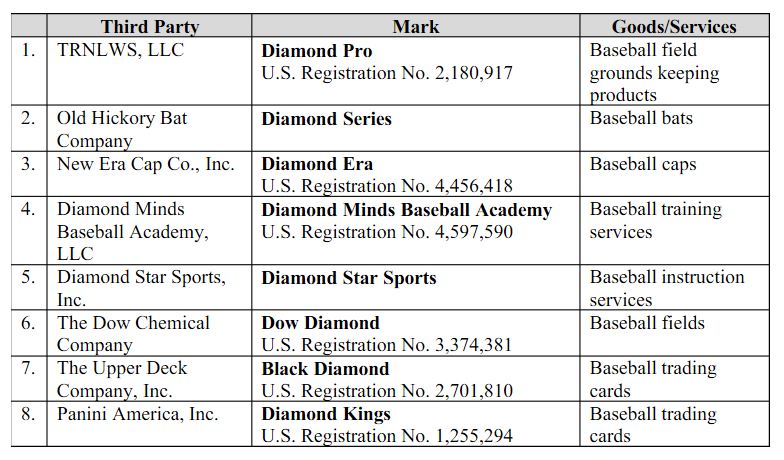
The complaint alleges that the term is generic for “baseball fields” and that the word has a well-known association with baseball generally. Due to this meaning, Cooperstown claims that a number of third-parties use marks that include the word DIAMOND in connection with baseball-related goods and services. Cooperstown included the table reproduced below as a sample of these third-party marks (some of which are registered). Relying on this evidence, Cooperstown alleges in its complaint that DIAMOND “is generic and/or descriptive when used in association with baseball-related goods and services” and that the term “is not a strong or distinctive mark in the field of baseball.”

Third-party marks - DJ Action

Cooperstown also argues that there is no likelihood of confusion due to Cooperstown’s use of its COOPERSTOWN mark on the bats. Notably, the term is not included in its application to register the PRO DIAMOND mark and therefore would not be considered as part of the likelihood of confusion analysis as to the mark identified in the application (as opposed to the mark as used in commerce).

Cooperstown’s arguments have some merit. The term “diamond” is, at a minimum, highly suggestive of a baseball diamond. It could potentially be descriptive in the sense that DIAMOND describes the intended purpose of the goods – to be used on baseball diamonds. But the evidence is not overwhelming. A quick search of the U.S. Patent and Trademark Office database revealed a number of third-party registrations that contain the term DIAMOND in connection with some type of baseball product or service. However, only two registrations identify sporting equipment.

Further complicating matters is that Diamond Sports’ registrations for their standard character marks have been registered for more than five years, meaning that they cannot be challenged on the ground that the marks are merely descriptive. As a result of the foregoing, Diamond Sports’ also has a reasonable basis for its objections to Cooperstown’s attempt to register the mark. Even if Cooperstown were to ultimately prevail, the disparity between the parties’ legal positions is unlikely to justify an award of attorney’s fees.

If Cooperstown prevails, it could obtain a registration for the PRO DIAMOND mark, a mark which Cooperstown considers to be so descriptive and potentially generic that “it is not strong or distinctive.” In light of this, is the investment in a federal court action worth the potential payoff?

A preliminary clearance search prior to filing the application likely would have identified Diamond Sports’ registrations, and would have confirmed that, while there was an argument that the term DIAMOND is weak in the field of baseball generally, there was not significant evidence that the term DIAMOND was week in connection baseball sporting equipment specifically. The records of the U.S. Patent and Trademark Office suggst that an application was likely to receive a refusal. Would Cooperstown have been better off not applying to register the mark at all and instead “fly under the radar?” Filing the application and receiving a refusal ran the risk that Diamond Sports could learn of the Cooperstown’s use and send a demand letter (is it too late for a spoiler alert?).

While “hope springs eternal” is perhaps the most popular baseball quote at this stage of the season, I’m reminded of an equally well-known baseball maxim: never make the last out at third base. For those uninterested in baseball, it simply means don’t take unjustified risks. Even if you make it to third, you still need the batter to get a hit to score a run. Maybe by the end of the season we’ll know which maxim is more applicable to the PRO DIAMOND mark.

Nobody Puts Trademark Claims in a Corner (Except when Copyright Law Preempts Them)

March 23, 2016—Nostalgia is a big seller these days. Hollywood continues to produce remakes (and remakes of remakes), politicians lament the better days of yesterday, and companies capitalize on feelings of nostalgia in order to make money. It’s not new, but it does seem to be more popular than ever. TD Ameritrade jumped on the Nostalgia Express last year with a commercial that was a nod to all of the fans of the film Dirty Dancing. The commercial used the tagline “Nobody puts your old 401k in a corner,” which is play on Patrick Swayze’s memorable line “Nobody puts baby in a corner.” Clearly, nothing says “dependable financial advice” better than Patrick Swayze in a leather jacket.

TD Ameritrade Screenshot

The commercial also recreates the final dance scene between the two main characters, where Jennifer Grey jumps into Patrick Swayze’s arms and he lifts her up above his head. Except in this case, it is a piggy bank (the commercial in its entirety is available here, while Patrick Swayze’s “baby in a corner” line can be viewed here).

Perhaps the goal was to incite consumers to share the ads on social media. And maybe that occurred. However the commercial also incited Lions Gate Entertainment (the owner of rights to the Dirty Dancing film) to file a lawsuit claiming copyright infringement, common law trademark infringement, and other unfair competition claims.

TD Ameritrade filed a Motion to Dismiss the claims. Last week, a California U.S. District Court dismissed the trademark claims, but denied the motion with respect to the copyright claims. Beyond a pleasant feeling of nostalgia, the court’s decision also provides two important lessons regarding trademark and copyright law (a copy of the order is available here).

First, trademark law does not protect any word or image that a person or company creates or uses. Trademark law protects words, images, or other indicators of source that have been used in commerce to identify and distinguish the goods or services of one party from another. A line from a movie does not identify or distinguish the source of the move no more than a guitar riff from a song identifies or distinguishes the source of a song. The court noted that it was unclear from the complaint how “the alleged mark NOBODY PUTS BABY IN A CORNER has been or is intended to be used.”

Instead, trademark rights are established when a trademark is used on a product in a way that associates the mark with the product. The size, font, and location of the wording all play a role. In the context of a movie, the Paramount Pictures logo at the beginning would be a use in commerce. But a line used in the movie, regardless of how memorable it may be, is not a trademark use merely because that dialogue was written, performed, and recorded as part of the movie.

Second, the court’s decision highlighted the necessity for parties to analyze each intellectual property claim distinct and separate. The court reasoned that Lions Gate’s complaint “bleeds together its copyright, trademark, and unfair competition claims — and the facts that support each cause of action — making it challenging for the Court, much less Defendants, to determine the allegedly separate theories underlying the different rights.” As you might expect, it’s not a good sign when a court is unable to discern the legal theory for your lawsuit.

The court determined that Lions Gate was actually asserting claims of copyright infringement. Lions Gate complaint identified the infringing activity as (1) use of a modified version of the “Nobody puts baby in a corner” line; (2) the re-creation of the “dance lift” scene; and (3) use of the tagline “Because retirement should be the time of your life,” – a reference to the song (I’ve had) the Time of My Life, which was used prominently in Dirty Dancing. The court considered these claims to amount to either unauthorized reproduction or creation of an unauthorized derivative works. These facts might support a claim of copyright infringement, but they do not support a trademark claim which requires confusion or mistake as to the source of the goods. Where a party asserts copyright infringement claim under the guise of a trademark claim, copyright law preempts the trademark claim under the Supreme Court’s decision in Dastar Corp. v. Twentieth Century Fox Film Corp., 539 U.S. 23 (2003).

Stay tuned for the court’s decision on the copyright claims as the case moves forward. And who knows, maybe the Ninth Circuit will provide us with another remake for Lions Gate’s trademark claims.

Solid Snake on Ice

March 11, 2016—Fans of the Metal Gear Solid franchise received disappointing news earlier this week when Project “Shadow Moses”–an ambitious fan reboot of the original game using Unreal Engine 4–was canceled.  A trailer showing the progress of the project prior to its termination is below:

This would have represented a significant improvement from the 1998 original Metal Gear Solid.

While disappointing, this wasn’t a terribly shocking development from the perspective of an intellectual property lawyer.  The developers of Shadow Moses made no secret of the fact that they were undertaking the development without formal permission from Konami, and given the importance of intellectual property rights to content companies, I would suggest that the eventual icing of this project was a foregone conclusion. Simply put, intellectual property rights can be incredibly valuable, but they also require incredible diligence.  Failure to vigorously protect those rights can result in significant erosion of value over time, potentially culminating in an entire loss.  It was simply unreasonable to expect that a large multinational corporation like Konami would let a project like this continue.

While I think Konami’s position and actions were correct from the perspective of our current laws, I don’t necessarily agree with them from a cultural perspective or from the perspective of what I wish the law actually was.  As I’ve written on other occasions, the current state of our “sharing” society requires a soul-searching reexamination of what we want our intellectual property laws to be, and what we want them to do.  In the United States, our intellectual property laws are based on the constitutional prerogative “To promote the Progress of Science and useful Arts.”  Stated differently, our intellectual property laws are supposed to provide sufficient incentives for people to create.  Our current laws have pursued promotion through a profit motive and structure.

This structure, however, has largely become obsolete in many contexts.  Incentives for creation have changed and the costs and burdens associated with creation and distribution have shrunk enormously. Content is not just being consumed, its being reused and repackaged for individual self-expression.  Music, movies, and video games are no longer just forms of entertainment.  They are common languages that can create quick and lasting connections.  In such an environment, intellectual property laws can just as easily serve as an obstacle to progress as they can an incentive.  Our laws need to adapt to appropriately reflect and enhance our shared culture.