arrow-double-right arrow-noline-right arrow-lrg-left arrow-lrg-right arrow-med-down arrow-med-left arrow-med-right arrow-med-up arrow-sml-right checkmark close close-sml contact-card event-clock linkedin menu minus outbound-link phone plus print search-lrg search-sml twitter Winthrop-mark

It’s DangeRuss, So DangeRuss

August 31, 2015—Russell Wilson (whose twitter handle is @DangeRussWilson) recently courted controversy with some comments made in an August 26 Rolling Stone article:

Another venture is slightly less altruistic. Wilson is an investor in Reliant Recovery Water, a $3-per-bottle concoction with nanobubbles and electrolytes that purportedly helps people recover quickly from workouts and, according to Wilson, injury. He mentions a teammate whose knee healed miraculously, and then he shares his own testimonial.

“I banged my head during the Packers game in the playoffs, and the next day I was fine,” says Wilson. “It was the water.”

Rodgers offers a hasty interjection. “Well, we’re not saying we have real medical proof.”

But Wilson shakes his head, energized by the subject. He speaks with an evangelist’s zeal.

“I know it works.” His eyes brighten. “Soon you’re going to be able to order it straight from Amazon.”

After facing some scrutiny, Wilson largely doubled down on his comments through Twitter over the next several days, “clarifying” that he didn’t mean to suggest that his magic water cured his concussion, but instead merely prevented his concussion.  Enter Russell Wilson, snake oil salesman.  In the grand tradition of Ponce de Leon and Bobby Boucher, we finally have our dihydrogen monoxide pitchman for the new millennium!

“But wait!” you say.  “This isn’t just water!  It’s got nanobubbles and electrolytes!”  I’ve previously ranted on the nonsense of electrolyte advertising.  As for “nanobubbles,” while the concept potentially has very important applications, the only thing oral consumption of bubbles is likely to cause — “nano” or otherwise — is belching, bloating, and flatulence.

Wilson’s comments are more dangerous than other baloney advertising claims because they make explicit health claims.  And the Federal Trade Commission, among others, require strong scientific support for any such claims.  In addition to federal laws and regulations, unsupported health claims also likely run afoul of state deceptive advertising laws.  By continuing to make these comments, Wilson is exposing himself and his company to possible legal claims.

The comment by Wilson’s agent in the quote above indicates that the agent, who is presumably a lawyer, is at least aware of the risk.  However, it’s questionable whether his passing comment about the absence of medical evidence would immunize Wilson and his company from lawsuits based on “testimonials” or claims where the disclaimer was not included.  Additionally, even if Wilson can dodge lawsuits, he should be judged harshly for his comments in the Court of Public Opinion.  He’s either a fraud or a fool, and in either case, it’s not his place to be be spouting off about health effects of any beverages, let alone one in which he has a financial stake.

Beer for Breakfast: Lessons in Co-Branding from General Mills

HefeWheaties Tableau

August 13, 2015—Yesterday, General Mills announced that it had partnered with Fulton Brewery to create HefeWheaties: a limited edition brew. The beer is a Hefeweizen, which is traditionally a wheat-based beer, making it a perfect canvas for the Wheaties brand.

Normally when these situations arise, it is because one party is complaining (For example, Lucasfilms’ objection to STRIKES BOCK beer). Not this time. Instead, we have two companies that appear to be on the verge of launching a very successful co-branding venture (just check out the press already, hereherehere  ).

Aside from the fact that I’m excited to try this beer, the news provides a number of insights into how to co-brand a product. The craft beer industry in particular lends itself to these experiments: craft breweries regularly create limited run products (aka seasonal beers). They also have a loyal fan base that is active on social media (free advertising!). Also, beer can tie in just about any product either through imitation of flavor, or finding a clever name and pairing it with eye-catching packaging. Yet the lessons that can be gleaned from the HefeWheaties announcement aren’t limited to breweries. Instead, the announcement provides insight for any business considering co-branding.

First, there should be a basis for the partnership. Fulton’s founder and a number of its employees are former General Mills employees. The companies have been connected long before this idea arose. As a result, there was a level of trust and collaboration that is difficult to create without a prior relationship. This doesn’t mean that you can only co-brand with current contacts; it just helps. If you don’t have an established relationship, build one! Collaborate on the co-branding idea rather than simply creating it yourself and then handing it off.

Second (or if you’ve failed lesson one above), the product should feel authentic. With HefeWheaties, consumers want to like the product: both companies are based out of Minneapolis; the wheat connection makes sense; and the past history between the employees and management all contribute to a feeling that the product is an idea, not a scheme. Plus, even though I never ate Wheaties as a kid, I feel some nostalgia for it (kudos to you, General Mills marketing team).

Third, make sure you consider the effect of the co-branding on your original market. We haven’t seen this play out yet with HefeWheaties, but there are appreciable (or at least vocal) numbers of people who don’t like seeing brands they purchase associated with alcohol. For example, Ben & Jerry’s announced earlier this year that it would be partnering with New Belgium Brewing to release a Salted Caramel Brownie Brown Ale. I can’t wait to try it when its released this fall. But Bruce Livingston, CEO of Alcohol Justice had a different view, calling it:

[a] crass, corporate greedy move to put a brand name like Ben & Jerry’s on a beer. It’s bad for children — who will start looking at beer as the next step after ice cream.

For our purposes, the merits of the characterization of “ice cream” as a gateway drug are unimportant. A company that co-brands should be aware that its brand and company will be associated with the partnering company, its products, and its industry. Give some consideration as to whether there is any potential for the co-branding to impact your public image and, if so, think about how you’ll respond.

Fourth, and finally, get the legal side taken care of in advance. You’ll likely need a trademark license. Decide whether royalties should be involved and, if so, when and how much. Carefully define the time frame for the license and renewal (or termination) options for both parties. These types of arrangements don’t need to be complicated. However, they became much more complicated after you begin selling product.

Yes, I know, Lesson Number One is work with someone you trust and like. However, business can affect that relationship. The parties’ memories may be a bit fuzzy months or years after you agree to start working together. It is much easier to avoid a dispute if the terms are in writing.

Co-branding doesn’t work for everyone, but it seems like it may work for HefeWheaties. The beer is set to be released on August 26, so perhaps we won’t have to wait long to gauge its success. But what’s really on my mind now is which cereal is next? I think a Peanut Butter Crunch stout could be good. Or maybe a Frosted Flakes porter. If anyone out there can make either of those happen, get a hold of me and let’s figure this thing out.

Justice Delayed or Justice Denied?

August 7, 2015—Many college sports aficionados are likely aware of the long-raging debate about whether college athletes in high revenue sports, like football and basketball, ought to be paid for their services. After all, college sports have become big business where top schools are routinely able to generate revenues exceeding $100 million dollars.  (See Business Insider Article here).  Those of us with an inherent and nagging sense of fairness and justice have felt that the athletes contributing to such riches should receive something for their efforts aside from a “free” education.  (For the brilliant John Oliver takedown of the NCAA position, see here.)  No doubt the free education is valuable, but it is a relative pittance to dollars we’re talking about here.

With this background, many of us were heartened to read the August 8, 2014 opinion by the United State District Court for the Northern District of California which required the NCAA to allow schools to pay athletes modest sums for their contributions on the athletic fields/floors.  The trial judge originally ordered that her ruling would be effective pending an appeal.  Unfortunately, on July 31, 2015, the United States Court of Appeals for the Ninth Circuit stayed the district judge’s ruling pending the decision on appeal.  This means that we will continue at least a little longer on the “no pay for athletes” model.

The Court heard oral argument on March 17, 2015 and is presumably working on a decision about whether it will affirm the district court’s ruling.  However, the Ninth Circuit’s most recent order is not a positive sign.  Although the order said that it was being entered “without expressing a view as to either party’s likelihood of success on the merits,” it seems unlikely that the appellate court would have entered this stay unless it was planning on reversing the district court decision.  We should soon know whether this case, which has been ongoing since 2009, was all in vain.

Octane Fitness Clarified the Standard for Attorney’s Fee Award, but Has Really Anything Changed?

July 31, 2015—It’s no secret, lawsuits can be expensive. That’s why parties frequently consider the availability of recovering attorney’s fees when deciding whether to pursue (or defend) a lawsuit. While attorney’s fees have been available in trademark infringement lawsuits for many years, the standard for granting awards of such fees has shifted in light of recent Supreme Court precedent. Just this week, Whole Foods learned that, at least in one Washington court, not much actually changed.

Whole Foods Market, Inc. (“Whole Foods”) is a national grocery store chain specializing in organic foods. Eat Right produces organic foods under the EAT RIGHT mark. Whole Foods even sold Eat Right’s products for nearly a decade. The relationship soured, however, when Whole Foods began a promotion in 2009 called “Eat Right America” that encouraged consumers to (you guessed it) eat right.

Eat Right reached out to Whole Foods and graciously offered to sell its brand. After three years of not taking any action, Eat Right demanded that Whole Foods stop using the “Eat Right America” phrase. Eat Right took another year to file a lawsuit. On May 14, 2015, the District Court of Washington granted Whole Foods’ Motion for Summary Judgment, ruling that the affirmative defenses of laches and acquiescence barred Eat Right’s claims.

Whole Foods filed a Motion for attorney’s fees on July 6, bringing us back to where we started.

The Lanham Act grants courts discretion to award attorney’s fees in “exceptional” cases. 15 U.S.C. § 1117(a)(3). However, “exceptional” has carried different meaning from circuit to circuit. The ambiguity was partially intentional, allowing courts to truly exercise their discretion in whether a party should be required to pay the fees of the other.

Many circuits required “willful infringement” or “bad faith” conduct on the part of the losing party before awarding fees. The conduct could involve the parties’ legal position, such as pursuing “objectively baseless” claims or defenses. The conduct could involve “vexatious litigation conduct.”

However, in Octane Fitness v. Icon Health & Fitness, the Supreme Court rejected these heightened standards. 134 S.Ct. 1749 (2014). The court found that the meaning of “exceptional” was not subject to any formula, but instead simply means that the case “stands out from others with respect to the substantive strength of a party’s litigating position (considering both the governing law and the facts of the case) or the unreasonable manner in which the case was litigated.”

Although Octane Fitness interpreted a provision of the Patent Act, the language is identical and courts frequently rely on interpretation of the Patent Act to interpret provisions of the Lanham Act. The Third Circuit applied Octane Fitness to trademark claims in Fair Wind Sailing, Inc. v. Dempster, 764 F.3d 303 (3d Cir. 2014).

Here, the court acknowledged the shift in standards under Octane Fitness:

Although the Lanham Act may not require subjective bad faith, a defendant seeking attorney’s fees under the Lanham Act must demonstrate, at minimum, that ‘the plaintiff has no reasonable or legal basis to believe in success on the merits.’

The court then concluded that Eat Right’s claims “were not groundless, unreasonable, or vexatious . . . or pursued in bad faith.” Accordingly, it denied Whole Foods’ motion for attorney’s fees.

While the court retains wide discretion to award attorney’s fees, the reasoning appears to disregard the Supreme Court’s ruling in Octane Fitness. The Supreme Court rejected the requirement of bad faith. Instead, it required only that the strength of the claims “stand out.” While there isn’t a clear way to quantify these with numbers, “standing out” certainly seems to be a lower threshold than “groundless” or “unreasonable.”

A number of practitioners (myself included) believed that Octane Fitness would make attorney’s fees more available to prevailing plaintiffs and defendants. The language of the Octane Fitness certainly enables this. However, it appears old habits die hard, and it may take some time for courts to kick the old habit of requiring “bad faith.”

Trademarks on the Internet: Are Consumers Really this Clueless?

July 15, 2015—Are you unaware of the difference between search engine searches and the search results? Do you believe that a search engine can read your mind and return exactly (and only) the results you expect to receive? Is this your first time using the internet? Good news! If you answered yes to these questions, the Ninth Circuit’s recent decision in Multi Time Machine v. Amazon, Inc. is made just for you. But on behalf of the remaining 98% of the public, can I just ask one question: really?

If you’re unfamiliar with the facts, we discussed the (then) soon-to-be-decided decision here a few weeks ago (links to oral argument included). Eric Goldman also had a nice article on Forbes.com on Monday. The short summary is this:

  • MTM Special Ops is a brand of military style watches;
  • Amazon does not sell MTM Special Ops watches;
  • If an internet user searches Amazon with the phrase “MTM Special Ops,” the search algorithm will return a handful of products which, based on past searches/purchases, are related to MTM Special Ops watches, all clearly labeled as “by Casio,” “by Luminox,” etc.;
  • MTM sued, claiming that consumers would be confused by the search results, either being confused as to the source of the goods or suffering from initial interest confusion; and
  • The district court granted summary judgment to Amazon.com.

In a 2-1 vote with one judge dissenting, the Ninth Circuit reversed (decision here). The court essentially held that in order to avoid initial interest confusion, Amazon (and other online retailers) must state precisely whether a particular search returned any exact matches. The kindest thing that can be said about this decision is that the Court really appreciates the role of a jury. But kindness aside, I’m still stuck wondering, really?

The court identifies the use of the plaintiff’s marks that is at issue here. They appear in the search engine field (the blank form). The exact search terms appear in quotations below the search field. And then there is another line which states: “Related Searches: mtm special ops watch.” Really? That’s the issue? The user is the one who entered the search term in the blank field. That blank field is editable in case the user didn’t find they wanted and, in case they choose to edit, Amazon includes the search terms below in quotations for the ease of the user. the “Related Searches” is clearly labelled, too. Is this confusing to anyone out there?

MTM had provided an expert report that stated that the search results are ambiguous, misleading, and confusing. The Ninth Circuit found that “a jury could infer that users who are confused by the search results are confused as to why MTM products are not listed. Even assuming this inference is warranted, it establishes that customers were not confused as to the source of the goods that appeared in the search results. They recognized that the search results were for different brands, not for MTM Special Ops.

There was also evidence that Amazon’s vendors and customers had complained to Amazon because “they did not understand why they received certain non-responsive search results when they searched for products that are not carried by Amazon.” Again, the evidence confirms that customers were not in fact confused by labeling of the search results. They were annoyed as to why other brands were coming up and confused as to the algorithm behind the search engine, but the court’s characterization suggests that consumers were able to easily confirm that the search results were not related to MTM Special Ops.

The court acknowledges that consumers are not likely to be confused once they visit the product detail page. It is unclear to me though what additional information is available on the product detail page that is not available in the search results. Each search result is clearly labeled as “Brand, Item number by Brand.” For example, Luminox Men’s 8401 Black Ops Watch by Luminox or Chase-Durer Men’s 246, 4BB7 Special Forces Black Watch by Chase-Durer.

The court appears to conflate consumer confusion regarding the marks with consumer confusion as to how search engines work. A search engine is not a personal assistant. A search engine is a functional tool used to index and access relevant information and reduce search time and costs. A user can, if they wish, access Amazon like a more traditional store: Shop By Department, Clothing and Jewelry Department, Watches, and then can click “Refine by Brand.” But that’s a lot of work. Instead, a search engine provides a quick access point to gather the most relevant options, some of which may not be exactly what the user was seeking. For example, the MTM Special Ops searches returned two fiction books. Which are clearly not watches and are clearly not MTM Special Ops brand books.

These same facts in a brick and mortar store could not support a reasonable claim of confusion. Imagine walking into Wal-Mart, Target, or any other large retailer and asking the very first person where the MTM Special Ops watches are. They’ll likely say: “Well, our watches are over there.” If you’re lucky, they may even walk you there and point at the watches. But they’re not likely to affirmatively state “We don’t have MTM Special Ops” watches. In my experience, it is usually “If we have them, they’d be in this aisle.” If I walked out with a Casio watch, would anyone really consider that to be trademark infringement?

Practically speaking, this is a simple fix for Amazon. If a search does not match up with a specific product, then it can state “There were no exact matches for the search, but the following results may be of interest.” The court frequently points out that Overstock.com does exactly that. But if the same type of inquiry in a non-internet store isn’t actionable, why should Amazon be potentially liable?

Perhaps, the issue is simply that “initial interest confusion” needs to be discarded, at least with respect to search engine/keyword cases. As the Ninth Circuit reasoned in Toyota Motor Sales v. Tabari, 610 F.3d 1171 (9th Cir. 2010):

[I]n the age of FIOS, cable modems, DSL and T1 lines, reasonable, prudent and experienced internet consumers are accustomed to such exploration by trial and error. They skip from site to site, ready to hit the back button whenever they’re not satisfied with a site’s contents. They fully expect to find some sites that aren’t what they imagine based on a glance at the domain name or search engine summary. Outside the special case of . . . domains that actively claim affiliation with the trademark holder, consumers don’t form any firm expectations about the sponsorship of a website until they’ve seen the landing page—if then.

The Multi Time Machine court discarded this argument (and Network Automation) on the grounds that this case involved summary judgment, rather than a motion for preliminary injunction. But this reasoning doesn’t involve weight of the evidence. It appears to be more of a legal conclusion regarding customer sophistication on the internet, which is directly relevant to the facts of Multi Time Machine.

Personally, I find Amazon’s search features very helpful. It is a convenient way to reduce search time, compare products, and find other potential goods for purchase. Do we really want to inhibit these advantages simply because a few users who rarely shop on the internet might be confused by the search results, even though they aren’t confused before they make an actual purchase? Really?

Pay Attention! Symbols Matter!

July 10, 2015—A couple different events occurred this past week which ought to serve as reminders of the importance of symbols and the need to protect brand perception when dealing with symbols.

First, the State of South Carolina underwent a tremendous rebranding recently when South Carolina’s government eventually (and, in my view, somewhat surprisingly) agreed to remove the Confederate battle flag from state grounds.  Of course, this does not mean that the flag is “banned,” it simply means that it will no longer serve as a representative symbol of the government (and by extension, the people) of South Carolina.  Individuals, in exercising their freedom of speech, are still entitled to purchase and fly the flag, to the extent they can find it.  So, if you want to continue protesting that it’s “heritage, not hate,” you can go right ahead.  But for all those that want to continue arguing the point, the simple fact of the matter is that the negative connotations associated with this symbol have, for a long time, outweighed any highly debatable positives associated with it.  That’s simply indisputable.  Regardless of whether you think the flag has positive symbolism (which is debatable), you can’t deny that it has become a symbol of racism and hatred.  When the negatives outweigh the positives, it should be a pretty easy decision for any brand-owner–in this case, the State of South Carolina–to cut ties with the symbol and move in a better direction.  When you’re dealing with symbols, perception is reality.

Second, Subway was  forced to undergo the cost benefit analysis in connection with its “Jared” branding campaign  when pitchman Jared Fogle’s home was raided by federal law enforcement just two months after one of his foundation’s employees was arrested on child porn charges.  At this point, any ties between the Fogle raid and child porn is speculative, but again, perception is reality, so Jared’s got to go.  (At least for now).  After all, the last thing Subway wants its customers thinking about when trying to pick a sandwich is child porn.

Because perception is reality and because symbols matter, those in charge of any branding campaign–whether it’s corporate, governmental, or even personal–need to be incredibly vigilant in both protecting their symbols, and in monitoring how their symbols are being perceived.  We received stark reminders of this during the past week.  Had South Carolina not taken down the flag, it risked being viewed as a state of backward hillbillies on the wrong side of history.  Had Subway not acted quickly when dealing with Jared, it likely would have risked an even further drop in sales and positive brand association than I’m sure its already experiencing.

Counterclaims for Cancellation Are Like Yoga Pants for Your Infringement Defense

July 2, 2015—Here’s one piece of advice you’ll hear from just about any trademark attorney: apply to federally register your marks as soon as financially possible. It is a very important step to take in order to protect your brand. A federal registration provides nationwide rights over any third-party that begins use of a confusingly similar mark after you file the application. This, along with other reasons, is why it is much easier to prevent or stop third-parties from using infringing a registered mark than it is for an unregistered mark. However, a registration is not a guarantee of success against third-parties, which is something a small entrepreneur may find out as its lawsuit against Skechers moves forward.

Terri Kelly is an entrepreneur who sells her own flip-flops at http://terrikelly.com/. She advertises her wares with the slogan YOGA PANTS FOR YOUR FEET®, as shown from her website below:

ypforfeet website

As you might guess, that “little r” is very important to this story. Ms. Kelly applied to register the YOGA PANTS FOR YOUR FEET mark on May 23, 2014. It ultimately registered on May 5, 2015. Why does this matter so much? Because sometime in early 2015, Sketchers began promoting sales of its footwear identifying them as being “like yoga pants for your feet.” After a cease and desist letter went un-ceased and un-desisted (that’s a legal term, I think), Ms. Kelly filed a complaint against Skechers on May 13, 2015.

Ms. Kelly seems to have a pretty strong claim. Skechers has used the entirety of Kelly’s mark for highly related footwear products. It also appears clear from publicly available Skechers began using the mark only after Kelly filed its trademark application. Accordingly, that registration provides presumptions of validity, ownership, and priority of the YOGA PANTS FOR YOUR FEET. But what if the registration is invalid?

A registration is vulnerable to cancellation on a number of grounds for the first five years of registration: First, if the third-party actually used the mark before you, it may be able to cancel the mark based on priority. Second, the party may be able to cancel the mark claiming that the mark is merely descriptive and never should have registered. Third, an application may be void if the mark was not in use at the time of the application (for use-based application). And fourth, if the applicant commits fraud upon the Trademark Office (submits materially false statements with the intent to deceive the Trademark Office).

As you might have guessed, Skechers has asserted all of these grounds in its counterclaim for cancellation of Kelly’s registration. Skechers also asserted a claim of fair use, meaning that it is making legitimate use of the words in order to describe their products.

There is a thin and subjective line between suggestive trademarks and merely descriptive trademarks. While Skechers is correct in that “YOGA PANTS FOR YOUR FEET” has some descriptive significance, I’m not convinced that it is merely descriptive as a whole. The individual words may be, but that doesn’t render the entire mark as merely descriptive. A number of well-known marks consist of descriptive components. If the shoe was on the other foot, I would think Skechers would agree. After all, Skechers is the company that owns the following applications and registrations:

  • 50% SHOE. 50% SOCK. 100% COMFORTABLE
  • SOCK-FIT
  • RUN HARD. LAND SOFT.
  • ALL AROUND COMFORT
  • RELAXED LIVING
  • ENERGIZE EVERY STEP
  • SHAPE-UPS
  • TONE-UPS

Kelly’s YOGA PANTS FOR YOUR FEET is at least as suggestive as all of these marks. I have to think that Skechers would take similar action against a competitor for using these same slogans. Also interesting was Skechers initial public response, which accused Kelly of “attempt[ing] to trade on Skechers’ long track record of success.”

We’ll have to wait and see what facts the parties come forward with to support and defend the claims of invalidity. In the event that the registration is considered invalid, it will be unfortunate. Many small businesses and entrepreneurs recognize the importance of protecting their brands, and invest the time and money to obtain a registration. The fact that you have a registration means little if the registration could be cancelled by a defendant. Unfortunately, parties often don’t find this out until after they’ve been harmed by another third-party’s infringement.

Here are three tips to consider when applying for a trademark to decrease the risk you’ll find yourself in this situation:

  • If you or your client has any inkling that the mark is merely descriptive, consider picking a new one. It is better to change the mark before you invest more money.
  • Make sure you can support your filing basis of the application. If you file on an intent-to-use basis, have documentation that shows your efforts and intention to sell the products or services identified in the application. If the application is based on use, make sure you’ve made a bona fide use in commerce of the mark.
  • If you ever see any issue regarding use in commerce (or if the Trademark Office refuses your specimen of use), don’t just try to find a way around it. If the specimen is refused, it may mean you haven’t made actual use in commerce. If this is the case, you can amend the application to an intent to use basis to possibly address the issue.

While these steps can’t guarantee that your registration will be valid, they can help you prevent some easily avoidable (but often overlooked) mistakes.

No Coke, Pepsi. No Infringement, Summary Judgment?

June 24, 2015—2015 was the 40th anniversary for the NBC comedy series, Saturday Night Live (SNL). After 40 years, a television show is bound to have a cultural impact. And one of the series’ most well known sketches involves Olympia Restaurant, where customers keep asking for Coke, but are repeatedly told, “No Coke, Pepsi.”

It is doubtful even the most ardent lovers of SNL would have expected that the show would have an impact on trademark jurisprudence. Yet in Multi Time Mach., Inc. v. Amazon. com the Ninth Circuit is considering whether to adopt a “No Coke, Pepsi” rule in the context of online shopping.

The case involves a trademark infringement claim brought by a watch manufacturer. The district court granted summary judgment for Amazon.com, finding that there was no likelihood of confusion as a matter of law. 926 F. Supp. 2d 1130 (C.D. Cal. 2013). The oral argument before the Ninth Circuit can be viewed here, with an audio only version available here.

The Ninth Circuit follows the Sleekcraft factors in determining whether a plaintiff has established a likelihood of confusion. However, in cases of internet advertising, and in particular, use of trademarks as a search term, the Ninth Circuit utilizes a modified approach first adopted in Network Automation, Inc. v. Advanced Sys. Concepts, Inc., 638 F.3d 1137 (9th Cir. 2011). In that decision, the Ninth Circuit added a new factor for internet advertising, namely, “the appearance of the advertisements and their surrounding context on search engine results.”

The plaintiff argued that Amazon’s display of search results created a likelihood of confusion as to whether the watches displayed as a result were somehow connected with Multi-Time Machine (MTM). Amazon did not carry MTM watches. Yet when entering a search, Amazon’s results did not say “no matches found.” Instead, Amazon uses an algorithm which displays products that internet users may be likely to purchase based on past consumer behavior (i.e., they searched for MTM and later purchased a Casio watch). The search results were not labeled as “sponsored ads” or “other items you might like.” However, each of the results clearly identified the model and brand of each product.

The plaintiff argued that this was insufficient. Instead, it reasoned that Amazon should have stated “No MTM, Casio, Luminox, etc.” Because the MTM brand still appeared in the search engine form at the top of the page, MTM claimed that there was a factual dispute as to whether an internet user might mistakenly assume that the results were sub-brands of MTM, or were connected in some other way to MTM.

In response, Amazon contended that under Ninth Circuit precedent, the relevant consumer was a “reasonably prudent consumer accustomed to shopping online.” Toyota Motor Sales, U.S.A., Inc. v Tabari, 610 F3d 1171 (9th Cir 2010). Each search result clearly identified the manufacturer of the watch and, as a result, internet shoppers could not reasonably assume a connection with MTM merely because it appeared in the search bar.

Amazon could have its search screen state whether a user’s search returned any exact results. But from a practical perspective, what would this look like? If I search for Take 5 on Amazon, must amazon inform me that it does not sell Take 5 candy bars, even if I’m actually looking for a Dave Brubeck vinyl? And what if Amazon actually had the MTM watch, should it have been required to display only MTM watches? Or, what if a consumer is actually using the mark as comparative advertising, similar to walking into retail store and asking whether they have something like a Calvin Klein jacket?

The degree of care and reasonable expectations of internet shoppers continues to evolve. In my own internet shopping, I’m easily able to discern between Amazon search results which include competitors’ products. But maybe I’m more discerning than others in my online shopping. No decision has been issued in the case, though, so MTM will just have to wait and see whether the Ninth Circuit’s response will be “No Remand, Affirmed.”

Protect and Serve Your Image

June 12, 2015—The few of you that read my posts probably know that I often use this as an opportunity to meander into observations that I find interesting from a branding perspective.  After all, as a litigator, I spend the vast majority of my day composing correspondence and briefs that dive into the finer points of law.  So when I get the opportunity to write about something a little less legal, I gladly accept it as a change of pace.

This brings me to my most recent random observation; an observation which intersects with personal branding, social media, and hot-button social issues.  When you see the image below, what do you think?  Do you think “Protect and Serve” or do you think “Punish and Enslave?”  (Congratulations to any other nerds who got the Punish and Enslave reference.)

policebadge

I’m not here to sway your opinion one way or the other on the underlying social issue.  That would require a deep and probably controversial discussion on race, social class, income inequality, politics, religion, and many other topics you’re not supposed to bring up at Lorentz family holidays.  However, the current state of unrest concerning our nation’s police forces does create an interesting case study in brand management.

Regardless of whether you are a “Protect and Serve” or a “Punish and Enslave” person, you can’t deny that there is an existing image crisis for police officers all over the country.  This crisis is the result of highly publicized, yet statistically minuscule acts of police brutality/stupidity/idiocy that have arguably tainted the entire profession.  Social media and sensationalizing traditional media have convinced a sizable population that the entirety of our criminal justice system is either corrupt or incompetent or both, and we need to start over.  My social media feeds are inundated with such posts, and it seems that there is little for the “good cops” to do other than weather the storm and post occasional videos of themselves playing pickup basketball with neighborhood kids.   (BTW, I’ve seen several of these videos in different locales over the past several months, so there seems to be some intentional efforts at image rehabilitation going on). These neighborhood outreach efforts give you a slight “feel good” moment, but they certainly do not inspire the same level of fervor as the incredibly negative police stories.

To be clear and to avoid angry emails and letters, I’m not suggesting or implying that commercial branding and police shootings/aggression are in the same realm of importance.  I am, however, suggesting that virtually every widespread social media phenomenon can provide lessons for those involved with managing their brands.  I can think of a few key takeaways from this situation.  First, a few bad apples really can spoil the barrel. All it takes is a few bad customer experiences magnified by the shrill screaming of many on social media to have the negatives overshadow substantially greater positives.  Second, once the negative publicity takes hold, it can be incredibly difficult to turn the tide.  There often is no perfect solution, and most solutions require a difficult to determine mixture of time and pro-active conduct.  If you argue too loudly and too soon, you are not giving sufficient consideration to the wronged.  If you wait too long and speak too softly, you risk letting the fire consume all that was good in your brand.

Pepsi’s Next Generation: The Last Generation

June 10, 2015—Back in the 1960s, Pepsi burst onto the scene by announcing to the youth of the decade that they were the Pepsi Generation (they didn’t have a choice). Then, in the 1980s, Pepsi became “The Choice of a New Generation.” And finally, in the late 1990s, Pepsi hitched their trailer to the surely-to-never-go-out-of-style Spice Girls to announce the arrival of GeneratioNext. I am a little rusty on my LSAT logic games, but I think this means Pepsi’s newest marketing idea will be GeneratioNexter. Or maybe Generation Kitty-Wampus.

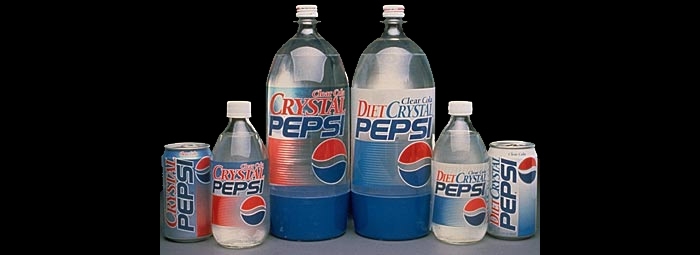
Yet, it looks like Pepsi is a bit more creative as their newest marketing idea took a different path. What if, instead of moving forward in time, Pepsi moved backward in time? Presumably, this was the idea behind Pepsi’s coy suggestion this week that it may be bringing back Crystal Pepsi. Yes, this Crystal Pepsi:

CrystalPepsiFamily

Maybe the best way to guarantee future success is to revive past failures. Crystal Pepsi was intended to be a healthier soda. Back then, people wanted natural and healthy options! But they didn’t want something that was too healthy, so it still had to be a soda. Pepsi attempted to further this “natural” image with this slightly dated television commercial back in 1992:

And in case you had the same thought as me (“Didn’t SNL do a great spoof of this commercial?”) Yes, you can view it here, and it is superb. Unfortunately for Crystal Pepsi, though, it was pulled from shelves less than two years later.

So how did this resurrection happen? And is it really happening? A social media campaign reportedly led by LA Beast seems to be partially to blame. The Pepsi Twitter account tweeted the following letter, which appears to be written with a typewriter on letterhead left over from 1993 (hopefully intentionally, if so, kudos to you Pepsi marketing):

Crystal pepsi letterAccording to Pepsi, the letter is authentic. And Crystal Pepsi wouldn’t the first soda to be brought back from the dead: Coke revived Surge earlier this year, also due to social media demand. But Pepsi hasn’t official announced a comeback, so perhaps it is just a media ploy and there really is no intent to begin selling Crystal Pepsi again.

Which got me thinking. Somewhere out there, someone is wondering whether they can start selling Crystal Pepsi before Pepsi does. Pepsi hasn’t sold Crystal Pepsi for over 10 years without any apparent intent to resume use until recently. The facts suggest a plausible basis for a claim of abandonment (a previous DuetsBlog post addressing abandonment is available here). A quick search of the U.S. Trademark Office reveals that Pepsi has abandoned any rights to any registrations or applications. So is our hypothetical user in the clear?

Unfortunately, this is a bad example as Pepsi has not abandoned its rights in its PEPSI mark. But what if it had been a stand-alone brand, like Surge? Would Pepsi still have rights in the trademark even though it hasn’t been used in over ten years? We’ve briefly discussed the concept of persisting recognition (or residual goodwill) in the past. Like most legal questions, the answer is “it depends.”

For purposes of registration, the Trademark Trial and Appeal Board does not recognize the doctrine. In fact, just recently, the Board cancelled a registration for the mark NAUGLES, owned by Del Taco, reasoning that:

Lastly we note that Respondent contends that it holds “considerable goodwill” in the Naugles mark, sufficient to defeat Petitioner’s claim of abandonment. The Board has never found residual goodwill to be a defense to abandonment, and we decline to do so here. The continued existence of enthusiasts of the old Naugles food items does not negate the statutory presumption of abandonment.

In that case, Del Taco claimed that even though it had closed the Naugles restaurants after merging back in the early nineties, that it still had legitimate rights twenty years later. The company claimed that the “History” portion of its website showed continued use, as well as its sale of promotional clothing. Del Taco’s best argument appears to have been that consumers could still order of the “Secret Naugles Menu,” which meant that consumers would request food entrees that were previously offered by Naugles. But not even the secret menu used the Naugles mark, instead, it consisted of orders like “a bun taco” or “egg burrito.” The Board did not find Del Taco’s evidence of use convincing, although maybe the Board informed Del Taco that they might still be eligible for a “Secret Naugles Registration.”

But what about outside the registration context? The Fourth Circuit has suggested that the potential for residual goodwill depends on the product, reasoning that:

Because fire trucks have very long lives (often twenty to thirty years), the mark stays visible, and the good will value of the mark persists long after production of trucks with that mark has ceased. Thus, it might be reasonable for a fire truck manufacturer to spend five or six years considering the reintroduction of a brand, even though the same passage of time would be unreasonable for a maker of a more ephemeral product, say potato chips

Emergency One, Inc. v. Am. FireEagle, Ltd., 228 F.3d 531, 537 (4th Cir. 2000). In contrast, though, a California court found that eight years of non-use of the COBRA mark in connection with cars constituted abandonment. Shelby v. Ford Motor Co., 28 USPQ2d 1471, 1475 (CD Cal. 1993).

Unlike Pepsi’s new/old refreshment, the precedent here is a bit murky. I guess we’ll just have to wait and see Pepsi’s next steps before we move forward with DuetsBlog Crystal Soda.