arrow-double-right arrow-noline-right arrow-lrg-left arrow-lrg-right arrow-med-down arrow-med-left arrow-med-right arrow-med-up arrow-sml-right checkmark close close-sml contact-card event-clock linkedin menu minus outbound-link phone plus print search-lrg search-sml twitter Winthrop-mark

Hawking a New Mascot

November 25, 2015—The big mascot news over the past year has been in the NFL, as Washington fights to maintain its registrations for the REDSKINS mark. As that dispute continues, the University of North Dakota tried to put to rest its longstanding issues regarding its previous use of the name “The Fighting Sioux.”

In 2012, UND dropped the old nickname. It was a long drawn-out battle between the NCAA, university administration, the North Dakota legislature, and others. In the end, it took a statewide referendum to enable the school to drop the name. But the issue wasn’t exactly resolved as UND never adopted a new nickname. Instead, they were simply “North Dakota,” or for those unable to not personify a school in the form of a nickname, “The North Dakota.” The name doesn’t exactly lend itself to a great mascot costume:

Possible Mascot - UND

Notwithstanding the aesthetic disadvantages, the mascot would be particularly susceptible to gusts of wind, which could present an issue on the plains of North Dakota.

Also, while “North Dakota” was going through its naming process, its intrastate rival North Dakota State University was getting its fair share of publicity. After all, all NDSU did was win back to back to back to back FCS titles (with a #3 seed in this year’s playoffs). I imagine it must have been a bit irritating to continue to correct sportscasters and members of the public that UND was the other North Dakota, not the one with all of those national titles.

In order to fix the problem, the school held a vote to determine the new nickname. Among the choices were Nodaks, Roughriders, Sundogs, Fighting Hawks, and the North Stars. Apparently the Frackers didn’t make the list. Votes were cast and, just last week, UND announced that the winning nickname was “The Fighting Hawks.” But did UND simply trade one controversial name for another?

I may be biased, but when I hear “The Fighting Hawks,” I can’t help but think of my alma mater of the University of Iowa and its Hawkeyes. Although the name is officially the “Hawkeyes,” we all know that when someone says “hawks,” they’re talking about the Iowa Hawkeyes. Among Iowa fans, “Go Hawks” isn’t just a cheer. It’s a greeting. See a friend on the street but don’t have time to say hello? A quick “Go Hawks!” does the trick just fine. In fact, it doesn’t even have to be a friend. If an Iowa fan sees an unknown stranger anywhere in the U.S. or around the world with a Hawkeye hat or shirt, there is a 95% chance that a “Go Hawks!” will be exchanged.

Okay, sure, there are other Hawks out there too. On the pro side there are Atlanta Hawks and the Chicago Blackhawks. In college, there are probably too many to name, including the Dickinson State University Blue Hawks, also located in North Dakota. However, the timing certainly is suspicious. After all, the Iowa Hawkeyes have gone undefeated in football this year and are currently slated to be one of the four teams in the College Football Playoffs (FYI: in addition to typing, I am also presently knocking on wood and throwing salt over my shoulder). And did I mention that Iowa just set the record for attendance at a wrestling meet, while knocking off the top ranked team in the country? Or that the Hawks are also on the cover of Sports Illustrated? Sure, it’s only a regional  cover, but do you know what state is included in that region? North Dakota.

Look UND, I can see why you would like to ride the coattails of Iowa’s popularity and success. You’re not the only one, either. The University of Southern Mississippi tried to capitalize on the iconic Iowa Hawkeye tiger hawk logo. It even led to an opposition at the Trademark Trial and Appeal Board (If you’re curious, Iowa is undefeated there, too). Heck, the fame of the Iowa Hawkeyes extends beyond the shores of the U.S.: even international pop groups use the Hawks to improve their image.

Perhaps though, in the spirit of the holidays, we can let this one slide. So for now, Happy Thanksgiving – and Go Hawks!

The Other Border Patrol

November 20, 2015—With all the flaming rhetoric going on these days relating to immigration, refugees, and border fences, I thought now might be a good time to introduce (or reintroduce) the world to a heavy hitter in the intellectual property border patrol: the International Trade Commission.  I suspect few people know specifically what the ITC can do, or the broad implications of the ITC’s power.  Please consider this a free introductory course.

Pursuant to 19 U.S.C. sec. 1337, the ITC is given the authority to investigate, among other things, alleged infringement of various intellectual property rights by importers.  The most common investigations by the ITC generally include patent or trademark infringement.  The proceedings are similar to litigation in the courts, but they move substantially faster and do not rely on juries for decisions.  A possible result of an investigation is that importers will be barred from continuing to import products which are deemed to infringe any properly established rights.  This is merely a high-level overview of how the process works, but based on the end result (barring imports), you can easily see how significant the ITC is.  In proper cases, it can simultaneously eliminate a market for a producer and eliminate a product for consumers.

The Federal Circuit recently considered a very important case relating to the ITC power which very few people are actually talking about.  However, the implications of the case are very important.  In the recently decided ClearCorrect case, the Federal Circuit held that the ITC did not have the authority to bar importation of digital data.  The Federal Circuit based its decision the grounds that the ITC was only allowed to bar importation of “articles,” which the Federal Circuit construed to mean “material things.”

It remains to be seen whether the Federal Circuit decision will ultimately result in a good or bad result.  On the one hand, as our digital and information economy continues to expand, it seems that barring digital imports will eventually be a necessary component of protecting intellectual property rights within the U.S. market.  On the other hand, I could easily see such a task over-burdening the ITC and giving the ITC more power now than Congress envisioned.  But this is one of those interesting legal issues where it will pay to stay tuned.  It’s possible that Congress will elect to expand ITC authority, or even come up with an entirely new mechanism for dealing with the problem.

It’s Not Delivery, It’s Infringement.

In-N-Out_Burger_hamburgers_and_cheeseburgers

November 12, 2015—We’re not talking pizza, we’re talking burgers. Not just any burgers, either, we’re talking In-N-Out burgers. As any California transplant will tell you, no other burger from any other restaurant comes close. In-N-Out has more than just burgers; it also has French fries, shakes, and drinks. They also have a drive-thru if you don’t want to get out of your car. However, In-N-Out does not have a delivery service. And a trademark infringement lawsuit filed yesterday seeks to keep it that way.

As a result of consumer demand and advancements in technology, a smorgasbord of food delivery services have emerged to make it easier for consumers to eat out while staying in. Here in Minneapolis, we have at least four options: Bite SquadGrubHubPostMates and the more recent entry, DoorDash.

It is our new Minnesotan friend DoorDash that was on the receiving end of In-N-Out’s lawsuit. In-N-Out asserts that it has repeatedly requested that DoorDash stop delivering In-N-Out food, and stop displaying the In-N-Out trademarks (including the In-N-Out logo) from DoorDash’s website. According to the complaint, DoorDash complied with In-N-Out’s request for a short period, but then resumed its delivery services.

But wait, isn’t DoorDash just giving consumers what they want and, along the way, increasing sales to In-N-Out? Where’s the beef? According to In-N-Out, they’ve got a Double-Double’s worth:

Defendant’s use of Plaintiff’s famous trademarks implies that Defendant not only delivers In-N-Out products to its customers, but that the quality and services offered by Defendant is the same as if consumers had made purchases directly from Plaintiff. Upon information and belief, the quality of services offered by Defendant does not at all comport with the standards that consumers expect from Plaintiff’s goods and services. Further, Plaintiff has no control over the time it takes Defendant to deliver Plaintiff’s goods to consumers, or over the temperature at which the goods are kept during delivery, nor over the food handling and safety practices of Defendant’s delivery drivers. While Plaintiff adheres to the Food Code, on information and belief, Defendant does not adhere to such regulations, including with regard to compliance with required food safety and handling practices.

If Vegas put odds on “what legal defense is DoorDash likely to assert,” the good money would be on “Nominative Fair Use” (sorry American Pharoah). We’ve discussed nominative fair use a few times at DuetsBlog, but the basic issue is whether the defendant is using the mark to identify the actual products or services of the plaintiff. A defense is likely established where:

  1. The product cannot be readily identified without using the trademark;
  2. Only so much of the trademark is used as is necessary for the identification; and
  3. No sponsorship or endorsement of the trademark owner is suggested by the use.

The issue in this case will be whether DoorDash’s use suggests that In-N-Out has sponsored or endorsed DoorDash as a delivery service. Third-party food delivery services have not been around for very long. Do consumers expect a delivery service to be endorsed by individual restaurants? Or do consumers consider a delivery service to be a neutral third-party that simply takes the travel out of “carry-out” service

Having used delivery services before, my instinct says In-N-Out may be out of line. On the one hand, if my Pizza Hut delivery guy delivers cold pizza to me, I would complain to Pizza Hut. But if I had a local pizzeria delivered via DoorDash, my reaction has been “that pizza doesn’t travel well, looks like I need to eat in.” Complicating the matter is the fact that DoorDash has entered into partnerships with other companies, including Taco Bell and 7-11.

Will that be enough to create an association in the minds of consumers? If DoorDash loses, it’s hard to see how any of the other food delivery services can survive, unless they reach individual deals with each and every restaurant they utilize. Such a requirement would add some significant business cost to this model, with little benefit to consumers. Here’s to hoping the issue is resolved quickly, especially for everyone who had planned on getting In-N-Out delivered for Thanksgiving.

Tissue Tussles at the Trademark Office

October 29, 2015—Each of the seasons has its own soundtrack to signal its transition. Spring is symbolized by the chirping of robins and sparrows. The sound of the grill and the splashing in the pool announces the arrival of Summer. Unfortunately for Winter, it got the short end of the stick. Nothing says Winter is on its way like the sound of you, your loved ones, and your co-workers, reaching for a tissue and blowing their nose.

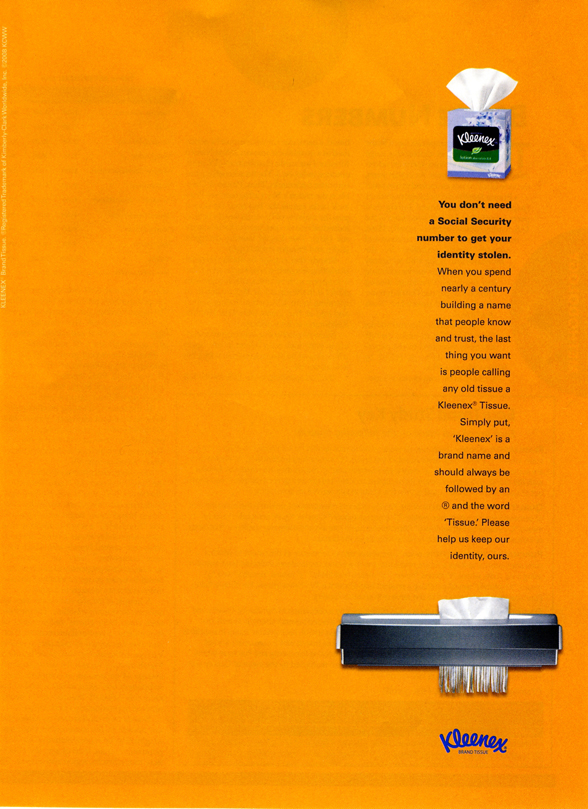
Those in the know on matters of the nose will take note: you reach for a tissue and not necessarily a Kleenex®. The owner of the Kleenex® brand has fought hard to keep its trademark from becoming generic, even purchasing advertisements to educate consumers on this distinction, like the ad reproduced below reminding consumers that “‘Kleenex’ is a brand name and should always be followed by an ® and the word ‘Tissue.’”

Kleenex - Trademark Usage Ad

The effort is ongoing, but Kleenex® continues to be a valid registered trademark. Even if Wikipedia (currently) states otherwise.

But the Kleenex® brand has more than one legal battle on its hands. This battle is not with consumers but instead with the U.S. Trademark Office. In May, Kimberly Clark (the owner of the Kleenex® brand) filed a trademark application for a product packaging configuration for facial tissue. The mark is described as “the configuration of a folding container for facial tissues” and is displayed in the drawing below:

Kleenex - Drawing

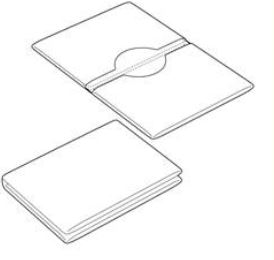
The actual product packaging, closed and open, looks like this:

Kleenex - Specimen

The Examining Attorney has refused registration, finding that the claimed mark is functional. We’ve discussed the limits imposed by the functionality doctrine a number of times at DuetsBlog, wondering aloud whether 2015 might be “the year of functionality refusals.” In short, a claimed mark is functional if it comprises matter that, on the whole, is essential to the use or purpose of the product, if it affects the cost or quality of the product, or if it would put competitors at a significant non-reputation-related disadvantage.

In support of the refusal, the Examining Attorney identified a number of utility patents owned by Kimberly Clark for facial tissue dispensers and packaging. Interestingly, none of the patents appear to cover this particular design, but instead address older versions of packaging, or a particular component that allows the packaging to dispense only one tissue at a time. The Examining Attorney also relied upon statements from advertisements for the goods, which claimed that the packaging is “slim, stylish and easily fit in a backpack or back pocket.”

The Examining Attorney’s evidence supports a prima facie case, but doesn’t appear bullet proof. Yet at first glance, the packaging appears to be nothing but functional. The packaging allows the tissues to be carried in a compact container, making it amenable to travel. The flat packaging is likely the most beneficial shape, making it easy to fit in pockets or bags. The folding feature is a simple and easy way to close the package, keeping contents from falling out, but still being readily accessible by the consumer. Overall, it looks like an uphill battle.

No response has been filed yet, but perhaps Kimberly Clark will find a way to overcome the refusal. Like the common cold, we’ll just have to wait it out.

Where We’re Going, We Don’t Need Ads

October 21, 2015—Where are we going? The future. Well, 1985’s future, as predicted in 1989. And technically, it’s not the future anymore; it’s the present (and soon, the past). You see, in the movie series Back to the Future, today, October 21, 2015, is the day that Marty McFly and Doc Brown travel to the future. It has become an unofficial holiday known as Back to the Future Day.

Time-Date-Screen

The movie gave us great predictions for the future, many of which came true. We now communicate via video screens, the Cubs might win the World Series, there really is a Miami baseball team, and we actually have hover boards. The move also gave us some of the great product placements of our time, which are still paying dividends to those brands nearly 30 years later.

Pepsi made an appearance in the movie as “Pepsi Perfect,” a nutritionally healthy soda packed with vitamins. And wouldn’t you know, Pepsi is releasing 6,500 limited edition bottles at $20.15 each. [Video Link]

Or who could forget Marty McFly’s futuristic Nike high tops, complete with Power Laces. Yes, finally, no more need to waste your time tying your shoes. [Video Link]

Nike previously released a version of Marty McFly’s Mag sneakers from the movie back in 2011. But those shoes didn’t have Power Laces. The company has stated publicly that it hopes to release the shoes, with Power Laces, yet this year.

However, still no word on whether the Black and Decker Hydrator will be released any time soon. Even if it does, it will probably take science a while to figure out how to rehydrate a Pizza Hut deep dish.

But for Pepsi and Nike, today is an incredible opportunity. Tens of thousands of people will be discussing Back to the Future. Inevitably, many of these conversations will include discussions of the Nike or Pepsi brand. These conversations will be organic, positive, and will result from genuine interest and happiness related to a shared interest in the Back to the Future trilogy. Not only does this affect brand awareness among younger generations, it builds loyalty through positive association.

I’m not sure how you measure that kind of positive association, but I’m guessing it’s about 1.21 gigawatts.

Unhappy Birthday

October 15, 2015—About a month ago, the United States District Court for the Central District of California issued a summary judgment ruling putting a nail in the coffin of one of the most tragically comical copyright claims of all time.  After years of litigation and undoubtedly hundreds of thousands of dollars in legal fees (perhaps more), the Court concluded that the lyrics to the song “Happy Birthday” were never actually transferred to Warner/Chappell Music, Inc., the current troll that had been forcing us all to sit through awkward and unsettling performances of “original” songs during birthday feasts at our favorite chain restaurants.  To those of you that don’t know the full lyrics, I’m reproducing them here:

Happy birthday to you / Happy birthday to you / Happy birthday dear [NAME] / Happy birthday to you

(No word yet on whether “You were born in a zoo / you look like a monkey / and you smell like one too” survives as a derivative work.)

The Court’s opinion is actually quite interesting, as it goes through a detailed history of the song and the absence of evidence demonstrating the “Happy Birthday” lyrics were ever actually assigned.  The lyrics and melody (both of which are separately protected) were originally written around 1900.  The melody and other lyrical variations of the song, such as “Good Morning to You,” slipped into the public domain in 1949.  However, based on a claim to the lyrics of Happy Birthday, the various defendants in the lawsuit garnered millions of dollars in royalties over the following decades.

Despite enjoying the historical component of the opinion, I became increasingly frustrated that the ownership of this song was a serious lawsuit.  The fact that there is even a need to use up court time on whether or not there was a valid assignment of a repetitive, four line song written more than a century ago starkly demonstrates a fundamental failing of our copyright system.  United States copyright laws are some of the most Byzantine and irrational in the world.  There are ridiculous variations on terms that are almost indecipherable to the lowly layman tasked with determining whether that photograph they want to post to Pinterest is copyrighted.  Just check out this Copyright Office circular directed solely to determining “copyright duration.”

Moreover, in my humble and ultimately irrelevant opinion, the Copyright Act has gone way beyond its proper constitutional bounds.  The so-called “Copyright Clause” of the U.S. Constitution, which is the basis for copyright laws (and others) in the U.S., gives Congress the authority: “To promote the Progress of Science and useful Arts, by securing for limited Times to Authors and Inventors the exclusive Right to their respective Writings and Discoveries.”  A century plus of protection seems neither “limited,” nor reasonably necessary to promote writings.  Indeed, rather than promoting progress, United States Copyright laws have created absurd results and opportunities for abuse.  I’ve previously blogged about invalid/questionable copyright claims regarding Sherlock Holmes and William Faulkner.  The seemingly endless string of copyright extensions has also created at least the appearance of corruption, as the most recent extension has been pejoratively referred to as the Mickey Mouse Protection Act.

With the proliferation of electronic media, we are facing inevitable and necessary reform to our current copyright system.  Along with net neutrality, I think it’s probably going to be one of the most important issues in the next decade.  After all, whoever controls the information controls the world.

Yosemite: The Park, the Name, and the Lawsuit

Tunnel View - Yosemite

Tunnel View – Photo by David Iliff. License: CC-BY-SA 3.0

September 25, 2015—As the saying goes, possession is nine-tenths of the law. That other tenth can be pretty complicated, depending on what you’re “possessing.”  When you’re arguing with an older brother over who “possesses” the remote control, it’s an open and shut case. But what about “possession” of trademarks? Trademarks represent the goodwill associated with a mark and the quality of the products or services sold under the mark. How do you “possess” goodwill?

This tension underlies a recent conflict between the National Park Service and former concessionaire DNC Parks & Resorts at Yosemite, Inc. As you probably guessed, the dispute has something to do with the “former” part of that last sentence. After the Park Service declined to renew the contract, DNC was required to sell its proprietary rights (fixtures, buildings, vehicles, etc.). DNC expected to be compensated for the trademarks associated with its services, such as Badger Pass, Ahwahnee Hotel, Curry Village, Wawona Hotel, and more. DNC valued these trademarks at $51 million.  The Park Service disagreed with the valuation and, ultimately, stated that if the trademarks were not available for use, the new concessionaire could simply rename the buildings. After nearly 10 months without obtaining a satisfactory resolution, DNC filed a lawsuit with the U.S. Court of Federal Claims.

DNC’s complaint is not a traditional claim of infringement but instead a breach of contract. DNC claims that the contracts signed among the parties required the new concessionaire to purchase the intellectual property from DNC. Back before the acrimony, DNC entered into a concession contract with the Park Service to provide services in Yosemite National Park. The services include operation of hotels, restaurants, and entertainment services such as the ski area, golf course, and other services.

For more than 20 years, DNC operated the establishments in Yosemite. They maintained the premises, cleaned the hotel rooms, and did all the items one would expect a business to do to build valuable goodwill and reputation associated with a brand. But did DNC possess the trademarks and service marks? Or was it merely a licensee of the Parks Service?

DNC’s contract requires the new concessionaire to purchase physical property, fixtures, and “other property.” DNC argues that intellectual property such as trademarks qualifies as “other property.” On its face, it seems like a relatively weak claim. However, prior to DNC, these services had been provided for more than 100 years by a single company, Yosemite Park & Curry Company (“Curry”). Curry successfully registered a number of marks with the U.S. Patent and Trademark Office. DNC’s original contract required it to purchase “intangible assets” from Curry, and Curry transferred these registrations to DNC after DNC took over operations. On a whole, these facts make DNC’s argument more plausible.

Unsurprisingly, this is not the first dispute of its kind. In 2006, the Ninth Circuit sided with a concessionaire over the State of California in Dept. of Parks and Rec. Bd. of Cal. v. Bazaar Del Mundo, Inc.448 F.3d 1118 (9th Cir. 2006). More recently, a similar dispute arose between the Park Service and a concessionaire operating at the Grand Canyon. Ultimately, the concessionaire agreed to back down.

Fortunately for the Park Service, Congress has its back with a new law that took effect last December. The law is codified at 54 U.S.C. § 302106 and provides:

Notwithstanding section 43(c) of the Act of July 5, 1946 (known as the Trademark Act of 1946) (15 U.S.C. 1125(c)), buildings and structures on or eligible for inclusion on the National Register (either individually or as part of a historic district), or designated as an individual landmark or as a contributing building in a historic district by a unit of State or local government, may retain the name historically associated with the building or structure.

The provision allows the Park Services to continue to use the names of landmarks and buildings, what convenient timing! But what does “retain the name” mean? Can Park Services merely identify the buildings as their historical names? Or can it do more? Can DNC also use the marks? Could DNC maintain an infringement action if the Parks Service or its licensees do more than simply “retain the name?”

The provision helps, but it doesn’t address the real issue: does DNC own these trademarks? The Park Service exercises some quality control over the services, including the ability to terminate the contract. And it seems likely that the public associates the hotel names like Ahwahnee Hotel with the Yosemite National Park, rather than a particular vendor. Does that mean the Park Service is the owner of the marks? Or, because of the inherent connection with Yosemite Park, are the names simply un-ownable when used in connection with services offered within Yosemite Park? Do they instead belong to the public?

It is possible that DNC’s lawsuit may succeed. However, if DNC wins, it may be the last successful concessionaire lawsuit as Congress may choose to further amend Section 302106 to make it even more difficult for concessionaires to bring similar lawsuits in the future.

Is Tiffany’s Major Victory Short-Lived?

September 21, 2015—On September 8, Judge Laura Taylor Swain ruled on summary judgment that Costco Wholesale Corp. had willfully infringed Tiffany & Co.’s trademark by selling engagement rings using the Tiffany name.  (Opinion here)  Frankly, the infringement ruling was not especially surprising, but the willfulness holding may raise an eyebrow or two.

Costco attempted to justify its use of the Tiffany mark by claiming that “Tiffany” was a generic descriptor for a particular type of ring mount.  A quick Google search turns up numerous examples of the mount, many of which appear to have no relationship to Tiffany & Co.  Costco also presented evidence supporting its belief that “Tiffany” could properly be understood as a generic descriptor:

Costco responds with the argument that it has not adopted the Tiffany mark at all, but simply utilized the generic term “Tiffany” to describe a particular type of pronged diamond setting on the unbranded rings that it sells. (See Costco Opp. Memo at p. 21.) To that end, Costco has submitted multiple dictionary entries, as well as an entry from a publication called The Jeweler’s Manual, which purport to show the viability of “Tiffany” as a descriptive term.  (See Costco Opp. Memo, Exs. 1-3.) Further, Costco has submitted a sworn affidavit from Harjit Grewall, a Costco diamond buyer, in which he indicates that “[i]n communications with wholesale vendors of diamonds and diamond rings, the word Tiffany is routinely used in its dictionary definition sense to refer to a type or style of pronged ring setting.” (Declaration of Harjit Grewall ¶ 2.) Mr. Grewall also states that “[i]nformation presented in signs . . .  including setting style information, is generally taken from vendor quote sheets that Costco receives from vendors.” (Id.¶ 7.) Costco has also proffered the Declaration of Megghan Haruff, an Assistant General Merchandise Manager at Costco, who also states that “the content of Costco in-store jewelry case display signs was prepared . . .based on item descriptions received from Costco vendors.” (See Declaration of Megghan Haruff ¶ 9.) By asserting that it extracts the word “Tiffany” from vendor-supplied information where it is used in a purely descriptive sense, Costco attempts to raise an issue of fact with regard to its intent to adopt “Tiffany” as a mark, which in turn would raise an issue of fact regarding Costco’s intent to mislead consumers and whether it has exhibited bad faith in adopting the Tiffany mark.

Despite this evidence, the Court held that “no rational finder of fact could conclude that Costco acted in good faith” in the way it used the Tiffany mark, and denied Costco the right to try this issue to the jury.  This holding seemed like a significant stretch to me.

Based on the opinion and the Complaint filed in the case, it appears Costco’s only actual use of “Tiffany” was in point of sale signs stating “639911 – PLATINUM TIFFANY .70 VS2, 1 ROUND DIAMOND RING – 3199.99” and “605880 – PLATINUM TIFFANY VS2.1 1.00CT ROUND BRILLIANT SOLITAIRE RING – 6399.99.”

tiffanyrings

If a jury were to find Costco’s evidence persuasive regarding the industry understanding of “Tiffany” as a particular setting, then it seems likely that a reasonable fact finder could conclude that Costco’s use was not bad faith.  The fact that they are not highlighting the word Tiffany in the description would be entirely consistent with a good faith descriptive use.

Now, to be fair, Tiffany did have additional evidence of some Costco employees suggesting an effort to copy Tiffany’s designs, but the Court isn’t allowed to weigh the evidence at summary judgment.  I think Costco presented enough to get past summary judgment on bad faith and willfulness.

Notably, the willfulness and bad faith holding is very significant.  It opens the door to a claim for Costco’s profits by Tiffany & Co.  In trademark cases, this generally is the best damages measure a plaintiff can hope for.  In addition, the judge parlayed the willfulness holding into a right for Tiffany & Co. to seek punitive damages from a jury.  And that’s just the problems in this case.  A willfulness and bad faith holding in this case could potentially open the door for consumer fraud actions under various state law theories, although Costco appears to have taken steps to avoid that risk by offering refunds to anyone that purchased the rings.

Ultimately, September 8 was a very bad day for Costco.  However, if I was a gambling man (and with the qualifier that I’ve read little more than the Court’s opinion on summary judgment), I’d bet that the summary judgment ruling of bad faith gets reversed on appeal.

Lego Adds a “Brick” to its Enforcement Strategy

September 9, 2015—The Danish Lego Group is no stranger to trademark disputes. Understandably, Lego enforces its rights in the LEGO mark against third-parties who use LEGO without their permission. Lego also claims trade dress rights in product shape and configuration of its blocks and enforces those rights against other building block manufacturers. Some competitors claim that these actions amount to an attempt to monopolize the building block industry, characterizing the company as using trademark law to unfairly harm competitors.

However, protection of the LEGO brand and product trade dress aren’t Lego’s only trademark concerns. Just last week, Lego filed a trademark opposition at the Trademark Trial and Appeal Board (TTAB) against startup company IdentiToy, opposing an application for the mark IDENTIBRICK.

IdentiToy developed technology that is used with tablet computers that allows the computer to interact with toys that are placed on the tablets screen. The technology appears to use optical sensors along with RFID technology

IdentiToy advertises that its technologies can be used with construction toys, too:

Identitoy - Sample

Although the technology is still in development, this video suggests that there could be some pretty interesting applications.

But back to Lego. If you’re up in arms thinking, “Lego can’t claim to own rights in the word BRICK!,” you’re correct. Well, at least Lego isn’t claiming rights in the word “brick.” Instead, Lego filed an opposition on the ground that IdentiToy’s mark was merely descriptive.

The Notice of Opposition alleges that Lego, its licensees, and numerous other third-parties frequently use the term “brick” to describe their products. According to Lego, allowing the IDENTIBRICK mark to register without a disclaimer of the term “brick” would harm Lego and Lego’s competitors by granting to IdentiToy rights in the word BRICK.

On its face, the claim seems reasonable and straight forward. Yet registration of IDENTIBRICK would not necessarily grant rights in the word BRICK to IdentiToy, and the rules of the USPTO suggest that the claim is unlikely to succeed. The IDENTIBRICK mark would likely be considered a unitary mark. Under the Trademark Office rules for examining applications, “no disclaimer of an element, whether descriptive, generic, or otherwise, is required” for unitary marks. TMEP 1213.05.

However, the rules do allow voluntary disclaimers of otherwise registrable matter. It appears that Lego is only concerned with ensuring that third-parties expressly disclaim the term BRICK when it appears in an applied-for mark. For example, Lego seems to have reached an agreement to withdraw an opposition regarding a similar application for the mark BRICKS OF THE ROUND TABLE.

It would be reasonable to doubt the legitimacy of Lego’s concern for the public’s right to use the word “brick.” This is particularly true because Lego owns a registration for BRICKMASTER in connection with “construction toys” which does not disclaim any rights in the word BRICK. However, Lego could claim acquired distinctiveness in this mark as it claimed to have used the mark for more than five years when the application was filed.

In light of the past perception of Lego’s enforcement efforts, IdentiToy may choose to cast themselves in a David and Goliath story. But the upside is small, as a disclaimer may not significantly harm IdentiToy’s rights in its IDENTIBRICK mark, and Lego may readily withdraw the opposition if IdentiToy agrees to enter the disclaimer. We’ll have to wait to see IdentiToy’s next move (or Tweet) to find out.

Can a Google Search Save Your Company $5 Million?

September 2, 2015—It sounds like a scam, but I swear, there is some truth to this headline. Just ask Hasbro, Inc., the owner of the Littlest Pet Shop line of toy animal figurines. If you have never seen one before, below is an example of two of the pets:

LPS - Harris Faulkner

That’s Benson Delwyler, who appears to be a dog, and Harris Faulkner, who is apparently a hamster. These are just two of the over 3,000 uniquely named pets that comprise the Littlest Pet Shop Collection. I even purchased a few of these as gifts for my nieces. I couldn’t tell you which ones though. I believe one was a turtle, but I certainly don’t remember their names; I doubt I even read the name at the time.

At least one person did pay attention to the name: Harris Faulkner, a Fox News journalist. How unhappy was she? Enough to file a federal lawsuit on Monday, August 31 seeking $5 million in damages. Ms. Faulkner claims that Hasbro’s use of her exact name amounts to false endorsement under the Lanham Act and violates her right of publicity (Complaint available here).

In addition to the use of her exact name, Ms. Faulkner alleges that

elements of the Harris Faulkner Hamster Doll also bear a physical resemblance to Faulkner’s traditional professional appearance, in particular tone the of its complexion, the shape of its eyes, and the design of its eye makeup.

Ms. Faulkner claims that Hasbro’s actions are particularly damaging. First, she claims that Hasbro’s “portrayal of Faulkner as a rodent is demeaning and insulting.” Second, she notes that she does not endorse any products because “doing so would be a breach of journalistic ethics, would directly harm her professional credibility, and would be in violation of her contractual obligations to her employer.” Finally, she is particularly troubled that the toy is labeled as a “choking hazard” for young children.

But is there any merit to Faulkner’s legal claims? Section 43(a) of the Lanham Act protects the names of celebrities in a manner similar to trademarks. Liability may arise if the plaintiff can establish that the defendant’s use would cause consumers to mistakenly believe that the plaintiff has endorsed or approved the defendant’s goods.

Ms. Faulkner alleges vaguely in the complaint that she has “seen evidence of actual consumer confusion” already. If such evidence exists, it would obviously be very helpful. I have my doubts, however. Looking at the market for Hasbro’s toys, it seems unlikely that parents/adults would purchase any of the toys based on the name, other than whether their child already owns that pet. Children requesting or purchasing the toys seem unlikely to have any awareness of the names of cable news anchors.

Also, by Ms. Faulkner’s own admission, journalists don’t normally endorse products. This is different from sports figures, actors, and other public figures that regularly use their name and image to endorse and advertise products. Even if defendant’s customers did recognize the name, they may be unlikely to mistakenly conclude that Faulkner endorsed the product because there is no natural tendency to associate journalists with product endorsement.

Unlike false endorsement claims, a right of publicity claim does not require any false statements or implications. Instead, the defendant’s use must merely be sufficient for consumers to identify the plaintiff from the defendant’s use. Although the name is identical, there is also no other indicia that suggests that the name is a reference to Ms. Faulkner, the journalist. The toy doesn’t come with a microphone, camera, or notepad. While the complaint attempts to manufacture this indicia by referencing the complexion, eyes, and makeup of the toy, it seems like a stretch since all of the Littlest Pet Shop toys appear to have the same eyes and makeup.

Regardless of the merits of Ms. Faulkner’s claims, Hasbro is going to spend an appreciable sum either to settle or fight this dispute. This is unfortunate because Hasbro could have avoided the issue with some simple trademark clearance searches. Conducting a legal clearance search is always a best practice. However, if there are simply too many product lines to have an attorney involved for each one, the marketing department should at least have a standard practice of a brief Google search to identify other companies, individuals, or products. A five second search would have revealed that “Harris Faulkner” is the name of a news anchor and television host for a national cable news network.

Even worse, I doubt Hasbro cares much about the name of the hamster, anyway. Perhaps Hasbro was using “Harris” as a clever way to sound like “Hairy.” And maybe someone on Hasbro’s marketing team was a big fan of the novel As I Lay Dying. But it is likely that the toy would sell just as well with any other name.

Luckily for Hasbro, this appears to be a unique situation. As of the publication date of this article, no “Whiskers Ryan” or “Meow Meow Milkone” has come forward with their own lawsuit. And as far as my childhood favorites go, I think any claims by the heirs of Leonardo da Vinci and Michelangelo would be time barred by now.