arrow-double-right arrow-noline-right arrow-lrg-left arrow-lrg-right arrow-med-down arrow-med-left arrow-med-right arrow-med-up arrow-sml-right checkmark close close-sml contact-card event-clock linkedin menu minus outbound-link phone plus print search-lrg search-sml twitter Winthrop-mark

An E-Bay User Copied and Sold Thousands of Designs for Profit, but is it Legal?

March 9, 2016—Three-dimensional printing technology continues to be a new frontier of creativity, advancement, and of course, legal issues. The laws surrounding 3D printing have always been a topic of concern, but the discussion took center stage over the last few weeks in an unprecedented way.

If you’re new to the idea of 3D printing, here’s a basic summary: a printer using hot plastic places the plastic in layers to build an object from the bottom up (Let CNN explain). In order to create the object, the printer relies on design files (CAD files) that contain the code regarding how to build the object. CAD files can be original creations, or users can use a 3D scanner to scan an object and help generate a CAD file. Simple, right? (previous DuetsBlog articles on 3D printing are available herehereherehere, and here).

Many users share, distribute, and sell their CAD files through online databases like Shapeways and Thingiverse. For example, if you had a 3D printer, you could download and create this World’s 2nd Best Lawyer Award for free!

2nd Best Lawyer

3D printing raises a number of legal issues, as users can scan and print objects that may infringe upon a third-party’s copyright, trade dress, or patent rights. These possibilities led one of our authors to wonder if 3D printing would become “the next Napster.” As with most new technology though, there is a lot of gray area, and little in the way of court decisions for guidance.

However, the 3D printing community recently was forced to confront this gray area head-on. News began circulating that an eBay user, just3Dprint had taken over thousands of CAD designs from Thingiverse and other websites and was selling the physically printed products on its eBay page for profit. Although all of the listings have been removed as of this posting, you can also visit Just 3D Print website for more information on its 3D printing services.

Understandably, many 3D printing community members were upset. Just 3D Print had taken the exact CAD designs (along with the accompanying photographs) and placed them on eBay for sale, reportedly without any attribution. While many Thingiverse users agree to license the use of the CAD files for free pursuant to a Creative Commons license, many of those licenses restrict the license to non-commercial use. As a result, Just 3D Print may have infringed the copyright in (1) the CAD file, (2) the physical object, and (3) the photographs.

But Just 3D Print doesn’t see it that way. In a lengthy response under the username JPI, the company made a number of claims, including that (1) CAD designs are unprotectable and that (2) that by uploading the designs any protectable rights in the designs became part public domain; and (3) Creative Commons licenses are unenforceable. We can easily disregard the public domain claim because merely publishing a copyrighted work does not place the work in the public domain.

The protectability of CAD designs is a more interesting issue, though. CAD designs of copyright protected objects could be protected as a derivative work of that object. CAD designs can also be original technical designs created without scanning a physical object. Yet if the design is merely a scan of a common object, it is possible that the CAD design may not meet the originality threshold if there is a limited number of ways to express the idea of printing that object. If that is the case, the “expression” (the drawing) merges with the idea (the common object) and the expression is not protectable. This is known as the merger doctrine.

Of course, in light of the sheer number of copied files, the use of the photographs, the intent to profit, and the blatant disregard of the Creative Commons licenses, I’d predict it is unlikely that the merger doctrine protects all of Just 3D Print’s actions. But if I’m going to print off an award for the World’s Second Best Lawyer, I had to at least ask the question.

Are Registrations for Product Configuration Trademarks for Suckers?

February 26, 2016—As a kid, I loved candy. But as an adult, who happens to be an intellectual property attorney, I still love candy. So you can bet your sweet tooth that I was feeling a sugar rush when I came across a pending application to register the claimed mark shown below:

Ice cream ring

The application was filed by Dulces Chompys, a Mexican candy manufacturer. Dulces Chompys describes the mark as “a candy portion in the configuration of an ice cream cone on a stylized ring” and has applied to register the mark in connection with “candy, marshmallows, bubble gum, chewing gum, chocolate, chocolate bars, chocolate candies, chocolate confections, honey, cocoa, sugar, gum sweets, confectionery made of sugar, mint-based sweets, lollipops.”

Unfortunately for Dulces, an Office Action has put the company in a sticky situation. The Examining Attorney provided a shopping list of refusals, including functionality under 2(e)(5), failure to function as a mark, and inconsistent goods (in the sense that the Examining Attorney is concerned that this product configuration could not be used as a configuration for honey, cocoa, or sugar).

Oh, also a likelihood of confusion refusal based another candy option you may have seen before:

Ring Pop Drawing

If you guessed Ring Pop, you’ve earned a look at a more delicious display of the most fashionable candy around:

Ring Pop Bag

The Topps Trading Company (yes, the baseball card company) applied to register the product configuration for its Ring Pop candy as a trademark in 1992, and the Certificate of Registration issued on July 26, 1994. Like Dulces Chompys, Topps also received a refusal on the ground that the mark was functional. However, Topps was able to overcome it.

Even if Dulces Chompys can convince the Trademark Office that its ice cream shaped lollipop ring is non-functional, will it still be stuck with an insurmountable likelihood of confusion refusal?  If so, it is hard to imagine what type of lollipop ring design would be able to avoid a likelihood of confusion with Topps’ product configuration.  The registration might effectively provide Topps with a monopoly on all shapes of lollipop rings. Of course, functionality is one of the grounds that can always be relied upon to cancel a registration, so we’ll have to wait and see whether Dulces is willing to take on a king-sized dispute.

Spongebob Suitpants: Viacom Sues Proposed “Krusty Krab” Restaurant

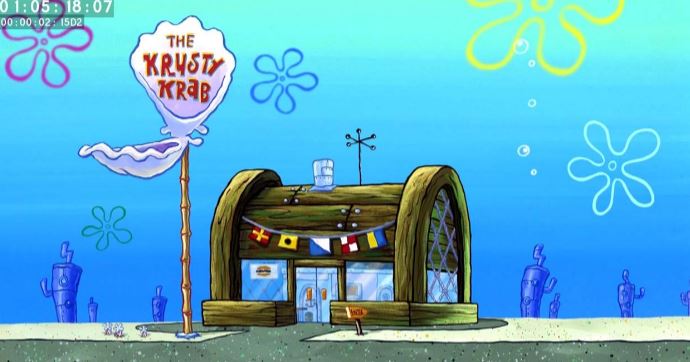
February 17, 2016—Calling all Spongebob fans: there is a company in Texas that wants to create a real life Krusty Krab restaurant. For those not “in the know,” Spongebob Squarepants is a Nickeloden cartoon featuring underwater sea characters. The main character, Spongebob, works at a fast food restaurant named The Krusty Krab, which is prominently involved in story lines in the show. The Texas company, IJR Capital Investments, is planning to open two “Krusty Krab” restaurants, presumably modeled after the cartoon version shown below. Adult fans will love it! Children will love it! Everyone will love it! Well, except for Viacom, the owner of the intellectual property rights in the Spongebob franchise.

Krusty Krab - Image

The dispute began when IJR filed an application to register the mark THE KRUSTY KRAB in connection with “restaurant services” with the Trademark Office. The Trademark Office approved the mark for publication, no third-parties opposed, and a Notice of Allowance issued. IJR did not claim any use of the mark and it appears that they have not yet opened any restaurants.

At some point, someone in Viacom learned about the application and on November 23, 2015, sent a letter to IJR. The letter is short but written in a friendly tone, offering a “reasonable phase-out period” to IJR. In response, IJR questioned whether Viacom had any rights in the mark KRUSTY KRAB and “declined to cease use.” It appears the discussions ended there, with Viacom deciding to sue IJR, filing a complaint with the U.S. District Court for the Southern District of Texas on Jan. 29, 2016.

This is not the first time a third-party has attempted to create a restaurant based upon a television series or movie. We previously discussed one attempt to create a Ricky Bobby Sports Saloon (also in Texas). That restaurant is now known as Pole Position following a lawsuit from Sony Pictures.

Will the situation be different with the Krusty Krab? In its response letter, counsel for IJR argued that “consumers are likely to have a high degree of care when purchasing IJR’s goods and services” and that IJR was “unaware of any actual consumer confusion.” Neither of these arguments are likely to hold up in court as fast food services involve impulse purchases of cheap products, meaning that customers don’t do much research or due diligence when making their purchases. Also, the target customer will likely be children, making the potential for confusion even greater. The lack of actual confusion also means nothing when there has been no opportunity for confusion to arise. This is the case here, because IJR has not yet used its applied-for mark in commerce.

IJR suggested in an interview that it was being bullied by Viacom, stating that “Big guys always want to do what they can to the little guy.” It is true that there are numerous examples of big companies overreaching and attempting to enforce overbroad rights in their trademarks against small companies or individuals. However, this doesn’t seem to be that situation. The big company isn’t always the bad guy just because they’re “big.”

Spongebob Squarepants has been on the air since 1999. The franchise is very popular and has had immense success, with toys, feature films, comic books, and other products.  In 2009, the franchise was valued at $8 billion. Given the widespread consumer recognition, IJR was well aware of Viacom’s rights. At best, IJR is a big fan of the cartoon and thought it would be fun to operate a real life Krusty Krab. At worst,  IJR picked the name for the express purpose of capitalizing on the goodwill associated with the Spongebob Squarepants franchise.

The ever-optimistic Spongebob would likely say that “there’s always a chance,” but I think it’s unlikely Texans will be eating at a Krusty Krab any time soon. If that’s too big of a letdown for you to handle (and you’ve got the money and time for an international flight), there’s apparently a real life Krusty Krab in Palestine you can visit.

Insert Coin

January 29, 2016—Those of you who occasionally read my posts may have noticed that video games are a hobby and interest of mine.  I have posted on issues involving video games several times. See Executing NoriegaFlash in the PanamaCalling All Gamers.  And as I look back on it now, it appears that I, for a long time, had an unhealthy addiction to Call of Duty. (Never fear.  I’ve moved on.)  But despite my general gaming interest, I’ve never taken the time to sit down and post about some of the incredibly important and interesting intellectual property issues that accompany video game development and distribution.

There are very few industries that so intricately intertwine the multiple pillars of intellectual property as do video games.  Indeed, its difficult to identify any other industries that depend so heavily upon copyright and patent and trademark and trade secret law.  Video game development involves artistry, technological innovation, and an entrepreneurial spirit; and it requires large doses of each. Mobile gaming brought along an explosion of development and distribution.  In an ever crowding field, I believe clearly defining and protecting the intellectual property rights associated with game development is going to be an increasingly important activity.  It will be an important strategy issue for developers, and it will be an important issue for elected representatives and regulators in attempting to set the proper incentives for creation and access.

In a lot of ways, the game is just beginning.

Does Louis Vuitton’s Loss to a Parody Defense Justify an Award of Attorney Fees?

January 28, 2016—Earlier this month, the Southern District of New York granted the defendant’s Motion for Summary in Louis Vuitton MalletierS.A. vMy Other Bag , Inc. The fashion giant had brought suit against a California company over its sales of a canvas tote bag that included an image that “evoked” Louis Vuitton’s classic handbag design. An image of the Defendant’s products is shown below and you can read more about the Motion for Summary Judgment here.


Fresh off their victory, the Defendant My Other Bag (“MOB”) filed a Motion for Attorney’s fees just last week. MOB claims that the facts of the case render it an “exceptional” case under the Lanham Act and therefore request an award of $398,821.

In its Memorandum, MOB acknowledges that the Second Circuit normally requires a showing of “bad faith” before awarding attorney fees. However, the Supreme Court’s ruling in Octane Fitness v. Icon Health & Fitness, 134 S. Ct. 1749, 1758 (2014) rejected this interpretation of the term “exceptional,” instead finding that an exceptional case is merely one that stands out from others due to the relative merits of the claims or the litigation conduct of the parties. Although the case involved a claim of patent infringement, much of the language in the Patent Act mirrors the language of the Lanham Act and, as a result, courts regularly rely on decisions interpreting provisions of one act to interpret the other. Indeed, the Third, Fourth, and Sixth Circuits (and numerous district courts) have all recognized the applicability of Octane Fitness to requests for attorney fees under the Lanham Act.

Does MOB have a winning claim? MOB won on summary judgment on all three claims. That’s helpful, but does not mean that Louis Vuitton’s claims were weak enough to justify an award of attorney fees. Moreover, defenses of fair use or parody are particularly difficult to evaluate as courts frequently reach different conclusions on similar facts. In fact, Louis Vuitton successfully sued Hyundai Motor Co. in the same district under arguably less favorable facts (as MOB points out in its motion, though, Hyundai Motors undermined its own case with some poorly worded testimony).

Predictably, MOB also throws out the “bully” label.  This is by far not the first time the label has been thrown at Louis Vuitton. MOB argues that Louis Vuitton has pursued numerous “weak” claims, including a law school symposium’s use of the LV design on a promotional poster, a “Chewy Vuitton” dog toy, a Danish artist who placed a photograph of a child refugee holding a Louis Vuitton bag on a t-shirt (and then the painting of that photograph), other art exhibits, and the appearance of a character named “Lewis Vuitton” in the movie The Hangover II.  It certainly can’t help that Louis Vuitton appears to wear these tactics as a badge of honor, alleging in its own pleadings that it “actively and aggressively” enforces its trademark rights.

The chances of the court not adopting Octane Fitness are low, but the better question is whether the court considers the facts of the case to justify an award. It will also be interesting to see what consideration the court gives to Louis Vuitton’s perceived “bullying” tactics. When granting the Motion for Summary Judgment, the court did not seem particularly impressed with Louis Vuitton’s claims as it wondered whether the company “just cannot take a joke.” Maybe a $400,000 bill would be the perfect punchline.

Louis Vuitton’s Other Lawsuit Was a Winner, but Loses to a Parody Defense – Again

January 13, 2016—Louis Vuitton is no stranger to trademark disputes. As a a manufacturer of handbags, wallets, and other luxury goods, the company has its hands full just addressing counterfeit products. However, like any other company, there is concern not just with “fakes,” but other products and services that may otherwise infringe or dilute Louis Vuitton’s trademark rights (anyone hungry for luxury waffles?). The company takes an admittedly “aggressive” approach to enforcement, sometimes resulting in criticism. For example, Louis Vuitton created controversy in the legal world with a cease and desist letter to a law school over a fashion law symposium flyer that riffed off of the LV handbag motif. While Louis Vuitton has won many legal battles, it has also lost  a few, too. Last week, the Southern District of New York added another tally to the loss column, granting summary judgment to the defendant, My Other Bag, Inc. (“MOB”) (decision available here).

Louis Vuitton sued MOB in 2014. MOB created a line of canvas tote bags that sell in the range of $30 – $55. The founder of the company provides an origin story for the brand on its website:

One fine day in sunny Los Angeles, California a designer handbag junkie found herself walking out of a grocery store with an arm full of perishables and a burning question: “if I don’t want to stuff my produce in my Prada, where can I find a stylish, Eco-conscious reusable bag?” Underwhelmed with her options, she took it upon herself to create My Other Bag: a line of Eco-friendly, sustainable tote bags playfully parodying the designer bags we love, but practical enough for everyday life.

On one side of the canvas tote bag appears the phrase “My other bag…” and on the other side appears a cartoon of a luxury handbag (with some changes to the shapes, and replacement of the LV with MOB). The bag that formed the basis for this suit is shown below (and is still up for sale on MOB’s website):

MOB Image

Louis Vuitton sued MOB, alleging trademark infringement, trademark dilution, false designation of origin, and copyright infringement. MOB moved for summary judgment on all counts, claiming that MOB’s use of an image that invoked the Louis Vuitton design was a parody and therefore a fair use.

A claim of “parody” is not a defense in and of itself, but generally qualifies as a type of fair use for copyright infringement and for claims of dilution. Section 43(c)(3) of the Lanham Act also specifically identifies “fair use” to include uses that are “parodying, criticizing, or commenting upon [a] famous mark.” With regard to trademark infringement, while there isn’t a strict “parody as fair use” defense, courts generally rely on the “defense” as a means of concluding that consumers are not likely to be confused. Defendants and applicants frequently claim that their reference to a famous mark qualifies as a fair use, with mixed results (for example, herehere, and here).

One decision frequently cited by courts to evaluate a parody defense involves a familiar name , Louis Vuitton Malletier S.A. v. Haute Diggity Dog, LLC, 507 F.3d 252 (4th Cir. 2007). In Haute Diggity Dog, the Fourth Circuit affirmed a finding that a pet toy manufacturer’s use of CHEWY VUITTON in connection pet chew toys constituted a parody that did not infringe Luis Vuitton’s trademark rights. That decision, and the court here, identified a parody as a work that (1) references the original/famous brand, (2) but makes clear that the work is not the original/famous brand, and (3) communicates some articulable element of satire, ridicule, joking, or amusement.

Here, the court had no trouble concluding that MOB’s bags constituted a parody. The tote clearly referenced the Louis Vuitton product through the similar design. However, MOB’s bag made clear that the bag was not a Louis Vuitton bag. As the judge noted, “the whole point is to play on the well-known “my other car . . .” joke by playfully suggesting that the carriers’ “other bag” – that is, not the bag that he or she is carrying – is a Louis Vuitton bag.”

Louis Vuitton argued that MOB’s bags  do not criticize or disparage the Louis Vuitton brand and therefore cannot be a parody. Louis Vuitton relied upon an unpublished decision in which Louis Vuitton successfully defeated a parody claim asserted by Hyundai Motor for its use of a similar design motif on a basketball in a car commercial. In that case, Louis Vuitton elicited testimony from Hyundai Motor in which it admitted that Hyundai did not intend to criticize or make fun of Louis Vuitton. The court distinguished that case (and noted that it would have declined to follow the decision any way), concluding that even vague critiques or general commentary can be sufficient to establish a parody.

In the end, the court granted summary judgment to MOB on all of its claims. The successful parody defense defeated Louis Vuitton’s claims of copyright infringement and dilution. With regard to trademark infringement, the court concluded that the parties’ products targeted different customers, were not competitive, that the purchasers of Louis Vuitton bags were sophisticated, the channels of trade distinct, and that there was a lack of any actual confusion. In summarizing the factors, the court reasoned that the “purchasing public must be credited with at least a modicum of intelligence” and concluded that the joke was so “obvious” that there could be no mistake as to source or affiliation.

This decision demonstrates the subjective nature of evaluating parody and fair use defenses. Two courts in the same district with very similar facts reached completely opposite conclusions. At first glance, I would have expected a two second clip of a basketball with a similar design in a car commercial to have a stronger argument for a parody defense than a canvas tote bag displaying a similar design (that is actually being sold). Stay tuned for coverage of any appeal, but for now, it looks like the score is Louis Vuitton 1 : Parody 2.

Did the Federal Circuit Just Save the Redskins’ trademark registrations?

December 23, 2015—Yesterday, the Federal Circuit issued its decision in In re Tam, an appeal filed by a musician whose application to register the mark THE SLANTS had been refused registration on the ground that it was disparaging to Asian Americans. The Trademark Trial and Appeal Board (TTAB) relied on the same provision to cancel the registrations for the REDSKINS trademarks owned by the Washington D.C. NFL franchise.  The applicant in Tam appealed, arguing that the provision violated the First Amendment. The Federal Circuit agreed and struck down the provision as unconstitutional.

The specific provision at issue is Section 2(a) of the Lanham Act, codified at 15 U.S.C. Section 1052. The provision provides, in pertinent part:

No trademark by which the goods of the applicant may be distinguished from the goods of others shall be refused registration on the principal register on account of its nature unless it [c]onsists of or comprises immoral, deceptive, or scandalous matter; or matter which may disparage . . . persons, living or dead, institutions, beliefs, or national symbols, or bring them into contempt, or disrepute[.]

The decision – all 105 pages – presents a number of interesting legal issues to explore. We’ll analyze the substance of the decision in the coming days, weeks, and months. However, the most interesting aspect is not what the decision says, but where the decision may go. The In re Tam decision directly conflicts with the Eastern District of Virginia ruling in Pro-Football v. Blackhorse, which upheld the TTAB’s ruling cancelling the REDSKINS trademark.

In Blackhorse, the court concluded that the provision did not implicate the First Amendment because a lack of registration does “not burden, restrict, or prohibit  [the] ability to use the marks.” However, the Federal Circuit disagreed. It concluded that the denial of a registration “creates a serious disincentive to adopt a mark which the government may deem offensive or disparaging.” The Blackhorse court also found that the registration of trademarks constituted government speech, making it exempt from First Amendment challenges. The court reasoned that, in denying registration to disparaging marks, the Trademark Office is “exercising editorial discretion.” The Federal Circuit disagreed, instead concluding that the issuance of registrations was merely a regulatory activity: processing trademark applications into registrations. The Washington Redskins have appealed the district court’s decision to the Fourth Circuit.

Given that the Tam decision invalidates a federal statute, there is a good chance that the Supreme Court will decide to review the decision. However, a review will be all but guaranteed if the Fourth Circuit upholds the District Court’s decision, resulting in a circuit split.  That case is still in the briefing stage and no oral arguments have yet been scheduled. As a result we’re not likely to have a decision until the fall of 2016 at the earliest. It’s going to be harder than waiting to open Christmas presents…

Fair Use’s Jedi Knight

December 18, 2015—This isn’t necessarily new news, but I thought it deserved a post regardless.  Back in late November, Google announced a new policy of pushing back against copyright holders issuing DMCA takedown notices regarding videos which Google believes make “fair use” of copyrighted material.  In Google’s words:

We are offering legal support to a handful of videos that we believe represent clear fair uses which have been subject to DMCA takedowns. With approval of the video creators, we’ll keep the videos live on YouTube in the U.S., feature them in the YouTube Copyright Center as strong examples of fair use, and cover the cost of any copyright lawsuits brought against them.

Hear, hear!  It appears that Google is taking seriously it’s changed corporate motto, which went from the passive “Don’t Be Evil,” to the active “Do the Right Thing” at the same time Google changed its corporate structure and put everything under the Alphabet umbrella.

Of course, it’s refreshing to see and it is “the right thing” for Google to stand up for fair use.  But let’s not be naïve.  This is undoubtedly a shrewd and calculated move for a company whose bread and butter is not creating its own content, but rather enhancing accessibility of content generated by others.  Google’s best known offerings other than search and website infrastructure–which themselves depend on content generated by others–are YouTube and Google Books.  Both depend heavily on a relaxation of traditional copyright norms and/or an expansion of fair use.  And this is BIG business-YouTube generated about $4 billion in revenue last year and will likely surpass that this year.

Fortunately, Google’s self interest in this case aligns with what I believe is the public interest.  Gigantic copyright holding organizations have, for too long, been able to throw their substantial weight around without any meaningful resistance.  The expense of litigation coupled with the possibility of life-destroying damages (or even imprisonment) authorized by the Copyright Act (seriously, copyright infringement can be punished more severely than violent crime), have allowed copyright holders to steam roll legitimate fair use, and they’ve had no qualms about the carnage.  We have been long waiting for someone to bring balance to the Force, and Google can fill this role.  In addition to the policy described above, they’ve also put together some nice materials on YouTube that make Copyright law accessible to the general public.  Consider me a fan, for now.

Samsung Seeks an Edge in Smartphone Wars through Federal Registration

December 16, 2015—For years, Samsung and Apple have battled over intellectual property rights associated with each party’s smartphones. Apple sued Samsung in 2011 and the jury found that Samsung had infringed Apple’s trade dress, design patents, and utility patents. On May 15, 2015, the Federal Circuit upheld the findings regarding infringement of design and utility patents, but found that Apple’s claimed trade dress was functional and vacated the damages award associated with the trade dress claims. Earlier this week, Samsung filed its request for Supreme Court review of the ruling. Although Samsung won an important battle for itself and all of Apple’s competitors, a recent filing by Samsung with the U.S. Patent and Trademark Office suggests that the smartphone trade dress battle may not be over.

On December 7, Samsung filed an application to register claimed trade dress for the product configuration of a smart phone. Samsung submitted the following drawing of the mark:

Samsung - Trade Dress DrawingThe drawing appears to show the Samsung Galaxy S6 Edge, shown below:

Samsung Phone

Samsung’s application contains a number of features that overlap with Apple’s claimed trade dress. So why file the application at all? Well, the latest rumors suggest that Apple may be introducing a curved display for its iPhone 7, similar to the Samsung Edge feature. Apple also recently received patent registration for technology that would enable its products to employ a curved screen. Assuming that the parties’ technology does not infringe the other’s patent rights, it could be possible for Samsung to prevent Apple from selling a curved display if Samsung can prove that it has protectable rights in a curved display trade dress.

Currently, Samsung’s application does not claim any rights in a curved display, but instead describes the mark as “a three-dimensional configuration of a smartphone.” However, an application for trade dress must specifically identify the aspects that are claimed as a feature of the mark and, just as importantly, the aspects that are not claimed as a feature of the mark. For example, when Apple sued Samsung for trade dress infringement, Apple claimed rights in the following configuration: (1) rectangular product with rounded corners; (2) flat clear surface display; (3) black borders around the surface display; and (4) when in use, an unchanging bottom dock of square icons, with a matrix of changing square icons above it. Likewise, Samsung will be required to specifically identify these features in its application.

However, this isn’t the only hurdle that Samsung will face. In order to be protectable, trade dress must be both distinctive and non-functional. Trademark rights can normally be established where the claimed mark is either inherently distinctive or has acquired distinctiveness. But the Supreme Court’s decision in Wal-Mart v. Samara Bros. Inc. clarified that product configuration marks can never be inherently distinctive. Instead, there must be proof that the claimed mark has acquired distinctiveness. Normally this is done through a claim of a period of use of five years or more. However, Samsung’s claimed first use date for this design is Feb. 3, 2015, about four and a half years short. Acquired distinctiveness can also be proven through significant sales, advertising, and publicity. However, with less than a year of use, Samsung may have difficulty proving that this particular design has acquired distinctiveness among consumers.

Samsung’s burden doesn’t get any easier with regard to proving that the claimed mark is non-functional, either. Samsung succeeded in proving that Apple’s trade dress (referenced above) was functional. Specifically, the Federal Circuit found that these features provide utilitarian advantages, making the product more usable, providing user friendly features, quick access to programs, greater pocketability, and better durability. Most of these features, if not all of them, appear to be present in Samsung’s current application.

Of course, the primary difference is the curved display. Although I don’t own a Galaxy S6 Edge, I presume the feature is popular because it increases the screen size, allows users to view notifications even if the phone is face down, and provides increased functionality for applications. Samsung also appears to be digging itself a pretty big hole with quotes like the following on its own website:

The device’s unique curved Edge screen provides quick access to frequently used apps, alerts and device functionality all with the swipe of a thumb, even when the cover is closed.

Right now, Samsung’s odds of obtaining a registration for the claimed trade dress seem low. Maybe Samsung plans to disclaim a number of these functional features, possibly increasing its odds; we’ll have a better idea once Samsung defines its claimed mark. However, in light of Samsung’s past statements (and success) in the Apple litigation and its promotion of the “edge” feature, this application may be dead on arrival, regardless of any future amendments.

Forget the 6s, is the iPhone 3d coming soon?

December 4, 2015—When the iPhone 6s was announced, the 3D touch was a heavily touted feature.  The touch screen can now sense how hard you’re pushing. Functionally, it’s a great improvement that gives users new ways to interact with programs. But a new trademark application filed by Apple on August 18, 2015 suggests that this may not be the only 3d feature in store for the iPhone.

The application seems basic at first glance. For many years, Apple has applied to register its app icons as trademarks. Nearly all of them, and each iteration of each icon. It seems a bit overzealous, especially because the icons are revised frequently. Below is just a small sample.

Apple - sample icon registrationsAnd yes, that is a click wheel iPod in the lower left-hand corner. I don’t even know if those are sold anymore, but I’m pretty certain that icon hasn’t been in any of last three iterations of Apple iOS.  That technology may already be obsolete, and the registration hasn’t even reached the point where a renewal needs to be filed! (Although, if you’re looking for some excitement, the renewal period opens on Dec. 7, 2015. It’s a one year renewal window with a six month grace period, so this will get really interesting around May of 2017).

Needless to say, applications to register new icons don’t raise any eyebrows. They usually come in multiple chunks for all of the new sleek, redefined versions of the mainstay apple icons (phone, mail, weather, maps). But Apple’s new application doesn’t follow that trend. And the image identified in this new application is different from any of the others before:

Apple 3d app iconApple describes the mark as:

three, three-dimensional squares with rounded edges, stacked at an angle with the bottom square in dark green, the middle square in light green, and the top square in white. The top square contains three rows of three hearts, eight of which are gray and one of which has a linear gradient color of red to pink.

The image appears to be an icon rising out of an iPhone display screen. The mark description confirms that this is the intent. Of course, filing a trademark application doesn’t mean that a 3d screen is possible. But a patent application? That would help. And yes, Apple applied for a patent on 3d display technology in 2010. The patent was approved in late 2014. Apple also has a pending application for a patent on an “eye-tracking” feature for a 3d display.

Of course,  just because there is a registered patent for the technology, doesn’t meant that the technology exists, or that it works, or that it works well enough to be commercially successful, or that it works well enough to be commercially successful and isn’t so expensive that nobody can even buy it. But filing a trademark application is a new step with a limited time frame to complete. So maybe a consumer oriented 3d feature isn’t too far down the road after all.  I think I’ll pass on 6c and wait for the iPhone 7, just in case.