arrow-double-right arrow-noline-right arrow-lrg-left arrow-lrg-right arrow-med-down arrow-med-left arrow-med-right arrow-med-up arrow-sml-right checkmark close close-sml contact-card event-clock linkedin menu minus outbound-link phone plus print search-lrg search-sml twitter Winthrop-mark

PTAB-Lovers Rejoice; IPR Lives!

April 27, 2018—Five months ago to the day, I predicted that the U.S. Supreme Court would uphold inter partes review (“IPR”) proceedings at the U.S. Patent and Trademark Office’s Patent Trial and Appeal Board (“PTAB”) as constitutional in Oil States v. Greene EnergyOn April 24, 2018, the Court so-held.

Back in November, the questions at oral argument in Oil States raised numerous intriguing issues:

  • Whether IPR proceedings are “examinational” rather than “adjudicatory.”
  • Distinctions between “public rights” and “private rights.”
  • The relevance of 19th-century cases on patents, such as McCormick v. Aultman.
  • The interplay of due process, given a patentee’s usually-substantial investment in the patented invention and reliance on the patent grant.
  • Opportunities for subsequent appellate review.

So which of these became the deciding issues in the Court’s opinion? Ironically, Justice Thomas–who has been known to refrain from questions at oral argument and was the only Justice not to ask a question during oral argument in this case–wrote for the 7-Justice majority. Justice Gorsuch wrote a dissenting opinion.

First, the majority held that IPR proceedings do not violate separation of powers by invading the sphere of the Judiciary under Article III of the Constitution:

When determining whether a proceeding involves an exercise of Article III judicial power, this Court’s precedents have distinguished between “public rights” and “private rights.” Those precedents have given Congress significant latitude to assign adjudication of public rights to entities other than Article III courts.

Recognizing that the Court has not been clear on this distinction, the Court provided some clarity:

[T]he public-rights doctrine applies to matters “‘arising between the government and others, which from their nature do not require judicial determination and yet are susceptible of it.’” Inter partes review involves one such matter: reconsideration of the Government’s decision to grant a public franchise.

Inter partes review falls squarely within the public-rights doctrine. This Court has recognized, and the parties do not dispute, that the decision to grant a patent is a matter involving public rights—specifically, the grant of a public franchise. Inter partes review is simply a reconsideration of that grant, and Congress has permissibly reserved the PTO’s authority to conduct that reconsideration. Thus, the PTO can do so without violating Article III.

The Court went on to incorporate Article I, Section 8, Clause 8 of the Constitution, which gives Congress the power to “promote the Progress of Science and useful Arts, by securing for limited Times to Authors and Inventors the exclusive Right to their respective Writings and Discoveries”:

Congress can grant patents itself by statute. And, from the founding to today, Congress has authorized the Executive Branch to grant patents that meet the statutory requirements for patentability. When the PTO “adjudicate[s] the patentability of inventions,” it is “exercising the executive power.”

Inter partes review is “a second look at an earlier administrative grant of a patent.”  The Board considers the same statutory requirements that the PTO considered when granting the patent…. So, like the PTO’s initial review, the Board’s inter partes review protects “the public’s paramount interest in seeing that patent monopolies are kept within their legitimate scope,” Thus, inter partes review involves the same interests as the determination to grant a patent in the first instance.

The primary distinction between inter partes review and the initial grant of a patent is that inter partes review occurs after the patent has issued. But that distinction does not make a difference here. Patent claims are granted subject to the qualification that the PTO has “the authority to reexamine—and perhaps cancel—a patent claim” in an inter partes review. Patents thus remain “subject to [the Board’s] authority” to cancel outside of an Article III court.

This Court has recognized that franchises can be qualified in this manner. For example, Congress can grant a franchise that permits a company to erect a toll bridge, but qualify the grant by reserving its authority to revoke or amend the franchise.

The Court then went on to distinguish 19th-century cases appearing to state that patents are private, not public, rights:

To be sure, two of the cases make broad declarations that “[t]he only authority competent to set a patent aside, or to annul it, or to correct it for any reason whatever, is vested in the courts of the United States, and not in the department which issued the patent.” (citing McCormick) But those cases were decided under the Patent Act of 1870. That version of the Patent Act did not include any provision for post-issuance administrative review. Those precedents, then, are best read as a description of the statutory scheme that existed at that time. They do not resolve Congress’ authority under the Constitution to establish a different scheme.

The Court also noted that even the English legal system, from which the U.S. derives many of its principles, contained a similar patent revocation process by petition to the Privy Council:

The Patent Clause in our Constitution “was written against the backdrop” of the English system. Based on the practice of the Privy Council, it was well understood at the founding that a patent system could include a practice of granting patents subject to potential cancellation in the executive proceeding of the Privy Council. The parties have cited nothing in the text or history of the Patent Clause or Article III to suggest that the Framers were not aware of this common practice. Nor is there any reason to think they excluded this practice during their deliberations.

For similar reasons, we disagree with the dissent’s assumption that, because courts have traditionally adjudicated patent validity in this country, courts must forever continue to do so.

The Court also rejected the argument that because IPR “looks like” the exercise of Article III judicial power, it is infringing on that power. And it “emphasize[d] the narrowness of [its] holding,” noting that appellant Oil States had not raised a due process challenge. Finally, the Court held that IPR proceedings do not abridge the “right of trial by jury” under the Seventh Amendment because Congress properly assigned the matter of patent rights to adjudication before the PTAB.

Justices Breyer, Ginsburg, and Sotomayor concurred, stating only that the opinion “should not be read to say that matters involving private rights may never be adjudicated other than by Article III courts, say, sometimes by agencies.”

Justices Gorsuch and Chief Justice Roberts dissented:

Today, the government invites us to retreat from the promise of judicial independence. Until recently, most everyone considered an issued patent a personal right—no less than a home or farm—that the federal government could revoke only with the concurrence of independent judges. But in the statute before us Congress has tapped an executive agency, the Patent Trial and Appeal Board, for the job. Supporters say this is a good thing because the Patent Office issues too many low quality patents; allowing a subdivision of that office to clean up problems after the fact, they assure us, promises an efficient solution. And, no doubt, dispensing with constitutionally prescribed procedures is often expedient. Whether it is the guarantee of a warrant before a search, a jury trial before a conviction—or, yes, a judicial hearing before a property interest is stripped away—the Constitution’s constraints can slow things down. But economy supplies no license for ignoring these—often vitally inefficient—protections. The Constitution “reflects a judgment by the American people that the benefits of its restrictions on the Government outweigh the costs,” and it is not our place to replace that judgment with our own.

This dissent is not at all surprising, given that during oral argument both Justices asked questions that suggested they doubted that patents were public rights. It goes on to say:

Article III, explains that the federal “judicial Power” is vested in independent judges. As originally understood, the judicial power extended to “suit[s] at the common law, or in equity, or admiralty.” From this and as we’ve recently explained, it follows that, “[w]hen a suit is made of the stuff of the traditional actions at common law tried by the courts at Westminster in 1789 … and is brought within the bounds of federal jurisdiction, the responsibility for deciding that suit rests with” Article III judges endowed with the protections for their independence the framers thought so important.

The dissent disputed the relevance and value of the references to the Privy Council, colorfully stating that the cases cited by the majority “represent the Privy Council’s dying gasp in this area.” And Justice Gorsuch embarked on a history lesson about the early years of our Republic. Wrapping up, the dissent expressed concern:

Today’s decision may not represent a rout but it at least signals a retreat from Article III’s guarantees. Ceding to the political branches ground they wish to take in the name of efficient government may seem like an act of judicial restraint. But enforcing Article III isn’t about protecting judicial authority for its own sake. It’s about ensuring the people today and tomorrow enjoy no fewer rights against governmental intrusion than those who came before. And the loss of the right to an independent judge is never a small thing. It’s for that reason Hamilton warned the judiciary to take “all possible care … to defend itself against” intrusions by the other branches. It’s for that reason I respectfully dissent.

As demonstrated by the Court’s opinion and the dissent, the primary issue was whether patents were public or private rights. The majority held they were public, between the government and the grantee, and its other holdings flowed from that decision. The dissent deemed patents private, akin to land grants and other personally-held rights, citing cases such as McCormick. In the end, due process did not play a role in the majority’s decision, but seemed to justify the dissent’s view that IPR proceedings are a form of Executive Branch encroachment. Given the majority’s explicitly-narrow holding and the dissent’s concerns, my guess is that the Court will be revisiting Oil States on a related issue in the near future. As always, stay tuned!

Game-maker Sues Lucasfilm over Han Solo Movie

April 25, 2018—You may have heard of a little movie called Star Wars. If you haven’t, well, I’ve got some movies for you to borrow. The film was released in 1977, and soon spawned a trilogy of movies that are among the most popular film franchises in the world. Fast forward forty years and eight of the nine triple-trilogy movies have been released, along with spin off movies such as Rogue One and the soon-to-be released Solo. However, the new Solo movie has created a spin-off of its own: a lawsuit filed by a U.K. gamemaker claiming that Lucasfilm’s movie and subsequent advertising infringes on his trademark rights in the mark SABACC.

The complaint was filed by Ren Ventures (“RV”) and its licensee Sabacc Creative Industries and the main issue involved is which party owns rights in the SABACC name and trademark. From the best I can tell, the name Sabacc was coined by George Lucas (the creator of Star Wars) or one of his co-writers at Lucasfilm. The game is mentioned in the original 1977 Star Wars movie and is referenced throughout the Star Wars universe of books and movies. For example, Han Solo “famously” won his spaceship the Millennium Falcon in a Sabacc game. That story likely plays out in the plot of the new Solo movie, which likely explains why Sabacc is prominently featured in advertising related to the movie, like this Denny’s commercial.

But does Lucasfilm’s use of SABACC as a fictional card game in movies and books create enforceable trademark rights? I haven’t seen any current use of SABACC with any specific goods or services, so there doesn’t appear to be any traditional trademark usage (affixed to goods or their packaging). However, Lucasfilms has sought and obtained registration for a number of similar features of the Star Wars universe, as you may recall from this Handy List of Star Wars References that Might Get You Sued. These registered marks include LIGHTSABER, THE FORCE, JEDI, and others. Of course, these marks are used with toys and other merchandise, making Lucasfilm’s claim to trademark rights a bit easier.

In fact, Lucasfilms distributed a licensed Sabacc card game in 1989. An image of the rules are below, but it appears this was a limited distribution.

Given that SABACC is a term coined by Lucasfilm and used only in the Star Wars universe, what type of Jedi mind tricks is RV using to assert its own rights in the SABACC name? Surprisingly, they’re relying on some ancient dark magic – a trademark registration. According to the complaint, RV sought to adopt a trademark for a game that mixed the rules of poker and blackjack. The complaint alleges that RV “searched the public domain for names” for such games, and the search revealed the names Pojack, 727, 727 Poker, Home Card, and Sabaac (ed note: one of these names is not like the other…). It’s unclear what RV meant by searching the “public domain,” as that phrase is normally used for copyright protected works that have lost their protection. Nonetheless, RV filed an application to register the SABACC mark for various computer game software and entertainment services. The application was published for opposition on June 7, 2016 and, after no third-party opposed, a registration issued on Aug. 23, 2016.

Although Lucasfilm actively enforces its rights at the U.S. Patent and Trademark Office, likely with the assistance of numerous watch services, its hard to fault Lucasfilm for not opposing. After all, even with all that Disney money, it might be difficult to justify a watch notice for each every made up element from the Star Wars universe. Regardless, Lucasfilm eventually learned of the registration and filed a Petition for Cancellation on May 1, 2017 with the Trademark Trial and Appeal Board (“TTAB”). Lucasfilm filed a Motion for Summary Judgment and, shortly thereafter, RV filed an infringement action and requested suspension of the cancellation proceeding at the TTAB.

RV has begun use of the SABACC game to promote online games, including at the iTunes store. A screenshot of the store is shown below:

You’ll notice that there are a number of word choices in the description that reference the Star Wars universe. This includes the reference to a “Cantina” (the Mos Eisley Cantina plays a major role in the original Star Wars movie), the word “galaxy” and the phrase “far, far away” (A reference to the films’ opening credits), and a reference to Cloud City, which plays a major role in the Empire Strikes Back. The use of a single one of these might not be concerning, but all of them in combination with Sabacc? Coincidence, I’m sure…

Setting aside Lucasfilm’s potential claims for trademark and copyright infringement, the facts strongly suggest that Luasfilm has a claim of unfair competition against RV. Based on all of these “coincidences,” the facts strongly suggest RV is attempting to capitalize on the goodwill and popularity of Star Wars. RV has essentially created the exact same game from the movies and books, is promoting the game utilizing similar imagery of robots, and utilizing words and phrasing uniquely associated with the Star Wars franchise to promote the game.

RV seems to be placing all of its eggs in the basket of “Lucasfilm didn’t use the mark in commerce and therefore we established valid trademark rights.” Unfortunately, there is at least one allegation in RV’s complaint that they might break a few of those eggs:

when consumers encounter Plaintiff’s pre-existing SABACC brand video playing-card game in the marketplace, they are likely to mistakenly believe that Defendants are the source of, and/or sponsor or endorse, Plaintiff’s SABACC brand video playing-card game, and/or that Defendants, the upcoming Solo Film, and/or Defendants’ Hand of Sabacc Commercial is/are otherwise associated or connected with Plaintiffs, Plaintiff RV’s SABACC Mark, and/or Plaintiff SCI’s pre-existing SABACC brand video playing-card game

The allegation arguably eliminates any need for Lucasfilm to establish use in commerce of the SABACC mark. The allegation suggests that the mere use of playing a Sabacc game in the movie or a in a commercial creates a likelihood of confusion with RV’s video game. If that’s all that it takes to create a likelihood of confusion, it makes it pretty easy for Lucasfilm to agree and simply gather the evidence of Lucasfilm’s use of Sabacc games in its films, moves, books, and related merchandise since 1977, and assert its counterclaim for infringement based on these prior rights.

With an upcoming premiere date of May 15 at the Cannes Film Festival, and a U.S. release date of May 25, there isn’t much time for the parties to work out a settlement. I’m not one with the Force and certainly can’t read minds, but I have a feeling this lawsuit won’t change Lucasfilm’s timeline.

Patent Appeals to the District Court: Win or Lose, You Pay Attorneys’ Fees?

April 11, 2018—Recently, the Federal Circuit Court of Appeals (the federal appellate court that primarily hears appeals in patents cases) heard arguments in NantKwest Inc. v. Matal, No. 16-1794 on the issue of attorneys’ fees (a timely topic) in certain patent cases.

Credit: PatentlyO

Attorneys’ fees are a necessary and inescapable cost of enforcing one’s rights and, as often is the case, can be astronomical in intellectual property cases. Under what is known as the “American Rule,” parties to a case usually must shoulder their own attorneys’ fees and costs–even if they win. Some statutes alter this general rule, allowing those who win in court (known sometimes as “prevailing parties”) to recover fees and costs. But reimbursement is the exception, rather than the rule.

The issue on appeal in NantKwest is unique and far more exceptional than prevailing party statutes. As clearly explained in a recent Law360 article, the case has to do with a previously-neglected section of the Patent Act, which provides that parties who “appeal” USPTO decisions directly to a district court (as opposed directly to the Federal Circuit) must pay “all expenses” incurred by the USPTO, win or lose. The full language can be found in 35 U.S.C. § 145, which provides:

An applicant dissatisfied with the decision of the Patent Trial and Appeal Board…may, unless appeal has been taken to the United States Court of Appeals for the Federal Circuit, have remedy by civil action against the Director in the United States District Court….The court may adjudge that such applicant is entitled to receive a patent for his invention….All the expenses of the proceedings shall be paid by the applicant.

For more than 100 years, the USPTO interpreted the “all expenses” language to apply only to travel expenses, expert fees, and miscellaneous costs. But in 2014, the USPTO argued that similar language in the Lanham Act (at 15 U.S.C. § 1071) entitled the USPTO to not only traditional costs, but also the USPTO’s attorneys’ fees. A district court agreed, and the Fourth Circuit Court of Appeals affirmed.

It wasn’t long until the similarly-worded language in the Patent Act came to bear on patent applicant NantKwest. Citing § 145, the USPTO argued that NantKwest should pay over $78,000 in attorneys’ fees. But the district court disagreed, stating that the word “expenses,” American Rule presumption, and over 100-year history of the Government’s position on this provision in the Patent Act, together required a narrow construction of the term. But the Federal Circuit reversed the district court in a 2-1 decision. Months later, the entire Federal Circuit agreed to hear the case en banc (to be considered by all of the judges, rather than a three-judge panel).

Numerous third-parties filed briefs with the Federal Circuit in anticipation of the rehearing. The American Bar Association is against an expansive interpretation, asserting that such would serve as a “roadblock to justice.” The International Trademark Association, which has interests given the similar language in the Lanham Act, and the American Intellectual Property Law Association agree.

The Federal Circuit recently heard oral argument in NantKwest and has not issued its opinion. But as I have chronicled before, the questions posed at oral argument may provide clues as to what may result. Here are some of the questions judges asked during the Government’s oral argument:

  • “[The USPTO] says there is no meaningful dispute with respect to whether ‘expenses’ covers attorneys fees or not. Isn’t there enough in the record to establish there is some ambiguity in terms of the coverage of ‘expenses’?”
  • “[The USPTO previously] hired independently counsel?” This references outside fee arrangements from the 1800s, perhaps establishing a factual basis for distinguishing attorneys’ fees from expenses.
  • “If it’s so clear, why did it take the PTO until the last couple years to tumble onto this supposedly unambiguous reading?”
  • “So, time out, [is the USPTO] saying that when the taxpayers were paying [the USPTO’s] fees, [the USPTO] had no obligation to seek them, but when the applicants would be paying [the USPTO’s] fees, now [the USPTO] suddenly need[s] to go seek them? You just said that [the USPTO] turned into a self-funded agency. Fefore that, who was paying the expenses of the agency?”
  • “So the statute has said for 170 years all expenses of the proceeding shall be paid by the applicant. That is not discretionary, correct? So the PTO did not have the discretion if the statute included attorneys’ fees…to not seek attorneys’ fees because the statute is mandatory, not discretionary?”
  • “Didn’t the agency become user-funded in the 80s?”
  • “Do you agree that since it wasn’t mandatory…the agency was in error for the last 170 years when it failed to seek attorneys’ fees?”
  • “What I don’t understand…if the AIA mandates that [the USPTO] be completely user-funded, why isn’t the cost of a patent examiner, or the cost of Xeroxing, or the cost of parking part of the fees pro-rata that [the USPTO is] seeking in this case?”
  • “Can you cite to any other provision…in which a loser can recoup its attorneys’ fees?”
  • “How are the salaries that are paid to the staff attorneys treated within the PTO budget? Are they an operating cost? Are they expensed out? Is there any profit margin factored into any of those costs?”
  • “Did counsel ever receive bonuses during a fiscal year? Counsel can get a bonus, isn’t that correct? Why aren’t they expensed in? Or in this particular instance?”
  • “Do you all keep detailed time sheets? Day-by-day, every [6] minute break? At the time that it is spent, or at the time in retrospect after the case is over? Are contemporaneous time sheets kept for every item that every lawyer works on?”
  • “What was the hourly rate?” The attorney for the USPTO responded that the value of USPTO attorney time is “roughly $100 per hour.”
  • “There’s no dispute in this case, at least, that expert fees are included in the statutory provision? And does the PTO contract with outside providers?”
  • “What about the access-to-courts issue?” This references a due process argument and the concern that requiring the payment of the USPTO’s attorneys’ fees would be prohibitive to small inventors and businesses.
  • “Is it your view that the expenses of this appeal should be payable, including the salaries of PTO employees who might be sitting here?”
  • “So you’re saying that the language in the statute that says ‘this proceeding,’ is not limited to the action in the district court, but also includes this appeal and maybe a Supreme Court appeal?” The USPTO responded yes, but that it wasn’t seeking such fees, prompting one judge to ask, “Why?…You don’t have discretion to request…or waive them.”
  • “Are you aware of any other statute that shifts the salaries of an agency’s attorneys onto the party who brought proceedings challenging the agency’s decision?”

Question to the other side, NantKwest:

  • “What is the purpose of the expense provision in section 145? Why did Congress adopt this unusual provision?” The answer? “We don’t know” because the legislative history doesn’t provide an answer.
  • “How are attorneys’ fees accounted for in a law firm? Are they profit? Income? Expense?”
  • “So your theory is that ‘expenses’ means traditional costs?”
  • “If you’re sitting there in Congress, and you’re trying to craft an unambiguous provision that would allow for the personnel expenses, would it be sufficient in this provision to say, ‘all of the expenses of the proceeding, including the personnel expenses’?” This spawned a great deal of back-and-forth about how Congress could have been more explicit without using the words “attorneys’ fees.”
  • “Is it your position that the ‘all expenses’ language is clear and doesn’t include attorneys’ fees? Or that it’s ambiguous, and, therefore, under Supreme Court precedent…doesn’t include attorneys’ fees?”
  • “My understanding is that nobody has identified any statute that uses generic language…without a parenthetical stating ‘including attorneys’ fees’ that has been interpreted to cover time for lawyers?”
  • “Are we really dealing with attorneys’ fees here?…In your experience as a practitioner…does that include a profit margin?”
  • “Do private law firms follow the government model? In which people who bill less hours…get to charge more per hour?” This was a somewhat lighthearted question.

On rebuttal:

  • “When did the Government determine that this provision included attorneys’ fees? For 170 years did [the USPTO] believe that it was entitled to seek them, but didn’t have to?”
  • “What about when the Government said that the possibility that the Government would try to seek fees was so remote that it could not be taken seriously?”

After listening to the oral argument, one is left with the distinct impression that the Federal Circuit was more critical of the Government’s newfound position and more accepting of NantKwest’s arguments. Yet, as shown above, the questions the judges asked the Government far exceeded those directed to NantKwest. As a recent Star Tribune article reported, if the case was being heard by the Supreme Court, this could suggest that the judges actually support the Government’s position. But given the entire tone of the oral argument–especially that of the rebuttal, in which the judges specifically asked the Government to address arguments raised by NantKwest–I cannot help but think the Federal Circuit will rule against the Government, creating a circuit split with the Fourth Circuit and ultimately setting up an appeal to the Supreme Court. Stay tuned!

UPDATE: The Federal Circuit rejected the USPTO’s arguments, stating “the American Rule prohibits courts from shifting attorneys’ fees from one party to another absent a ‘specific and explicit’ directive from Congress. The phrase ‘[a]ll the expenses of the proceedings’ [in 35 U.S.C. § 145] falls short of this stringent standard.”

Warby’s Fast Food: Can Arby’s Take a Joke?

March 29, 2018—Maybe you’ve heard of Warby Parker. The eye wear company has become quite successful in a previously monolithic industry. But a tongue-in-cheek advertising effort for a new onion ring monacle might just cross the line into provoking a trademark feud. See, Exhibit 1, below:

And, for the main course:

Even if Warby’s doesn’t actually sell the products, the packaging incorporates not only the entirety of the Arby’s trademark, but also the iconic, cowboy hat/maybe-its-a-fishhead logo. Has Warby Parker’s rebellious attitude finally crossed a line?

It turns out, no. No, it hasn’t. According to AdWeek, Arby’s and Warby Parker specifically teamed up on this project as part of an elaborate April Fool’s Day joke (and, ICYMI, this is not Warby Parker’s first rodeo, either). So the joint use of the marks is authorized by both parties and not an infringement. As the companies explain in their joint press release:

Arby’s has an eye for meat. Warby Parker has meat for eyes. The result? A new partnership sandwiched somewhere between vision and at least eight different kinds of meat.

If you’re lucky enough to live in New York, New York, there will be two real life Warby’s restaurants, beginning this Friday, March 30th. The participating locations are at 121 Greene Street and 32 E. 23rd Street. I don’t know where those addresses are, but for marketing purposes I hope it isn’t Long Island (no offense, Long Island).

So yes, this isn’t an infringement issue. But this is still a trademark story. At some point attorneys on both sides of the equation received an email because “This sounds awesome, but I think we have to run it by legal first.” Thankfully, the attorneys didn’t get in the way of this project to prevent it from actually happening.

My only complaint is that the companies announced it as an April Fool’s Day joke. You have to at least try to trick people into falling for it. Come on.

Glade No. 1, 2, 3, 4, and… Chanel No. 5?

March 23, 2018—Recently, a friend and I were watching The Bachelor—I know, I should be ashamed. During one of the commercial breaks, a spot appeared on-screen showing a woman wearing an elegant dress walking through a hallway. She turns into a doorway, and blue, shimmering light projects onto her face, as if she was underwater. A speaker off-screen says, “Open the door to a beautiful new experience for your home.” The commercial cuts to a small bottle with a spray nozzle on top. The bottle has a typical shape, but its packaging includes, near the top of the bottle, a “No. 3.” Are you thinking what I’m thinking? Immediately, my mind goes to Chanel’s timeless No. 5 perfume.

The speaker continues, introducing “Glade Fine Fragrance Mist.” The woman then crosses through a vertical air-water surface, as if she is entering a Stargate. She passes the boundary and floats in the adjoining room, which is filled with water. The speaker describes the “mist” as a bouquet of “florals, beechwood, and lush fruits that whisper a story on the air.” We also learn that the mist is infused with “essential oils” and “artfully crafted. Imagination? We have a fragrance for that.” The screen then shows the “Glade” logo, and the speaker identifies “S.C. Johnson, a family company.”  Take a look for yourself:

After watching the commercial, my friend remarked, “Hey, doesn’t that sound a lot like Chanel No. 5?” I thought the same thing. Just take a look at the branding for the advertised “Glade Atmosphere Collection”:

Now compare the “No 1,” “No 2,” “No 3,” and “No 4” for the above bottles to the Chanel No. 5 registered mark (which, by the way, has been registered since 1960, whereas the “Glade Atmosphere Collection” mark has only been registered since 2017):

Notice the similarities? The ‘o’ of the “No” is super-script in both marks. And, as anyone who passed Kindergarten will surely agree, one cannot help but intuitively notice that No. 5 follows 1, 2, 3, and 4. Combine that with the fact that air fresheners are similar to perfume, in a sense, and you have a formula for some potential consumer confusion. The use of small bottles and elegant advertising furthers the connection. And when you consider the historical fact that Coco Chanel picked No. 5 from a batch of perfumes labeled 1 through 5 (as well as 20 through 24), one cannot help but think that the similarities are more than just coincidence and happenstance.

Although floral scents are common, that Chanel No. 5 has a distinct smell of jasmine, bergamot (citrus/spicy orange), rose, lemon, linen, neroli (bitter orange), ylang-ylang (woody, an “essential oil”), lily of the valley, and iris makes the comparison to Glade’s Atmosphere Collection even more uncanny. Indeed, Glade “No. 1” has scents of jasmine and rose, in addition to cedar and apple. No. 2 smells of sweet pea and pear. No. 3 exudes beechwoodstarfruit, and coconut—not that far off from No. 5’s tropical notes.  And No. 4 is a “velvety kiss of patchouli [a member of the mint family] and amber.” These scents certainly seem similar to Chanel’s No. 5, even if spread across multiple bottles.

What do you think? Do Glade Nos. 1 through 4 come dangerously close to No. 5? Given the similar marks and smells, one cannot help but make the comparison.

USPTO Adds New Tool to Fight Fraud

March 7, 2018—Yesterday, the U.S. Patent and Trademark Office announced a new pilot program to help fight fraudulent trademark applications. Specifically, the new program addresses situations where the applicant provided the USPTO with a fraudulent specimen to demonstrate use of the trademark.

Only a narrow subset of fraudulent applications would be vulnerable to a claim under this pilot program. One example could include the whiskey specimen shown below.

Based on the name alone, I assume this is some high-quality booze. However, it might surprise you to learn that this is not a real bottle of whiskey. I just created it using MS Paint (cue mindblown gif).

Most attorneys understand that submitting this as a specimen would constitute fraud on the USPTO. However, not all individuals and companies understand the use requirements for obtaining trademark protection in the U.S. Some may mistakenly believe that registering a trademark is merely a ministerial act, requiring only a picture of how the applicant plans to use a trademark. Others might understand the requirement, but simply don’t care about the legal ramifications of submitting a fraudulent specimen.

It is not unsurprising that many fraudulent specimens come from foreign countries and, in particular, individuals in foreign countries.  A real life example of a possibly fraudulent specimen was submitted for this application, and is shown below.

Based on the lack of information on the label and the positioning of the wording, it appears that the applied-for mark was digitally added to the image. This is an example of the type of fraud that can be submitted through the new pilot program.

The full details of the pilot program are available here. The basic details include:

  1. Eligibility: the allegedly fraudulent specimen “is potentially not in actual use, but has instead been created for the purpose of submission to the USPTO as a specimen.”
  2. Evidence: Supporting evidence must include either (1) references to prior registrations or applications that show the same “mock up” or digital specimen with different marks (i.e., a company has applied to register five trademarks for whiskey, and submitted five version of the same mock up imagine but with different marks; (2) evidence showing use of the same digital image from a third-party on a website, advertisement, or other publication that shows that the alleged fraudster merely deleted wording and added its own mark.
  3. Reporting procedure: an email must be sent to the USPTO.gov email addressed identified in the Pilot Program instructions. There is not a formal online submission form. The email must include “Duplicative Specimens — [Serial Number]” in the subject line, provide any additional serial numbers in the body, and include the supporting evidence.
  4. Timing: The USPTO will consider evidence sent prior to the opposition deadline, or likely any time if the application has not yet been approved for publication.

The program is narrowly tailored, but will certainly be helpful to address some of the most egregious cases of fraud. These types of fraud may also be difficult to uncover before the end of the publication period. Nonetheless, it is encouraging to see the USPTO institute programs like this, as it allows the USPTO to help combat fraud within the applicable statutory constraints.

The Sweet Smell of Registration

March 2, 2018—Last year we took a whiff of Hasbro’s application to register the smell of its Play-Doh® for “toy modeling compounds.” We didn’t think the application was ripe for a functionality refusal, but a refusal on the ground of a lack of acquired distinctiveness seemed like a certainty.

An Office Action issued on May 26, 2017, refused the application on the ground of a lack of acquired distinctiveness. The Office Action also included a number of Requests for Information to determine whether a functionality should issue, too.

For the uninitiated, a trademark must be distinctive in order to be protectable. Because a scent mark cannot be inherently distinctive, an applicant must establish “acquired distinctiveness,” also known as “secondary meaning,” to obtain a registration. Essentially, acquired distinctiveness means that the claimed mark may not have been a symbol of the source of the goods, but because of advertising, commercial success, publicity, etc., the public has come to recognize the claimed mark as a identifying a particular source for the goods.

For attorneys looking for a good playbook as to how to establish acquired distinctiveness, look no further than Hasbro’s Response, filed on November 27. The Response includes pretty much every piece of evidence that you could ask for.

It included the classics:

  • Sales numbers, more than a billion since 2004 in the U.S.
  • Advertising numbers, $77 million since 2004 in the U.S.
  • Longstanding use, since the year 1956
  • Unsolicited media attention referencing Play-Doh’s “unique and distinctive smell” and its “legendary scent”

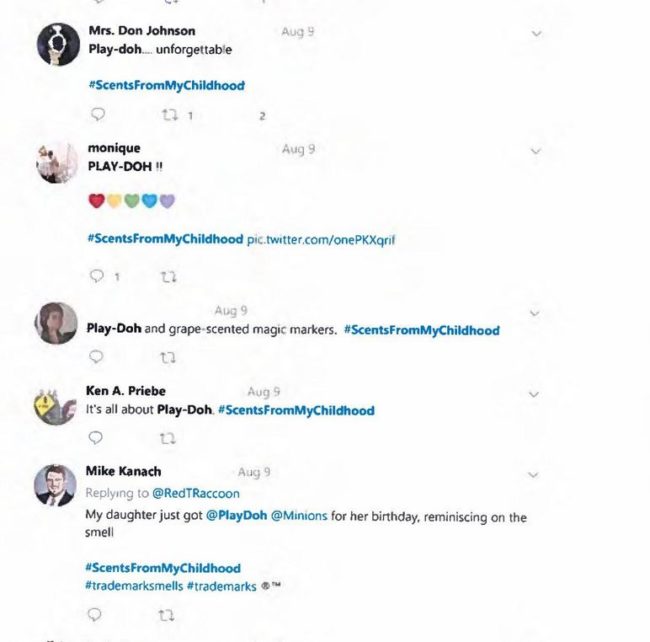
It included new hits, like screenshots of social media of consumers talking about the memory of the smell of Play-Doh as a child. It also included “blogs written by experienced attorneys who opine on the source-identifying function and registrability of the applied-for mark.” Looking at those articles, you might even recognize a familiar blog post. No need for any thanks, Hasbro. But on a completely unrelated note, this R2-D2 Play-Doh set looks pretty great. Just saying.

The Response also included the obligatory declaration from a Hasbro head honcho to support these claims. The declarations always have at least one over-the-top assertion that you just can’t help but include. Here, it was the reference that Play-Doh for some people is “as identifiable as their mother’s faces.” Might be a bit of a stretch, not that I’m saying I wouldn’t have included it though. For me, the gem is the strange but unforgettable fact that since 1956 more than 950 million pounds of Play-Doh had been sold. If only it had included a reference as to how big that Play-Doh boulder would be.

And yes, the Response even included the coveted, but not always available “look for advertising”:

I’m not entirely convinced this qualifies as “look for advertising” though. It doesn’t direct consumers to the claimed trademark like a “look for the purple cap!” might do. Just looking at the advertising doesn’t tell me what type of smell I’m looking for. It’s close enough though, and the rest of the evidence is pretty compelling.

So, do you think the evidence was successful? Could the examiner smell what Hasbro was cooking? If you guessed yes, then congrats. The application published on February 27. Now all that is left is to see whether any of Hasbro’s competitors file an opposition to the application.

It’s certainly possible that a competitor might feel that providing Hasbro with ownership of the “scent of a sweet, slightly musky, vanilla fragrance, with slight overtones of cherry, combined with the smell of a salted, wheat-based dough” might put them at a non-reputational, competitive disadvantage. In theory, it doesn’t seem like granting Hasbro the registration will be problematic, but in practice it will depend upon how broadly Hasbro interprets its rights.

But that may be putting the cart before the horse. Let’s wait and see how the next 35 days go before we start talking enforcement.

“Brother Thelonious” Monk’s Likeness Protectable Decades After Death

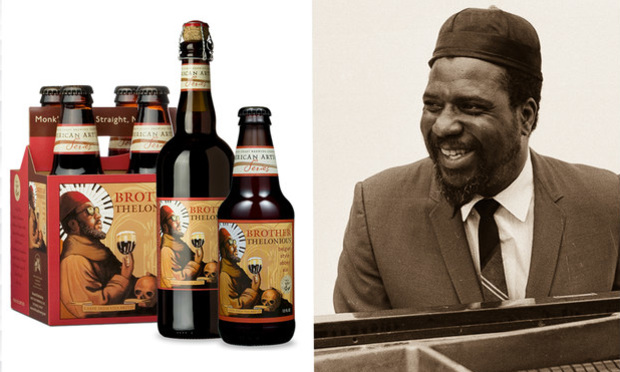
February 23, 2018—Earlier this month, a California federal judge kept alive a suit brought by the estate of famous jazz musician Thelonious Monk against North Coast Brewing Co. for trademark infringement and infringement of the right of publicity. The dispute centers around North Coast’s popular “Brother Thelonious” Beligan-style abbey ale (beer seems to be on the mind here at DuetsBlog as of late), which features a likeness of Thelonious Monk on its label:

Credit

The estate, managed by Thelonious Monk’s son, Jr., agreed to allow North Coast to use the likeness for selling the beer so long as North Coast agreed to donate some of its profits to the Thelonious Monk Institute of Jazz. North Coast apparently upheld its end of the deal, donating over $1M to the Institute since 2006. Though, North Coast also expanded its use beyond beer, to beer brittle, goblets, hats, apparel, signs (metal, neon, and paper), playing cards, pins, and even soap (made–incredibly–using the beer).

North Coast even registered a trademark on its label design, which “consists of a profile portrait of a gentleman in a red cap, dark glasses, and brown monk’s garb holding a glass of dark beer in one hand and a human skull in the other hand, with a stylized circular black and white piano keyboard behind his head, in an abbey setting.” Sounds like Thelonious Monk, don’t you think? North Coast also has a registered trademark on the name “Brother Thelonious.” A little late to the game, the estate registered a trademark on “Thelonious Monk” this summer.

In 2016, the estate rescinded its permission to use Thelonious Monk’s likeness, and after North Coast refused to stop using the likeness, initiated its lawsuit. The district court judge denied North Coast’s motion to dismiss the case, stating that the factual record underlying the dispute needs to be fleshed out before any of the estate’s claims can be decided. Give it several months to up to a couple years before the court issues a ruling.

The estate’s lawsuit, especially the claim for infringement of the right of publicity, got me thinking about the basis for the right of publicity and the right’s applicability to celebrities who have died–sometimes referred to as “delebs.” Sadly, Thelonious Monk died in 1982. But, like many celebrities, the value of his work and likeness endure after death. Indeed, some celebrities have become bigger in death than they were in life (e.g., Tupac ShakurMichael Jackson, and Elvis Presley). And beloved local delebs continue to make appearances:

Credit

At first glance, it seems odd that a deceased celebrity (through an estate) would have any right to control the use of likeness after death, let alone profit from it. Indeed, the right of publicity, provided under state law, is largely founded on privacy grounds, protecting the use of one’s identity in commercial advertising given the personal and private interests at stake. After death, those personal privacy interests are no longer compelling. But the right of publicity in many states is also founded on property grounds, in view of the fact that (at least for many celebrities) individuals often invest extensive time, energy, and money in promoting and creating their own personal brand. The thought is that, like other intellectual property rights, one should be able to receive the benefits of that investment (which encourages such investment in the first place). Thus, the right of publicity is based upon both privacy and property interests.

The right to publicity is recognized in over 30 states, but the scope and breadth of the right varies in each state largely because states have differing views on whether the right should be grounded in privacy, property, or both (and if both, to what degree?). Many of these states have a right of publicity statute, but some do not. For example, as I discussed previously, Minnesota does not have a right of publicity statute. In 2016, the Minnesota State Legislature considered the “Personal Rights In Names Can Endure” (“PRINCE”) Act, but never passed the bill. Have no fear, though; previously, in Lake v. Wal-Mart Stores, Inc., the Minnesota Supreme Court recognized the right of publicity based on “individual property” rights and “invasion of privacy,” citing Restatement (Second) of Torts § 652B (1977). 582 N.W.2d 231 (Minn. 1998).

Interestingly, because the right of publicity is a creature of state law, where a person was domiciled (residing) at the time of death controls what kind of right of publicity that person’s estate has after death. Estates for celebrities who were domiciled in Oklahoma are the most fortunate and can enforce the right of publicity for up to 100 years after death. But woe be upon an estate in Wisconsin, which bases its right of publicity on privacy interests and only allows living persons to enforce the right. The amount of time a right of publicity can be enforced after death varies dramatically state-to-state. For a helpful run-down of most states, see this useful overview.

How about in Minnesota? The PRINCE Act would have allowed an estate to enforce a right of publicity for up to 100 years, like Oklahoma’s statute. Under the common law, it remains unclear how long the right persists–though, the U.S. District Court for the District of Minnesota held (ironically) in Paisely Park Enterprises, Inc. v. Boxill, that the right survives death. See 2017 WL 4857945 (D. Minn. Oct. 26, 2017) (Wright, J.). How long thereafter? The Restatement (Second) of Torts doesn’t say.

The most basic takeaway from the current state of the law is that celebrities with likenesses that may have great value in commercial use should consider domiciling in states that have favorable post-mortem rights of publicity. Thelonious Monk was domiciled in New Jersey when he died, and the New Jersey right of publicity extends no longer than 50 years after death. So the estate has about 14 more years during which it can enforce the right, which Thelonious Monk may not have ever exercised in life.

By the way, if you’re interested in trying out the Brother Thelonious, it is available in two Twin Cities locations: First, and most appropriately, the Dakota Jazz Club & Rest(Minneapolis), and also at Hodges Bend (St. Paul).

Who Owns the Trademark Rights to Tesla/SpaceX’s Roadster?

February 9, 2018—Today I write with a thought-provoking question: Just who owns the trademark rights to Telsa’s/SpaceX’s Spaceman Roadster? Tesla? SpaceX? Perhaps even humanity?

If you didn’t catch it, SpaceX recently launched its first Falcon Heavy three-booster rocket designed to carry large payloads into space. In a stunning feat of engineering and genius marketing, the rocket sent SpaceX CEO (and Telsa CEO) Elon Musk’s Tesla Roadster toward the Sun (where it will orbit for billions of years), all while returning two of the three boosters to the same location from which the rocket departed.

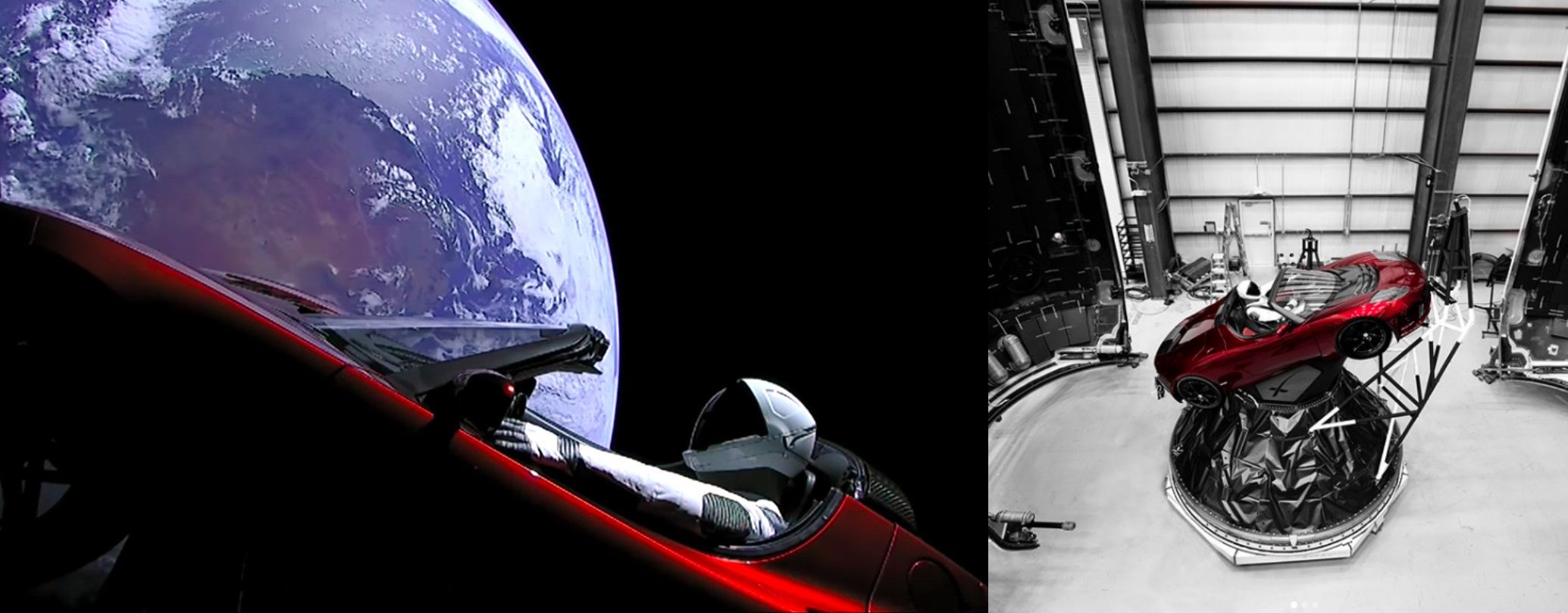
It might seem incredible to believe, but the NASA-defined space object “Tesla Roadster (AKA: Starman, 2018-017A)” is now traveling away from the Earth on its trajectory to the Sun. You can track the object using NASA’s HORIZONS system and even watch a live feed from its on-board cameras.

Yes, these are real pictures: creditcredit.

If you haven’t seen the launch and booster touch down, now is the time; it is truly awe-inspiring and one of the biggest feats of the decade. It may also be the most ambitious marketing promotion for a product and service (the Falcon Heavy) ever, establishing both Tesla and SpaceX as innovative, intelligent, and forward-thinking brands. And that gets me thinking: Spaceman (or some similar description), as a potential name, symbol, or device, could constitute a trademark. But because two separate companies, Tesla and SpaceX, are involved in launching the car into space, just who has a right to the mark? And does Spaceman itself operate as a mark identifying either company as its source?

The answer could hinge on whether either company decides to use the mark to designate itself as the source of certain goods or Spaceman, for that matter. The primary purpose behind trademark protection is to reduce information and transaction costs, while protecting investment in the creation and promotion of marks that do just that. Thus, a fundamental inquiry in trademark infringement cases is whether use of a mark causes consumer confusion as to the source of a good or service. So far, both companies have touted the Falcon Heavy achievement. But Spaceman itself does not clearly indicate one source over the other. Of course, the Roadster identifies Tesla as its source, but the rocket on which it is affixed designates SpaceX as the means for its position in space. Maybe that is enough of a distinction to make the mark part Tesla and part SpaceX.

I would like to believe that both companies’ CEO, Elon Musk, would think of Spaceman not as a symbol of either business, but rather a symbol of human achievement and what is to come. Indeed, both companies have grand visions for humanity. SpaceX’s mission is “to enable humans to become a spacefaring civilization and a multi-planet species.” Telsa is purposed on “accelerat[ing] the transition to a sustainable energy future.” To any other-worldly being, Spaceman itself identifies Earth and its people as its source. In this way, Spaceman is similar to other satellites within the solar system, which identify Earth as progenitor. Perhaps, then, it is fair to say that we all have a stake in the symbol. What do you think?

Hands Off Jay-Z’s Hand Gesture Trademark

February 8, 2018—Words and pictures are so 2017. This year, it is all about the non-traditional trademarks (i.e., something other than brand names and images). In the past, we’ve covered a variety of these types of trademarks, from colors to product shapes, to sounds and even the touch of a product. Even looking only at college football, there are registered marks for the color of a field, player uniforms, and fan chants.

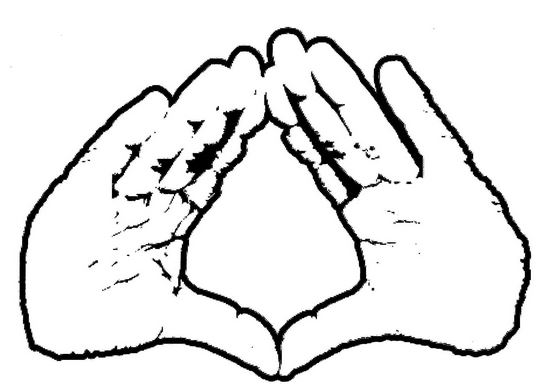
And 2018 has already given us a new category: hand gestures. Music and fashion mogul Shawn Carter (also known as Jay-Z) recently applied to register the hand gesture below for entertainment services.

According to one origin story, the image of a diamond was meant as a reference to the slang term “rock” for diamonds. Jay-Z’s record label is Roc-A-Fella Records, and using the hand symbol has come to be known as “throwing up the roc.”

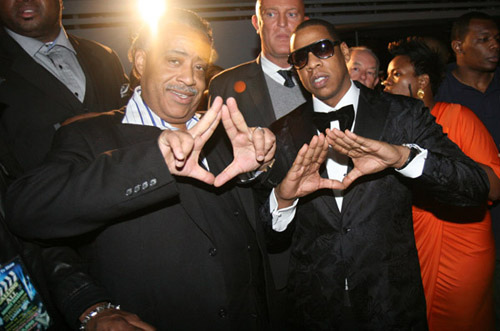
Whether due to Jay-Z’s popularity or due to the calorie burning benefits of raising your arms briefly, the symbol has become a bit ubiquitous in popular culture. Everyone from Aaron Rodriguez, Fran Drescher, to Warren Buffet and others are documented roc-throwers. But nobody can do it quite like Hov himself:

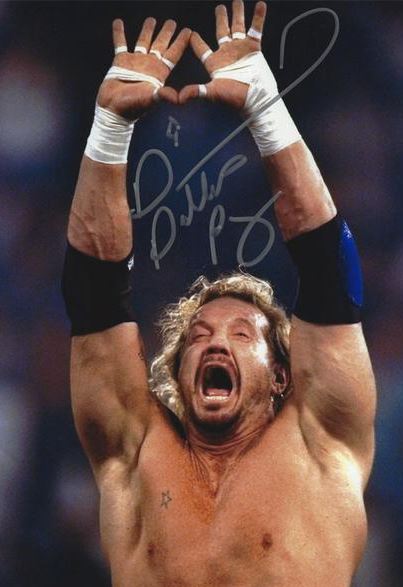
Also worth adding to the list is professional wrestler Diamond Dallas Page. He’s been throwing the roc since the ’90s:

Although his gesture is just a little bit different, with his fingers extended. Also, he refers to his symbol as the diamond cutter. He also has already registered a version of the gesture (shown below) as a trademark for various clothing items.

And, come to think of it, he sued Jay-Z over the symbol years ago. Although there isn’t much information available, it appears the case settled out of court with Jay-Z making a payment of an undisclosed amount (to keep it fair and balanced, there is a wrestling source and a hip hop source).

As of yet, no word on whether Diamond Dallas Page will take action against Jay-Z’s trademark application. Perhaps the settlement between the parties prevents him from doing so. But if so, then why did Jay-Z wait for nearly a decade to file his own trademark application? And although the Diamond Cutter was registered as a trademark, should either celebrity own enforceable rights in a hand gesture? Does it really signify source? Or does it remind us of something in a non-trademark manner, like trash compactors remind me of Star Wars or triangles remind me of the White Stripes?

And I would be remiss to not mention the elephant in the room: the conspiracy theory that Jay-Z along with many other musicians, politicians, and others are part of a secret society of the IlluminatiFreemasons, or (more recently) Taco Bell. Fingers crossed the Trademark Office utilizes her power to issue a Request for Information to demand that Jay-Z answer once and for all whether he is, in fact, a member of the Illuminati.