arrow-double-right arrow-noline-right arrow-lrg-left arrow-lrg-right arrow-med-down arrow-med-left arrow-med-right arrow-med-up arrow-sml-right checkmark close close-sml contact-card event-clock linkedin menu minus outbound-link phone plus print search-lrg search-sml twitter Winthrop-mark

What Health Care Providers Need to Know About Minnesota’s New Payment Withhold Law

Entities operating under an agency payment withhold should take notice of a new law that went into effect on May 24, 2025. Minnesota Statutes Section 15.013 adds specificity and clarification regarding timing and notice requirements that agencies must comply with to withhold payments when an “agency head determines that a preponderance of the evidence shows that the program participant has committed fraud to obtain payments under the [applicable] program.”

Under the law, the term “fraud” is the “ intentional or deliberate act to deprive another of property or money or to acquire property or money by deception,” and includes “knowingly submitting false information” to a government entity for the “purpose of obtaining a greater compensation or benefit than the person is legally entitled,” as well as committing crimes, such as theft, perjury, or forgery under state or federal law. The new law affects “program participants,” which are defined as “an entity, or an individual on behalf of an entity, that receives, disburses, or has custody of funds or other resources transferred or disbursed under a program.” “Agency” is also broadly defined to include any state officer, employee, board commission, authority, department, or other agency of the executive branch of state government and also includes Minnesota State Colleges and Universities.

The new administrative payment withhold law is of particular significance to health care providers, especially those that receive Medical Assistance (“MA”) reimbursement through the Department of Human Services (“DHS”). Recent investigations by DHS have led to widespread and well-publicized allegations of fraud and abuse within Minnesota’s MA program, which has resulted in DHS shutting down an entire reimbursement program, including housing stabilization services, as well as targeted accusations of fraud aimed at numerous personal care assistance programs, among other programs.

The new statute requires that an agency provide “at least 24 hours” notice of the decision to withhold payments “before withholding a payment” and directs that the withholding period cannot “exceed 60 days.” The notice must cite to the new law, include the effective date of the payment withhold, list the reasons for the payment withhold, and include the date that the administrative withholding period terminates. Importantly, entities have a right to appeal the payment withhold decision by requesting a contested case hearing under Minnesota Statutes Chapter 14, “or by petitioning the court for relief, including injunctive relief.”

These new requirements both complement and significantly update current laws regulating DHS administrative payment withholds. For example, under the existing law, DHS is not required to give prior notice of a payment withhold and the payment withhold typically went into effect before recipients had notice. The standard for initiating a withhold is now better defined, affording providers greater procedural fairness. Under the existing law, DHS could withhold based on a “credible allegation of fraud” which only required fraud allegations that had “an indicium of reliability.” Now, under Section 15.013, a higher standard of proof is required, and the agency has authority to withhold only if it “determines that a preponderance of the evidence shows that the program participant has committed fraud.”

Lastly, perhaps the most important update is the 60-day limit on payment withholds. DHS investigations routinely extend for months (and sometimes years) without resolution. This has resulted in an extreme burden for providers, and in some instances forcing a business to shut its doors, even when no wrongdoing occurred. Although investigations can still extend beyond 60 days, limiting the payment withhold will help level the playing field for providers impacted as collateral during DHS’ sweeping investigations in response to Minnesota’s Medicaid fraud crisis.

If you are an entity facing an administrative payment withhold implemented by a government agency, Winthrop & Weinstine, P.A. can help you assert your legal rights and protect your business.

Deadline for Conversion to Lower-Potency Hemp Edible Licenses Announced

The Minnesota Office of Cannabis Management (OCM) recently announced that it will be opening the application window for lower-potency hemp edible manufacturer, lower-potency hemp edible retailer, and lower-potency hemp edible wholesaler licenses next month.  OCM will accept applications for those hemp business license types between October 1 and October 31, 2025.

This deadline is critical for anyone who intends to manufacture, sell, or distribute hemp-derived cannabinoid products, edibles, or beverages after October 31, whether or not you currently hold a registration to manufacture or sell help-derived cannabinoid products.  After the application window closes, hemp businesses that do not have a pending lower-potency hemp edible application (or have not applied for and received a different cannabis license) will no longer be permitted to sell hemp-derived products under their existing registration.

If you have questions about the application process or about the impact the license conversion may have on your business, please contact one of our cannabis law attorneys and we will be happy to help you.

Unlocking Tax Breaks for Small Business Owners: How Section 1202 Can Help You Exclude Millions in Gains

Significant changes in the One Big Beautiful Bill Act (“H.R. 1”) have made Section 1202 of the Internal Revenue Code an even more valuable tax break for small business owners and investors. These updates expand who can qualify, shorten the time to claim benefits, and increase the amount of gain that can be excluded.

Qualified Small Business Stock (“QSBS”) Rules Prior to H.R. 1

To take advantage of Section 1202, both the stockholder and the issuing corporation must fulfill a series of requirements.

Stockholder Eligibility Criteria

First, the holder of the stock must be a non‑corporate entity (either an individual, partnership, or trust). Second, the stock must have been held for a minimum of five years to qualify for the exclusion. Third, the stock must also have been acquired in exchange for cash, property, or services, not in exchange for other stock. This rule includes LLC membership interests, which the courts have defined as “stock” for these purposes (for further analysis, see Leto v. United States, No. CV‑20‑02180‑PHX‑DWL (D. Ariz. 2022)).

If the stockholder is a pass‑through entity, such as a limited liability company, partnership, or S-corporation, the exclusion may still apply. In this case, the entity itself must meet the five‑year holding requirement, and the gain must be passed through to a non‑corporate owner who: 1) held an interest in the pass‑through entity at the time it acquired the QSBS, and 2) has continued to hold that interest.

Issuing Corporation Requirements

The corporation issuing the stock must also satisfy several conditions to ensure the stock qualifies for the exclusion.

Before all else, the stock must have been issued after August 10, 1993. The percentage of gain that can be excluded depends on the issuance date: 50% for stock issued between August 11, 1993, and February 17, 2009; 75% for stock issued between February 18, 2009, and September 27, 2010; and a full 100% for stock issued on or after September 28, 2010.

The issuing corporation must also be structured as a C‑corporation with less than $50 million in gross assets at the time of issuance, calculated based on the tax basis of the assets. For LLCs that convert to C‑corporations, this means the conversion must occur before reaching $50 million in gross assets. However, careful planning is required, as certain actions (such as cash contributions in exchange for shares) can inadvertently push gross assets over the limit and disqualify the stock.

Qualifying as a “Qualified Business”

Next, the business itself must also meet the criteria of a “qualified business.” The issuing corporation cannot exceed $50 million in gross assets, which includes cash and the aggregate adjusted tax basis of other property. Additionally, under the “look‑through rule,” if the corporation owns more than 50% of another company, it is considered to own its proportionate share of the subsidiary’s assets, which could potentially push the corporation over the $50 million limit.

To qualify, at least 80% of the corporation’s assets must be used in qualifying activities. Certain service businesses, such as those dependent on the reputation or skill of their employees (including health, law, engineering, and consulting firms) are excluded. A full list of non‑qualifying activities can be found in the IRC.

What’s New?

H.R. 1 resulted in three key changes to the application of Section 1202 on QSBS:

  • First, the limitation on the size of the underlying business increases by 50%, heightening the limit from $50 million to $75 million.
  • Second, the holding period shifts from an all-or-nothing rule (requiring a full five years before any exclusion applied) to a phased-in schedule that begins at three years and reaches the full benefit at the same five-year mark.
  • Third, the flat cap on the tax benefit allowed increases from $10 million to $15 million. The 10x adjusted basis of the QSBS remains unchanged.

Asset Limit Increase

The first change increases the gross asset limit for qualifying businesses from $50 million to $75 million. This limit is measured at the time the QSBS is issued and immediately afterward. As long as the corporation’s gross assets are at or below the $75 million threshold at those points, the stock can still qualify, even if the company’s assets later grow beyond the limit. Beginning in 2027, the $75 million threshold will be indexed for inflation. This change applies only to stock issued after July 4, 2025.

As an example, before H.R. 1, a manufacturing company with $52 million in gross assets couldn’t issue QSBS, the $50 million cap made it ineligible. After H.R. 1 raised the limit to $75 million, a newly incorporated C-corporation with $70 million in gross assets could issue qualifying stock. Investors in that August 2025 raise may now be able to exclude millions in future gains under Section 1202.

Shortened Holding Period

The second change replaces the all-or-nothing five-year holding rule with a phased schedule: 50% of the gain can be excluded after three years, 75% after four years, and the full 100% after five years. Again, this change only applies to those shares acquired after July 4, 2025.

For example, in August 2026, an investor puts $1 million into QSBS from a qualifying tech startup with $60 million in assets. Before H.R. 1, they would need to wait until August 2031 for any exclusion. Under the new phased approach, selling after three years allows a 50% exclusion, after four years 75%, and after five years the full 100%, giving flexibility if an early acquisition offer arises.

Increase on Tax Benefit

The third and final change to Section 1202 QSBS benefit is the increase in the flat cap from $10 million to $15 million. This will only affect those taxpayers where $15 million is greater than 10x that taxpayers’ basis in the stock. To the extent the 10x test exceeds $15 million, this change will not affect the taxpayer. Again, this cap will increase for inflation beginning in 2027 and will affect stock acquired after July 4, 2025.

For example, in late 2025, an investor buys QSBS for $500,000. In 2030, they sell it for $20 million, realizing a $19.5 million gain. Under the old rules, the exclusion would be the greater of $10 million or 10x basis ($5 million), so $10 million. With H.R. 1’s higher flat cap, they can now exclude $15 million, shielding an additional $5 million from tax.

Navigating the Potential Pitfalls

For those who meet these stringent criteria, the tax savings can be substantial. But navigating the rules can be complex, with pitfalls that may cause a business to lose its QSBS status. An LLC that converts to a C‑corporation, for example, must do so before surpassing the $50 million asset threshold. Further, specific transactions, like cash contributions for shares pushing the assets over $50 million, redemptions by the issuing company, or the issuing company holding too much cash, can result in losing the QSBS status.

Conclusion

Section 1202 of the Internal Revenue Code presents a unique opportunity for investors and business owners to exclude millions of dollars from taxable income, but only if they carefully navigate the requirements. For those ready to invest in small businesses, understanding these rules can make a significant difference in your tax bill. Proper planning, awareness, and ultimately, documentation of the criteria are essential to unlocking these savings and maximizing your financial benefits.

If you have questions about Section 1202 or how your business can reap the maximum tax benefits using this tool, please feel free to reach out to any member of our Tax team.

The Basics: Stablecoins and The GENIUS Act

What is a stablecoin, and why should I care?

A stablecoin is a type of cryptocurrency designed to maintain a fixed value—most often pegged to the U.S. dollar—by being backed 1:1 with reserves. Think of it as a digital IOU: for every $1-pegged coin in circulation, the issuer holds $1 in safe, highly liquid assets.

You should care because stablecoins make dollars programmable, instantly transferable worldwide, and usable in digital ecosystems without going through traditional payment rails. If you are considering being an issuer, it represents a new way for you to participate in payments, settlements, and financial innovation, which could potentially open new revenue streams, strengthen customer engagement, and position your organization favorably in a rapidly growing digital asset market.

What are the key features of a stablecoin?

There are five fundamental characteristics that are critical to understanding the nature of a stablecoin as a digital asset:

  1. Pegged Value: The most common stablecoins promise that 1 coin = $1.
  2. Blockchain-Based: Stablecoins live on public or private blockchains, meaning they can be sent globally in seconds, 24/7.
  3. Fully-Backed Reserves: The peg is maintained because each coin is supported by cash or cash-equivalent reserves.
  4. Redemption Right: A holder can, at any time, return the coin to the issuer and get $1 back (at “par”).
  5. Two Pricing Tracks:
    1. Issuer Redemption Price: Always $1 if the issuer is solvent and compliant.
    2. Market Price: The coin may trade above/below $1 in secondary markets due to liquidity, access, or panic. A “failed peg” occurs when the market price drifts significantly from $1.

What is a “peg” and how do reserves work?

In stablecoin terms, the “peg” is the promise that each coin will always be worth a fixed amount of currency (usually $1). That peg is what gives the stablecoin its “stable” part, as opposed to the price swings you see in Bitcoin or Ethereum.

Reserves are what make the peg believable. For every $1-pegged coin issued, the issuer must hold $1 in safe, highly liquid assets such as cash in a bank account or short-term U.S. Treasuries. Those reserves are held separately from the issuer’s other funds and can’t be used for unrelated purposes.

Here’s how it works in practice:

  • You buy a stablecoin directly from the issuer.
  • Your $1 goes into a reserve pool.
  • When you redeem the coin, the issuer takes $1 out of reserves and sends it back to you.
  • If the reserves are always intact and redemption happens promptly, the peg holds.
  • If reserves are lacking or redemption stalls, confidence drops and the market price can dip below $1, even if the issuer still claims the peg.

Why do stablecoins exist when we already have things called “dollars”?

Four reasons:

  1. Speed: Stablecoins are able to be settled instantly, as compared to the several minutes or hours needed for bank wires, or in the case of Automated Clearing House (ACH) transfers, days.
  2. Availability: As a digital asset, stablecoin can operate outside of bank hours and across borders, eliminating the need to wait until the next business day to transact.
  3. Programmability: Stablecoin integrates with smart contracts within the broader, existing digital asset ecosystem.
  4. Liquidity in Digital Markets: Stablecoin is liquid. It can facilitate trading, lending, and settlement unilaterally in cryptocurrency environments without converting back to traditional government-issued currency, known as fiat currency.

Keep in mind that one critical difference between stablecoins and dollars is that unlike cash deposits, payment stablecoins are not insured by the federal government.

What is the GENIUS Act?

The Guiding and Establishing National Innovation for U.S. Stablecoins Act of 2025 (the “GENIUS Act”) is the first U.S. federal law specifically regulating “payment stablecoins.” A payment stablecoin is a digital asset that is designed to be used for payments and pegged to a fiat currency (e.g., the U.S. Dollar). Only certain approved entities, or “permitted payment stablecoin issuers,” can issue these tokens. Stablecoins not issued by permitted issuers are ineligible for treatment as cash or cash equivalents for accounting, margin, or settlement purposes in regulated financial markets.

Digital assets that are also national currencies, deposits, or securities under the federal securities laws are not eligible to be payment stablecoins under the GENIUS Act. In other words, the GENIUS Act makes it clear that a payment stablecoin won’t be treated as a security or commodity under federal law. This means less regulatory overlap and more clarity for your business.

Who is eligible to be an issuer?

Only three categories of businesses may issue stablecoin:

  1. Subsidiaries of insured banks. A subsidiary of an insured depository institution may issue payment stablecoins after receiving approval from the insured depository institution’s appropriate federal banking agency.
  2. Federal-qualified non-bank issuers. A non-bank entity, uninsured national bank, or federal branch of a foreign bank can also can issue stablecoin, but it must receive pre-approval to do so by the Office of the Comptroller of the Currency (“OCC”).
  3. State-qualified issuers. Issuers that have been approved to issue stablecoins by state stablecoin regulators and which don’t qualify as under the other two categories above.

Public companies who do not engage primarily in financial activities generally cannot issue a payment stablecoin unless the Stablecoin Certification Review Committee (the “SCRC”), an oversight body consisting of the Secretary of the Treasury, the Chair of the Board of Governors of the Federal Reserve System, and the Chair of the Federal Deposit Insurance Corporation, unanimously find that the company will not pose a material risk to the U.S. financial and banking system and the company agrees to adopt certain data use and privacy measures.

What obligations does an issuer have under the GENIUS Act?

Under the Genius Act, an issuer of stablecoin has two fundamental obligations: (1) convert, redeem, or repurchase the payment stablecoin from the coin holder for monetary value (e.g., cash); and (2) create a reasonable expectation that the payment stablecoin will maintain a stable value. The GENIUS Act also imposes the following additional obligations on issuers:

1. 1:1 Reserve Backing

Issuers need to keep enough reserves to back every stablecoin issued: dollar for dollar. Reserves must consist of cash, short-term U.S. Treasuries, certain money market funds, or other approved low-risk assets. Reserves that comply with the GENIUS Act are “bankruptcy remote,” which means they must be held by qualified custodians and are off-limits to other creditors.

2. Restrictions on Issuer Activities

The GENIUS Act imposes significant restrictions on the activities of issuers of payment stablecoins, limiting such activities to:

  • issuing and redeeming payment stablecoins;
  • managing reserves;
  • custodial or security services; and
  • functions directly related to one or more of the above activities.

The Genius Act also prohibits both domestic and foreign permitted issuers from paying interest or yield to holders of payment stablecoins.

3. Par Redemption

Under the GENIUS Act, issuers must redeem 1 coin for $1 in cash with clear procedures and advance notice for any policy changes.

4. Transparency Measures

Every month, an issuer must publish a breakdown of its reserves, have its executive team certify as to the accuracy of those numbers, and have an outside accounting firm review its report. Issuers also need to make their redemption policies public and have a process in place to redeem coins quickly when users ask.

5. Other Requirements

Issuers must also meet the Genius Act’s capital, liquidity, risk management, marketing, anti-tying, audit and reporting, anti-money laundering, and economic sanctions compliance requirements. The Genius Act provides that issuers will be treated as financial institutions under the Bank Secrecy Act, which means that they will need to comply with the Bank Secrecy Act’s anti-money laundering and Know Your Customer (KYC) requirements. The Genius Act also establishes bankruptcy provisions for permitted issuers.

How will issuers be supervised?

The OCC regulates federal qualified payment stablecoin issuers, while subsidiaries of insured depository institutions are overseen by their respective federal banking agencies. State-qualified issuers with less than $10 billion in outstanding stablecoins may be regulated solely at the state level if the state regime is certified as “substantially similar” to the federal regime. Issuers exceeding this threshold, or those in non-certified states, are subject to joint state and federal oversight. The SCRC regulates certification and review of this process as well as the approval process for non-financial public companies applying to be permitted payment stablecoin issuers.

Does the Genius Act permit foreign payment stablecoin issuers to sell payment stablecoins in the U.S.?

Yes, subject to certain additional restrictions. Foreign payment stablecoin issuers may offer or sell stablecoins in the U.S. if they are subject to a regulatory regime deemed comparable by the Secretary of the Treasury, are registered with the OCC, maintain sufficient U.S. reserves, and are not domiciled in sanctioned or high-risk jurisdictions. Foreign issuers must comply with U.S. reporting, supervision, and enforcement requirements.

What requirements does the Genius Act place on custodial service companies and banks?

Entities providing custodial or safekeeping services for stablecoins or related assets must be subject to federal or state supervision and adhere to detailed requirements regarding accounting and segregation. The GENIUS Act does not restrict banks or depository institutions from engaging in otherwise permissible digital asset activities, including issuing digital assets representing deposits or providing custodial services.

Is a payment stablecoin a “security” under the federal securities laws?

No. The GENIUS Act expressly excludes payment stablecoins issued by permitted issuers from the definition of a “security” under the Securities Act of 1933, as amended, the Securities Exchange Act of 1934, as amended, the Investment Company Act of 1940, the Investment Advisers Act of 1940, and the Securities Investor Protection Act of 1970. These stablecoins are also excluded from the definition of “commodity” under the Commodity Exchange Act. The GENIUS Act clarifies that permitted stablecoin issuers are not required to register as investment companies solely due to stablecoin issuance and that advice limited to such stablecoins does not trigger investment adviser registration.

When will the GENIUS Act become effective?

The GENIUS Act becomes effective on the earlier of January 18, 2027, or 120 days after the issuance of implementing regulations by federal banking regulators. Until the effective date, any person may issue, offer, or sell payment stablecoins in the U.S. After the effective date, only permitted issuers may issue stablecoins, with a transition period for the offer and sale of pre-existing stablecoins until July 18, 2028, when full restrictions take effect.

How Have Banks Responded to the GENIUS Act?

In a joint letter to Senate Banking Committee leaders, the American Bankers Association and more than 50 state banking associations urged Congress to tighten the GENIUS Act, warning that several “loopholes” could jeopardize consumer protection and the stability of the banking system. The groups argued that the GENIUS Act’s ban on interest-bearing stablecoins is easily circumvented because exchanges and other third parties may still offer yield, potentially siphoning deposits away from traditional banks. They also pressed lawmakers to eliminate an exemption that allows non-financial companies to obtain federal approval to issue stablecoins, contending that mixing commerce and banking heightens conflicts of interest and competitive imbalances. Finally, the bankers asked Congress to repeal a provision permitting state-chartered issuers to operate nationwide without additional state approvals, asserting that it undermines the dual banking system and state consumer-protection authority.

What does the GENIUS Act mean for the future of banks and stablecoin issuers?

The GENIUS Act introduces a new era of regulatory clarity and operational requirements for both stablecoin issuers and banks. For stablecoin issuers, the GENIUS Act establishes a clear path to legal compliance, but also imposes significant obligations, including licensing, reserve backing, activity limitations, and ongoing reporting and audit requirements. Only entities that qualify as permitted payment stablecoin issuers, such as subsidiaries of insured depository institutions, federal qualified issuers, or state-qualified issuers, will be able to issue payment stablecoins in the U.S. after the effective date. Foreign issuers must meet comparable regulatory standards and register with U.S. authorities to access the U.S. market.

Banks and depository institutions may continue to engage in digital asset activities that are otherwise permissible under existing law, including issuing digital assets representing deposits and providing custodial services for stablecoins and related assets. However, banks seeking to issue payment stablecoins must do so through approved subsidiaries and comply with the GENIUS Act’s requirements. The GENIUS Act also clarifies that payment stablecoins issued in compliance with the GENIUS Act are not considered securities or commodities, reducing regulatory uncertainty for banks and issuers alike.

Overall, the GENIUS Act is expected to foster greater confidence and participation in the U.S. stablecoin market, while raising the bar for compliance, transparency, and risk management.

If you have any questions about the GENIUS Act and its potential impact on your business, or would like to develop a customized compliance strategy, please contact Vince Pecora or any member of our Banking team.
Tariffs and Business Sales: Using Earnouts to Bridge Valuation Gaps in M&A Deals

Recent changes in U.S. trade policy have created a lot of uncertainty for business owners, especially those who buy or sell products internationally. New and proposed tariffs (taxes on imported goods), along with retaliatory tariffs, can be announced or rolled back with little warning. This makes it hard to predict how a business may do in the future, as past performance may not be a strong indicator when considering future financial forecasts impacted by these trade limitations—which, in turn, makes it difficult to agree on a fair price when considering the purchase price of your company.

If your business relies on global supply chains or sells to customers beyond the U.S., these unpredictable tariffs can have a large impact on your profits. For many companies, this has created an additional challenge in the M&A market; buyers may worry that tariffs and other trade barriers lower margins or limit market access, while sellers do not want to be penalized for global macroeconomics far outside their control.

What Is an Earnout and How Can It Help?

The increased uncertainty is one of many factors that could cause a discrepancy between the price the seller believes the company is worth versus the price the buyer thinks is worth the risk involved. To help bridge this valuation gap, buyers and sellers are now more frequently turning to earnouts and other contingent consideration structures. An earnout is a contractual provision whereby a portion of the purchase price is paid at closing, and another portion (or portions) is contingent on the target company achieving certain financial or operational performance goals within typically a few years after the closing of the transaction. For buyers, this limits the amount of capital needed up front, which is helpful in a cash-conscious market, and lowers risk if the business is impacted in the near future, while also giving their financing sources more confidence to lend in a speculative environment. For sellers, earnouts provide the chance to receive more money than a risk-averse buyer would otherwise be willing to pay up front, if the seller believes the earnout targets are achievable despite, or perhaps due to, the uncertainty.

While earnouts are often used when previous owners or key employees stay on to help operate the company, they are also a way for buyers to delay some payments to see if major circumstances arise that could undermine the predicted valuation and performance of the company. This approach became especially relevant during the COVID-19 pandemic, and, much like then, companies today need to think creatively to address the unique challenges caused by increased tariffs at a level not seen since before World War II.

Key Points to Consider When Using Earnouts

No two M&A deals are the same, and there is no one-size-fits-all answer to an earnout provision. Each one will be unique, based on the companies involved, their industry, the market at the time of closing, both sides’ predictions of future earnings, and other deal-specific considerations. The following are some issues both sides should take into consideration while drafting earnouts to address these uncertainties and bridge the valuation gap:

  • Clear Goals: The earnout should spell out exactly what targets need to be met—such as revenue, profit, or other measures. In today’s environment, you might want to use targets that account for the impact of tariffs, like “tariff-adjusted” profits, financials that exclude specific cost line items, or using non-financial, operational performance goals such as key business activities, milestones, or KPIs. Avoid ambiguous language to help avoid disputes down the road.
  • Payment Structure: Earnouts can utilize a multitude of payment structures, including a minimum and maximum amount that can be paid, or tiered payments that can help absorb some of the volatility in the future, as opposed to an all-or-nothing approach.
  • Change-in-Law and Force Majeure: Sellers may wish to negotiate language in the agreement to explicitly address how regulatory changes, including tariffs, will impact or change the calculations and thresholds for earnout eligibility.
  • Dispute Resolution: Earnouts are one of the most common sources of legal fights after a sale. Including clear rules for resolving disagreements—such as mediation or arbitration—can save time and money.
  • Seller Protections: Sellers may want extra protections, like holding some money in escrow or requiring performance guarantees, to ensure they get paid.
  • Buyer’s Responsibilities: Sellers should consider covenant language defining the buyer’s post-closing conduct expectations—explaining how the buyer must act and steps they should take to best position the business to reach the earnout payment thresholds—so sellers have a fair shot after the business is out of their control (or even if the sellers are staying on in some capacity).
  • Timing Considerations: In a time of tariff uncertainty, buyers may look to prolong closing in an effort to get a clearer picture of the financial landscape. This extension of time, however, could prove to be risky for sellers, who may miss out on other opportunities in the interim.
  • Additional Concerns: While earnouts can help mitigate tariff turmoil, it is also important to consider additional protections in the agreement, including:
    • Additional due diligence to understand how tariffs may affect your particular business;
    • A more robust “material adverse effect” clause, potentially articulating the ability to walk away in the case of certain events (i.e. larger tariffs); and
    • Broader representations and warranties and potentially additional insurance.

Conclusion: Earnouts as a Solution in Uncertain Times

Earnouts are no longer just price bridges; they are also risk management tools for both sides of a transaction. For companies considering M&A transactions in this environment, understanding how to navigate the risks and opportunities surrounding earnouts is crucial. With buyers more cautious and sellers often unwilling to capitulate on the price of their company when it comes down to potential future risks, earnouts and other contingent payments create an opportunity for both sides to reach a deal. In these times, it is essential for both parties to engage in comprehensive, creative negotiations and seek expert legal and financial counsel to mitigate risks, maximize profits, and reach a deal that can withstand any tariff storm.

If you’re thinking about selling or buying a business, talk to your advisors about whether an earnout makes sense for your situation.

For further guidance on structuring or negotiating earnouts and other issues in your next transaction, please reach out to a member of our M&A team.

What Minnesota’s New Trust Law Means for You

Minnesota is implementing changes to the laws that govern trusts, estates, and powers of attorney, with most of the changes effective August 1, 2025. These legislative updates modernize long-standing rules, streamline the trust administration process, provide clarity to areas of ambiguity, and introduce new tools for trust planning.

Whether you have existing trusts or are just considering getting started with your estate planning, these changes may impact how your estate plan operates and how your wishes are carried out. Now is the time to review your estate plan to ensure it aligns with the new legal framework.

1. Long-Term Trust Planning: Trusts Can Now Last 500 Years

Under the new law, Minnesota increased the vesting period for trusts to 500 years—a major change from the previous 90-year limit.

Why it matters: This expansion now allows Minnesota trusts to exist for up to potentially 500 years, which fits a trend that we have seen with other jurisdictions in extending the rule against perpetuities. This now makes Minnesota a more attractive state for those interested in establishing long-term, multi-generational “dynasty trusts.” These dynasty trusts are a tool that can be used to:

  • Preserve wealth in the family;
  • Minimize estate, gift, and generation-skipping transfer taxes owed by each generation; and
  • Protect assets from creditors and divorcing spouses for centuries.

This change also encourages keeping administration of trusts within Minnesota, as Minnesota residents with these types of trusts have increasingly selected other states with more favorable laws in which to establish these types of trusts. The new rule applies to trusts created on or after August 1, 2025.

2. Protection Against Unintended Beneficiaries and Fiduciaries

Two important changes provide greater protection against unwanted beneficiaries and fiduciaries:

  • A parent of an adult child can now be disqualified from inheriting from the child’s estate if the parent and child were estranged in the year preceding the child’s death and the parent’s rights could have been terminated while the child was a minor.
  • Former in-laws are now automatically removed as a beneficiary from wills, trusts, and other beneficiary designations and fiduciary appointments after a divorce or annulment—unless the documents are intentionally updated to keep them in place.

Why it matters: These provisions help align default inheritance rules with the general expectation of what most individuals would want in these types of situations, but they are no substitute for a well-maintained estate plan. We still recommend reviewing your plan after any major life changes.  For example, if an in-law is named as a fiduciary in your documents and is automatically revoked on divorce, you still should execute a new document naming a new individual in that fiduciary role, or it may leave you with no individual named at all in that role.

3. Defined Roles for Trust Advisors and Protectors

Minnesota’s revised law clears up the definitions of the duties and responsibilities of investment advisors, distribution advisors, and trust protectors named in directed trusts.

  • Investment and distribution advisors are considered fiduciaries by default unless otherwise stated in the trust.
  • Trust protectors are not fiduciaries unless the trust expressly states that such roles are to be fiduciaries.
  • The law also makes other default rules applicable to trustees also applicable to directing parties.

Why it matters: These revisions give trustees, advisors, and beneficiaries a clear understanding of the responsibilities of each role. It also provides clarity to a long-standing issue for professional advisors in that it clarifies whether they need to act in a fiduciary capacity. Many attorneys, CPAs, and advisors have historically been hesitant to take on these advisor roles in trusts due to the ambiguity in their duties, and these laws aim to clear that up.

4. Deadlines for a Trust Contest

The law continues to permit a trustee to enforce a 120-day deadline to contest the validity of a revocable trust after the settlor’s death—but only if certain requirements are met. The amendment clarifies the content of the notice, which currently requires:

  • A copy of the trust
  • Notice of the settlor’s death
  • The trustee’s name and contact information
  • A statement of the deadline to file a challenge

Why it matters: This provides certainty for trustees and reduces the risk of delayed litigation. Proper notice is essential to get the clock ticking on the 120 days. Trustees should consult counsel to ensure compliance with the notice requirements.

5. Power of Attorney Clarification: Express Language Now Required to Grant the Power to Amend Trusts

Agents acting under a Power of Attorney cannot revoke, amend, or consent to the modification or termination of a trust unless that authority is explicitly stated in the Power of Attorney document or in the trust itself.

Why it matters: Under previous law, it was unclear whether this power was given, and often agents were taking actions in this area that were not expressly permitted by the power of attorney document. The modification to the law aims to make it clear that there is no authority to amend or revoke trusts unless explicitly stated in the document itself. The standard Minnesota Statutory Power of Attorney form does not grant an agent the power to amend or revoke a trust.  There may be times when a principal may want to grant the agent the power to amend or revoke trusts, and the pros and cons of granting this power should be discussed with your estate planning attorney.

6. Streamlined Termination of Small Trusts

The threshold for terminating a “small” or “uneconomic” trust without court approval is increased from $50,000 to $150,000.

Why it matters: Trustees now have a much easier process to close small trusts without costly and time-consuming court proceedings or tracking down signatures from qualified beneficiaries. Trusts under the $150,000 threshold typically have administrative costs that are difficult to justify for the amount of assets that the trust holds, and therefore, the trustee and beneficiaries desire to terminate the trust and distribute the funds outright to the beneficiaries. We often see documents that fund trusts with less than $150,000 for a specific beneficiary. Now is the time to discuss eliminating these trusts or alternative options with your estate planning attorney.

7. Additional Technical and Administrative Updates

The updates include several other technical revisions that aim to streamline the trust administration process, resolve ambiguity or uncertainty surrounding various provisions in the Trust Code, and modernize the laws.

What Should You Do Now?

These revisions bring Minnesota’s laws in line with national trends, offer new planning opportunities, and give trustees and estate planners new tools to ease the trust administration process. At the same time, older documents may now fall short of your current goals or the updated legal standards.

We recommend you:

✔ Contact your estate planning attorney regarding any updates in this alert that you feel may apply to your situation.
✔ Review and update as needed your Trust, Power of Attorney, and other estate planning documents to ensure that you have the appropriate beneficiaries and persons named in your fiduciary roles.
✔ Continue to re-visit your estate plan on a regular basis, and particularly after major life events such as marriage, divorce, estrangement, a birth or death of a family member, or a change in health.
✔ If you are named as a trustee or other fiduciary in an estate planning document, discuss your duties and responsibilities with your attorney to explore what tools may be available to assist you in your role.

If you have questions about how these changes affect your estate plan or your responsibilities as a trustee, agent, trust beneficiary, trust protector or advisor, contact a member of our estate planning team for assistance.

Legislative Top 5: Special Mid-Summer Edition

Special Election 34B – Speaker Emerita Hortman Seat

Following the horrific events of the early morning of June 14, including the assassination of Speaker Emerita Melissa Hortman, Governor Tim Walz has called for a special election. A primary will be held on August 12, with the general special election on September 16. The following candidates have filed to run and will be on the ballot:

  • Xp Lee (DFL) – Received party endorsement
  • Christian Ericksen (DFL)
  • Erickson Saye (DFL)
  • Ruth Bittner (R) – Because she was the only Republican to file, she will not participate in the Primary Election.

Special Election 47 – Senator Nicole Mitchell Seat

On July 18, Senator Nicole Mitchell (DFL-Woodbury) was convicted on two burglary-related charges stemming from an incident in April of 2024. She officially resigned her seat on July 25, triggering another special election. The Governor is expected to officially call for the special election in the coming weeks. However, both of the members of the Minnesota House of Representatives that reside in this district (Rep. Amanda Hemmingsen-Jaeger and Rep. Ethan Cha) have stated that they intend to run for the open seat. Should one of them win, a special election will then be needed to fill the open House seat. Republican Dwight Dorau has also announced that he intends to run for the Senate seat. He ran for the Senate against Mitchell in 2022, and for the House in 2024, losing both races. It is likely that additional candidates will also seek the Senate seat.

Special Election 29 – Senator Bruce Anderson Seat

On the same day that Sen. Mitchell announced her intent to resign on a future day, the Senate lost long-time member Sen. Bruce Anderson (R-Buffalo). Sen. Anderson served in the legislature for more than two decades, with long stints in both the House and Senate, passing away unexpectedly at the age of 75. Sen. Anderson was known as a voice for veterans and as a kind man for whom faith and family were always important. It is likely that this special election will be held on the same day as the Mitchell special election.

Sen. Fateh Mayoral Dream

This November, Minneapolis will choose a mayor, and Sen. Omar Fateh was endorsed by the DFL last weekend for that post. Sitting Minneapolis Mayor Jacob Frey, who is seeking another term, is contesting the endorsement as technology issues bogged down the endorsement process, with Frey supporters eventually leaving the convention prior to the successful vote to endorse Fateh. Should Fateh win the November mayoral election, another special session would be needed to fill his Senate seat, and once again, it is possible that a House member would seek the seat, meaning one more special election for the House as well.

Sen. Pratt to Seek Congress

With the expectation of an open Congressional seat in CD2 due to Congresswoman Angie Craig (DFL) seeking an open Senate seat, Republican state Sen. Eric Pratt has announced that he intends to run for Congress. Sen. Pratt is among the highest ranking members of his caucus and would likely be Chair of the Finance Committee if Minnesota Republicans were to take control of the Senate in 2026. However, Minnesota law forbids candidates from filing for two offices in the same election, so if Sen. Pratt receives the Republican nomination or decides to run in a primary election for Congress, he would have to give up his Senate seat. The Senate is currently DFL-controlled by the closest of margins, 34-33 (pending no changes following the special elections). Sen. Pratt’s DFL colleague, Sen. Matt Klein, previously announced his intention run for the Congressional seat as well. Thankfully, since this race isn’t on the ballot until 2026, no special elections will be needed.

Sweeping Budgetary and Tax Legislation Enacted, Impacting All Sectors

On July 3, 2025, the U.S. House of Representatives passed H.R.1, referred to as the “One Big Beautiful Bill Act” (“OBBBA”). The following day, President Trump signed the bill into law, marking a key milestone in his second-term agenda.

OBBBA introduces sweeping changes to numerous areas of U.S. federal income tax law in addition to a large number of non-tax budgetary measures. Among its many provisions, the Act extends and modifies several key tax provisions enacted in the Tax Cuts and Jobs Act of 2017 (“TCJA”) and introduces new limitations and sunsets on certain energy-related tax incentives established under the Inflation Reduction Act of 2022 (“IRA”).

At 870 pages, the One Big Beautiful Bill Act (OBBBA) spans a broad range of issues—from broad-based tax changes to Medicaid, healthcare, defense, education, federal land and resource management, and infrastructure—and will bring significant changes across multiple industries and sectors. While the full impact of the law will become clearer over time, its practical effects will depend heavily on forthcoming regulations, IRS guidance, and other administrative interpretations. The President has already issued an executive order directing the Treasury Department and other agencies to enforce the new limitations on renewable energy incentives “strictly”, including revisiting prior guidance for determining when a project is “under construction”.  In addition, the full impact of a number of policies contained in OBBBA will depend on how state governments respond (including, for the tax changes, which changes each state government decides to conform to for state tax purposes).

Below is a summary of the key tax provisions of the bill that are most relevant to business and investment activity. The Winthrop & Weinstine attorneys listed at the end contributed to this summary and would be pleased to discuss how these changes may affect you, including for any specific transactions and planning strategies.  We will be monitoring closely any implementing guidance as it is issued, as well as relevant state legislative activity.

Headline Business Tax Provisions

  • Business Interest Limitation – 163(j): The limitation on the business interest deduction has been returned to 30% of EBITDA. Since 2022, businesses were limited to 30% of EBIT absent falling under an exception, e.g. certain real estate trades or businesses, which meant that businesses with significant depreciation and amortization deductions were put at a disadvantage in deducting business interest. The change is effective taxable years beginning after 2024. OBBBA permanently adopts the more generous EBITDA-based limit used prior to 2022. However, the definition of Adjusted Taxable Income (ATI) is modified to exclude income inclusions under Sections 951(a), 951A, and 78 (i.e., certain controlled foreign corporation income), which could reduce the ATI base for some taxpayers. Note that OBBBA expands the deductibility cap to apply to business interest that must be capitalized, along with other changes that further reduce the cap in certain situations. The OBBBA also establishes a new ordering rule that requires that the Section 163(j) limitation be determined before the application of any interest capitalization provisions, except for interest capitalized under Sections 263A(f) and 263(g) (i.e., for certain produced property and straddles).
  • Bonus Depreciation – 168(k): The OBBBA permanently reinstates elective expensing (100% bonus depreciation) for qualifying business property, such as machinery, equipment, and other short-lived assets, acquired and placed in service after January 19, 2025. This provision allows businesses to immediately deduct the full cost of such property in the year it is placed in service, rather than depreciating it over time. Originally introduced by the TCJA, this provision was set to phase down starting in 2023 and expire after 2026.
  • Qualified Production Activities – Temporary Expensing: Additionally, the OBBBA provides elective temporary 100% expensing for certain newly constructed nonresidential real property used in “qualified production activities.” These activities generally include the manufacturing, production, and refining of tangible personal property in the U.S., excluding agricultural and chemical production. To qualify, construction must begin after January 19, 2025, and before January 1, 2029, and the property must be placed in service before January 1, 2031.
  • 199A Pass-Through Business Deduction: The OBBBA permanently extends the 20% deduction for qualified business income for noncorporate taxpayers.  This deduction generally applies to business income (excluding employee wages or income from specified services) and certain passive income, subject to limitations.  Initially, introduced in the TCJA, the deduction was set to expire after 2025. OBBBA also eases the income-based phaseout of the deduction and introduces additional taxpayer-friendly adjustments.
  • SALT Deductions: The OBBBA increases the federal deduction cap for state and local taxes (SALT) from $10,000 to $40,000 ($20,000 for married individuals filing separately) for tax years 2025 through 2029. The cap increases by 1% annually beginning in 2026 and reverts to $10,000 ($5,000 for separate filers) in 2030. For tax years 2025 through 2029, the increased cap is phased down for taxpayers with modified adjusted gross income over $500,000. The $40,000 cap is reduced by 30% of the excess over the threshold, but not below $10,000.  Ultimately, the OBBBA did not make any changes regarding the “pass-through entity tax” workaround to the cap on SALT deductions for business and investment income earned by certain pass-through entities.

Research & Development Credits and Expensing

  • Full Expensing Reinstated: The OBBBA permanently restores the ability to fully deduct domestic research and experimentation (“R&E”) costs in the taxable year they are paid or incurred, reversing the five-year amortization requirement introduced by the 2017 TCJA. This change is retroactive to tax years beginning after December 31, 2021, and is codified in the revised language of Section 174(a), effectively reinstating pre-TCJA treatment for domestic R&E expenditures.
  • Transition Relief for Amortized Costs: The OBBBA provides transition relief for taxpayers with domestic R&E costs that were capitalized and amortized under the TCJA regime between 2022 and 2024. Under a new rule in Section 174A(c)(2)(A), taxpayers may fully recover any remaining unamortized domestic R&E expenditures incurred during that period. The catch-up deduction may be taken entirely in the first taxable year beginning after December 31, 2024 (typically 2025 for calendar-year taxpayers), or spread evenly over two years—2025 and 2026—at the taxpayer’s election.
  • Foreign R&E Still Amortized: The OBBBA’s reinstatement of full expensing applies only to domestic research expenditures. Foreign R&E costs remain subject to the existing amortization requirement under Section 174A(d), which mandates a 15-year straight-line amortization period for research conducted outside the United States. This distinction underscores the legislative intent to incentivize U.S.-based innovation and may impact how multinational companies allocate their global research activities. Taxpayers engaged in cross-border R&D should carefully evaluate their cost tracking systems and consider whether certain activities can be restructured to meet the criteria for domestic treatment and qualify for more favorable tax benefits.

Energy Credits

  • Wind and Solar Energy – 45Y and 48E: The OBBBA repeals the clean electricity production (45Y) and investment (48E) tax credits for solar and wind facilities placed in service after 2027. Previously, these credits were available through 2032, followed by a phasedown.  Other non-solar or wind technologies under 45Y and 48E remain eligible for the full credit through 2032, with a phasedown beginning thereafter.  For the solar/wind 45Y/48E repeals, the 12/31/27 placed-in-service deadline applies only to facilities for which construction has not started by 7/3/2026.
  • Energy Efficient Homes – 45L: The Section 45L new energy efficient home tax credit is repealed for homes constructed and acquired after June 30, 2026. Previously, the credit was available through 2032.
  • Residential Clean Energy – 25D: The Section 25D residential clean energy tax credit is repealed for expenditures made after December 31, 2025. Previously, the credit was available for property placed in service before December 31, 2034.
  • Qualified Commercial Clean Vehicles – 45W: The Section 45W qualified commercial clean vehicles tax credit is repealed for vehicles acquired after September 30, 2025. Previously, the credit was available through 2032.
  • Alternative Fuel Refueling Property – 30C: The Section 30C alternative fuel vehicle refueling property tax credit is repealed for property placed in service after June 30, 2026. Previously, the credit was available through 2032.
  • Clean Hydrogen Production – 45V: The Section 45V clean hydrogen production tax credit is repealed for hydrogen produced at facilities beginning construction on or after January 1, 2028. Under prior law, the credit was available for facilities that began construction before January 1, 2033.
  • Advanced Manufacturing – 45X: The Section 45X advanced manufacturing production tax credit is repealed for eligible components that are integrated, incorporated, or assembled into another eligible component, effective for components sold in tax years beginning after 2026. A phasedown of the credit for sales of critical minerals begins in 2031. In addition, no credit is available for wind energy components sold after 2027.
  • Clean Fuels – Section 45Z: The Section 45Z clean fuel production tax credit is extended for fuel sold through December 31, 2029 (previously scheduled to end December 31, 2027).
  • Foreign Entity Restrictions – Sections 45Y, 48E, and 45X: New limitations disallow clean energy tax credits if the taxpayer is a specified foreign entity or foreign-influenced entity. Foreign entities include entities from China, Iran, North Korea, and Russia. Additionally, for Sections 45Y, 48E, and 45X, credits are unavailable if the taxpayer receives material assistance from a prohibited foreign entity. This restriction applies to facilities beginning construction and components sold after 2025. Material assistance is defined relative to a threshold cost ratio.
  • Transferability Restrictions: Transfer of clean energy tax credits to specified foreign entities is prohibited across applicable provisions.  Otherwise, transferability of tax credits was unaffected by OBBBA.
  • Elective (Direct) Pay – Sections 45Q, 45X, and 45V: Elective pay remains available for applicable entities (e.g., tax-exempt organizations) and for eligible taxpayers under:
    • Section 45Q (carbon oxide sequestration),
    • Section 45X (advanced manufacturing production), and
    • Section 45V (clean hydrogen production), while the credit remains in effect.

Other Tax Credits

  • Low-Income Housing Tax Credit (“LIHTC”): The OBBBA increases the 9% LIHTC allocation by 12% for calendar years after 2025. In addition, for private activity bond-financed projects, the 50% test is effectively reduced to 25% for buildings placed in service after December 31, 2025, provided that bonds financing at least 5% of the aggregate basis of the building and land are issued in 2026 or later.
  • New Markets Tax Credit (“NMTC”): The OBBBA permanently extends the NMTC program, establishing a $5 billion annual allocation limitation for each calendar year after 2019. It also allows unused credit allocation authority to be carried forward for up to five calendar years, with any unused authority from 2025 or earlier treated as if it occurred in 2025.
  • Advanced Manufacturing Investment Credit – 48D: Tax credit increased from 25% to 35% for property placed in service after December 31, 2025, but credit termination date of December 31, 2026 is retained.

Opportunity Zones

  • Permanent Extension of the QOZ Program: The OBBBA eliminates the sunset provision for the Qualified Opportunity Zone (“QOZ”) program, which was originally scheduled to expire on December 31, 2026. This change makes the QOZ program permanent, with most modifications taking effect on January 1, 2027.
  • Rolling 10-Year Designation Period: The first designation date is July 1, 2026, by which time state governors must specify QOZs to be effective from January 1, 2027, through December 31, 2036. Subsequent re-designations will occur every ten years, with each designation effective for the next ten calendar years.
  • New Rolling Gain Deferral: In conjunction with the permanent extension of the QOZ program, for investments made after December 31, 2026, deferred gains from QOZ investments will be recognized on the fifth anniversary of the investment, rather than on a fixed date.
  • Basis Step-Up: The OBBBA modifies the basis step-up, removing the 5% step-up. Investors will still receive a 10% step-up in basis if the Qualified Opportunity Fund (“QOF”) investment is held for at least five years. However, for investments held for at least five years in newly defined “qualified rural opportunity funds,” investors will receive a 30% step-up in basis.
  • Stricter Eligibility Criteria for QOZ Designations: The OBBBA tightens the criteria for QOZ eligibility. After December 31, 2026:
    • Tracts will qualify as QOZs only if the median family income does not exceed 70% of the applicable state or metropolitan area median family income (down from 80%).
    • The poverty rate test (20% or more) remains but is now supplemented with an “anti-gentrification” trigger, disqualifying tracts if the median family income exceeds 125% of the applicable state or metropolitan area median family income.
    • The “contiguous tract” exception from the original 2017 designation process is eliminated.
    • The blanket QOZ designation for all low-income communities in Puerto Rico is repealed, effective December 31, 2026.
  • Gain After 30 Years: Under the OBBBA, gains realized on QOF investments that are sold or exchanged after holding the investment for at least 10 years are not subject to tax. However, any appreciation occurring after 30 years will be taxable. Specifically:
      • For investments sold or exchanged before 30 years, the step-up will reflect the fair market value as of the date of sale or exchange.
      • For investments held for 30 years or more, the basis step-up will be fixed at the fair market value on the 30th anniversary of the investment.
  • New Reporting Requirements (and Penalties for Non-Compliance): The OBBBA introduces new reporting requirements for QOFs and businesses. QOFs will need to report to the IRS various details, including the value of total assets, the value of QOZ property, the applicable North American Industry Classification System (“NAICS”) codes, the QOZ census tracts they invest in, investment amounts in each QOZB, the value of tangible and intangible property (owned or leased), the number of residential units they own, and the approximate number of full-time employees. Non-compliance with these reporting requirements may result in penalties of up to $10,000 per return, or up to $50,000 for QOFs with assets over $10 million, with harsher penalties for willful non-compliance.

Other Noteworthy Domestic Business Tax Changes

  • Excess Business Losses: The OBBBA permanently retains the limitation on excess business losses for noncorporate taxpayers, a provision originally introduced in the TCJA, which was set to expire in 2028. Under this provision, the “one and done” rule still applies, meaning the limitation is only applicable in the year the loss occurs, and any disallowed loss is carried forward as a net operating loss in future years.
  • Qualified Small Business Stock (QSBS) Expansions —1202: The OBBBA increases the gross asset value cap for QSBS issuers from $50 million to $75 million and introduces an inflation adjustment. Additionally, the Act modifies the formula for the per-issuer cap on the QSBS exclusion, raising the dollar-based limit on excluded gain to $15 million (adjusted for inflation), up from the current $10 million limit. The OBBBA also shortens the holding period required to qualify for QSBS benefits by introducing a 50% exclusion for gain recognized if the stock is held for three years, and a 75% exclusion for gain recognized if held for four years. The 100% exclusion under current law remains in place for stock held for five years or more. The changes to the gross asset value cap apply to QSBS issued after July 4, 2025, and the other modifications apply to taxable years beginning after July 4, 2025.
  • Section 179: The OBBBA increased the maximum Section 179 expensing amount to $2.5 million, reduced by the amount by which the cost of qualifying property exceeds $4 million, both of which will be adjusted for inflation.  (Section 179 applies to a slightly broader class of depreciable capital investment than bonus depreciation.)
  • Restoration of Taxable REIT Subsidiary Asset Test: The taxable REIT subsidiary threshold is increased to 25 (from 20) % of a REIT’s assets for taxable years beginning after December 31, 2025.
  • Tax-Exempt Organizations: The OBBBA adds two new graduated rates (4% and 8%) for the TCJA’s university endowment excise tax on investment income based on the size of endowment per student.   Expanded the list of “covered employees” of certain tax-exempt organizations subject to excessive compensation restrictions to include all employees or former employees.
  • Reduced Tax Rate for Agricultural Lending: The OBBBA provides a 25% gross income exclusion for interest earned by domestic banks and insurance companies on loans secured by agricultural real property, effective for taxable years ending after the enactment of the OBBBA.
  • Increased Reporting Threshold for Forms 1099-MISC and 1099-NEC:  The reporting threshold for Forms 1099-MISC and 1099-NEC is increased from $600 to $2,000 with the new threshold adjusted annually for inflation.
  • Reinstatement of Third-Party Settlement Reporting Thresholds: The OBBBA reinstates the previous Section 6050W reporting thresholds for third-party settlement organizations, requiring reporting only when gross payments exceed $20,000 and the number of transactions exceeds 200.

U.S. International Tax Provisions

  • GILTI &FDII: The OBBBA introduces significant modifications to the taxation of global intangible low-taxed income (now renamed “net CFC tested income” (“NCTI”)) and foreign-derived intangible income (now renamed “foreign-derived deduction eligible income “FDDEI”)). These changes include adjustments to tax rates, taxable income computations, and the Section 250 deduction for both regimes, plus new acronyms for both types of income. Under prior law, the NCTI and FDDEI tax rates were determined by applying a deduction under Section 250, which reduced the amount of income subject to tax. The OBBBA permanently adjusts the Section 250 deduction for both NCTIand FDDEI:
    • For NCTI, the deduction is changed to 40%, from 50% (with a previously planned decrease to 37.5% for taxable years beginning after December 31, 2025).
    • For FDDEI, the deduction is now set at 33.34%, replacing the prior 37.5% deduction (which was set to decrease to 21.875% after 2025).

As a result, the post-Section 250 NCTI tax rate is now 12.6% (which rises to an effective rate of 14% when taking into account the revised 10% haircut – reduced from 20% – on associated foreign tax credits) and the effective FDDEI rate is also approximately 14% following the enactment of the OBBBA. The OBBBA also eliminates the ability to reduce NCTI and FDDEI by a deemed return on qualified business asset investment (“QBAI”) when determining the amount of income subject to tax under the NCTI and FDDEI regimes.

In a taxpayer favorable change, interest expense deductions and research & experimentation expenditures are no longer required to be apportioned to NCTI for foreign tax credit purposes.  Instead, NCTI and FDDEI is only reduced by the Section 250 deduction and directly allocable expenses.

  • BEAT: OBBBA permanently establishes the Base Erosion and Anti-Abuse Tax (“BEAT”) at a rate of 10.5%, which is an increase from the prior 10% rate.
  • CFC-Rules–951, 951B, 954(c)(6), 958: The OBBBA reinstates the rule turning off “downward attribution” in measuring CFC status, which had unintended and burdensome U.S. tax compliance obligations on foreign-controlled enterprises with U.S. subsidiaries. The Act also requires that all U.S. shareholders must include a pro rata share of a CFC’s subpart F income and net CFC tested income (“NCTI”) for their period of ownership as U.S. shareholders (i.e. not just U.S. shareholders on the final day of the CFC’s taxable year). In addition, the Act makes permanent the frequently extended “CFC look-through” rule under Section 954(c)(6).
  • New Sourcing Rule: Sales income for inventory produced in the U.S. and sold through a foreign office or fixed place of business are treated as 50% foreign source for foreign tax credit limitation purposes.

Headline Individual Tax Provisions

  • Permanent Extension of TCJA Changes: The OBBBA makes the existing individual income tax rates and brackets permanent.  It also increases the standard deduction by $750 for single filers and $1,500 for married filing jointly filers, with the increased amounts made permanent and subject to inflation adjustments.
  • Child Tax Credit Expansion: Increases the Child Tax Credit by $200 and makes the change permanent.  The provision also requires that a valid Social Security number be provided for each qualifying child.
  • 35% Cap on Itemized Deductions: Limits the tax benefit of itemized deductions for taxpayers in the top marginal bracket (37%) by capping the value of those deductions at 35%.
  • Permanent Non-Deductibility of Miscellaneous Itemized Deductions: Permanently eliminates certain miscellaneous itemized deductions that were scheduled to expire under the TCJA, including unreimbursed employee expenses, investment advisory fees, tax preparation fees, certain legal fees, hobby expenses, and safe deposit box rentals.  However, a new exception is introduced for certain unreimbursed expenses incurred by eligible educators.
  • No Tax on Tips and Overtime:  The OBBBA provides temporary above-the-line deduction of up to $25,000 for reported tips and up to $12,500 for overtime pay.  The deduction begins on January 1, 2025 and expires on December 31, 2028.  These deductions are subject to a phase-down based on income levels.
  • Deduction for Car Loan interest: Provides a temporary deduction of up to $10,000 for interest on car loans associated with vehicles that were finally assembled in the United States.  The deduction applies to interest paid on cars purchased in 2025 and is set to expire at the end of 2028.  The deduction is subject to a phase-down based on income levels.
  • Special Tax Deduction for Seniors: Permanently eliminates personal exemptions. For tax years 2025 through 2028, individuals aged 65 and older are allowed a $6,000 deduction, which phases out for taxpayers with modified adjusted gross income exceeding $75,000 ($150,000 for joint filers).
  • Trump Accounts: The OBBBA establishes new tax-favored savings vehicles known as Trump Accounts for children under age 18.  Annual contributions are limited to $5,000 per child (indexed for inflation), and distributions are generally prohibited until the child reaches age 18.  Employers may contribute up to $2,500 per employee on a nontaxable basis. Like IRAs, Trump Accounts allow investments to grow tax-deferred.  Under the Trump Accounts Contribution Pilot Program, the federal government will make a one-time $1,000 contribution to accounts for U.S. citizen children born between 2025 and 2028.
  • Remittance Tax4475:  A 1% excise tax is imposed on individuals sending remittances. The tax does not apply to transfers withdrawn from accounts at financial institutions or other funded by U.S.-issued debt or credit cards.
  • Tax Credit for Contributions to Scholarship-Granting Tax-Exempt Organizations: Beginning in 2027, the OBBBA establishes a permanent federal income tax credit for up to $1,700 per year for individual contributions to qualified scholarship granting organizations (“SGOs”). The credit is dollar-for-dollar and not subject to an aggregate national cap.  The U.S. Treasury Department will administer the program.  States must opt in and provide a list of eligible SGOs.  Contributions may only be used for scholarships in states that have opted in.  Further guidance will be issued by the Treasury Department through regulations.

Lobbyist Expansion – A Brief History

The 2023 Legislature passed a suite of new laws that expanded who must register as a lobbyist, particularly in regards to lobbying local governments. (A description of those changes can be found here.) While the prior law only required registration and reporting if you were lobbying at the state level or within certain communities in seven county metro area, the 2023 legislation expanded the scope to include influencing the official action of any political subdivision in the state. In early 2024, the State Legislature postponed the implementation of the new local government lobbying requirements to June 1, 2025. The delay was intended to allow for time to address significant questions regarding implementation and potential unforeseen consequences, including the possibility of thousands of new lobbyist registrants who may not have previously considered themselves lobbyists. Although relatively minor changes were passed by the legislature this year (see below), the broad expansion passed in 2023 officially took effect as of June 1, 2025.

Key Changes in 2025

The State and Local Government and Elections Omnibus bill (S.F. 3045) was the last piece of legislation to pass in the 2025 Regular Session. Article 7 of the bill includes various changes and clarifications to the lobbyist registration laws. The effective date of these changes is June 1, 2025, which coincides with the expansion of local lobbying requirements. In order to further help the public, the Campaign Finance and Public Disclosure Board is required to create a new Lobbyist Handbook, written in plain language, by January 15, 2026.

Limiting Factors on Lobbyist Registration

One of the issues receiving significant concern following the 2023 changes related to at what point a person acting in their professional capacity to provide information to a governing body became a lobbyist for purposes of registration. To clarify the intent of the legislature, several changes were made, including:

  • Creating a definition for “expert witness,” and specifying that an expert witness is not considered a lobbyist when communicating with public or local officials if the communication occurs at a public meeting or is made available to the public. This exclusion does not apply if the expert witness is lobbying the Public Utilities Commission.
  • In the case of those working on a project funded through conduit financing, a finance professional subject to the Security Exchange Commission regulation who is working with a registered lobbyist and principal is not required to register as a lobbyist.
  • Despite not having to register with the Board as a lobbyist, the exemption only applies if the name, employer, and specific subject communicated by expert witnesses and finance professionals is reported to the Board by a designated lobbyist that they are working under the direction of.

More Definitions

The 2023 law notably used the terms “local official” (indicating a non-elected person) and “official action of a political subdivision” without providing clear definitions. Each of these are now more clearly defined to specify that they include people or actions that relate to:

  • The authority or ability to make major decisions regarding the expenditure or investment of public money,
  • The responsibility or ability to make recommendations to a chief executive or the governing body about major decisions regarding the expenditure or investment of public money, or
  • The authority to vote as a member of the governing body on major decisions regarding the expenditure or investment of public money.

Notably, even with these changes, individuals who appear before local elected bodies (including city councils) must consider whether such an appearance triggers lobbyist registration and reporting.

Not Lobbying: The statute is clear that submitting an application for a grant or responding to an RFP is not lobbying, nor are administrative or technical communications related to the same.

Additionally, a “major decision regarding the expenditure of public funds” includes:

  • Development and ratification of operating and capital budgets of a political subdivision,
  • Whether to apply for or accept state, federal, or private grant funding,
  • Selecting recipients for a grant, or
  • Tax abatement, tax increment financing, or expenditures on public infrastructure used to support private housing or business developments.

Not Lobbying: Collective bargaining of a labor contract and discussions regarding litigation between the party and the political subdivision are specifically excluded and do not trigger lobbyist registration requirements.

Contingent Fees Exceptions

Minnesota has long had a law prohibiting lobbyist compensation that is dependent upon the outcome of any action for which they are lobbying. The legislature included an exception to this prohibition for attorneys and finance professionals, to the extent that they are working on a project funded through conduit financing.

Other Campaign Finance and Elections Changes in 2025

Article 7 further outlines a new program for non-incumbent Secretaries of State-elect, State Auditors-elect, and Attorneys General-elect to access state funding for inaugural events and transition expenses. It also provides that additional inaugural and transition expenses may be paid through the candidate committees as non-campaign disbursements and requires that candidates not raise or spend for these purposes in any other committee or format.

Other changes include a new requirement for candidates who have signed spending limit agreements to promptly report large personal contributions, a clarification that candidates must file pre-primary and pre-general reports in the year they appear on the ballot, and new disclaimer requirements for unofficial mailings of sample ballots and absentee ballot requests.

Finally, Article 7 expands the definition of a proof of campaign finance violation claim to include any violation of chapters 211A and 211B.

If you have any questions about these changes or any other campaign finance or lobbying issues, please contact Winthrop & Weinstine’s experienced Campaign Finance and Lobbying Compliance teams.

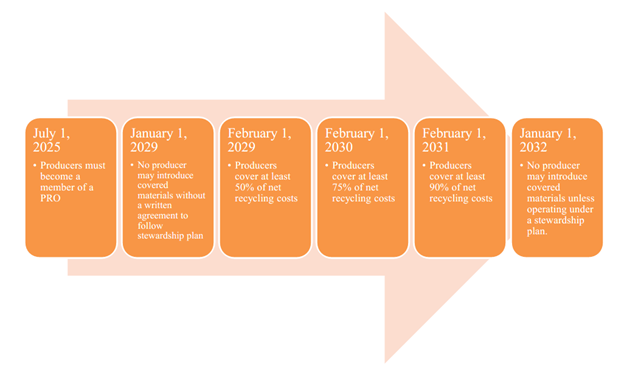
Do you use packaging? If so, you need to know about Minnesota’s new packaging law and the upcoming deadline of July 1, 2025

Minnesota is now the fifth state—joining Maine, Oregon, Colorado, and California—to pass what are called “extended producer responsibility” laws, in line with a growing trend across the country [1]. In 2024, Minnesota enacted the Packaging Waste and Cost Reduction Act[2] (the “Act”). The stated goal of this legislation is to encourage sustainable design, while addressing the environmental effects of products brought to market.

For businesses that use packaging in their products (and let’s be honest, who doesn’t?), this new law introduces important changes designed to reduce packaging waste. Businesses will need to navigate these requirements in the near future. In particular, if you are a “producer” under the Act and produce certain packaging, you must be a member of an approved “producer responsibility organization” (“PRO”) starting on July 1, 2025.[3] By January 1, 2029, if you have not joined the PRO, you cannot introduce your packaged products in Minnesota.[4]

WHO MUST COMPLY WITH THE ACT?

The Act imposes new requirements on businesses that are deemed “producers” of packaging in Minnesota. While the Act generally holds the brand owner of a product responsible for compliance, its scope includes companies that introduce packaging into the state, including licensed distributors and resellers in some circumstances.[5] This means that not only manufacturers and brand owners, but also distributors, importers, and even retailers in many cases, will be required to take action under the new law.

Under the Act, the definition of “packaging” is also exceptionally broad, encompassing more than just a visible container around a product. Packaging includes any materials used to transport, protect, market, or handle a product. This means it covers not only traditional containers but also items like pallets, strapping, cushioning, weatherproofing, coatings, labels, and even inks and dyes. Essentially, if any material plays a role in moving or marketing a product, it may be considered packaging under the Act.

Put simply, most businesses will be affected by this law. For example:

  • Electronics manufacturers;
  • Toy companies;
  • Grocery stores;
  • Clothing companies;
  • Importers that sell directly to consumers;
  • Retailers of private-label products;
  • Franchisors; and more.

That said, there are some organizations that are not affected:

  • Government agencies;
  • Nonprofit organizations that are registered 501(c)(3) charitable organizations;
  • Small local businesses with less than $2,000,000 in global sales or introduced less than 1ton of packaging into Minnesota in the last fiscal year;
  • Paper mills that exclusively use virgin wood fiber in the products they produce (e.g., a paper mill that manufactures paper using only newly harvested wood); and
  • Paper mills producing containerboard from 100% postconsumer recycled content (e.g., a facility that makes corrugated cardboard entirely from recycled paper).

In addition, there are some materials exempted from the Act, such as packaging for infant formula, medical food, fortified oral nutritional supplements, drug or medical devices, medical equipment, newspapers, and magazines. The Act also exempts from “covered materials” those that are used to contain a product that is used for the production of another product (essentially B2B sales).

Businesses will need to carefully review the Act’s definitions and forthcoming regulatory guidance, and consider all factors specific to their operations to determine whether they are required to comply with the Act. Given the complexity of the law and its broad scope, it’s important to assess your business’s role and packaging practices to ensure compliance.

What Responsibilities Do Producers Have Under the Act?

The Act establishes a program that requires producers to become members of a PRO.[6] Producers will pay annual fees to the PRO based on the amount and types of packaging they sell.[7] The PRO will provide producers with guidance on compliance with the Act.

The Act states fees paid by producers will fund at least 90% of the costs (phased in over time) related to collecting, sorting, transporting, and preparing packaging and paper products for refill, reuse, recycling, or composting.[8] “Service providers” can receive reimbursements for offering such services, which will likely be paid for in substantial part by PRO membership fees.[9]

The PRO will also develop and implement a “stewardship plan,” approved by the Commissioner of the Minnesota Pollution Control Agency, which outlines how the PRO will expand collection services and cover service and program costs.[10] Through the PRO, producers must work together to meet the program’s requirements, including specific targets for waste reduction, reuse, recycling, composting, and incorporating recycled content in their products.

In particular, the Act establishes that PROs will work with their members to ensure packaging is reusable, refillable, recyclable, or compostable by no later than January 1, 2032.[11] Below is a list of the major milestones set out in the text of the Act:

Failure to comply with the Act carries significant liability, including civil penalties. [12] In cases of willful or negligent violations, producers may even face criminal liability.[13] Thus, businesses need to be aware of these consequences and take proactive steps to comply with the Act.

KEY TAKEAWAYS

To comply with Minnesota’s Packaging Waste and Cost Reduction Act, businesses must determine whether they are a “producer” of “packaging.” Producers must meet certain deadlines, including joining a PRO by July 1, 2025. The initial approved PRO is Circular Action Alliance (CAA) — a 501(c)(3) nonprofit, producer-led organization.[14]

For further advice and detailed guidance on adjusting your business practices in light of this new law, please contact your legal team. As always, the attorneys at Winthrop & Weinstine are dedicated to assisting your business in navigating these complex regulatory changes effectively. Please do not hesitate to contact us regarding any questions or concerns regarding the Act.

We express special thanks to Eddie Brody, who contributed to the research and content of this update.


[1] See Minn. Pollution Control Agency, Packaging waste and cost reduction act (2024) (listing Maine, Oregon, Colorado, and California as the four other states to pass EPR legislation).

[2] Minn. Stat. § 115A.144–1463.

[3] Minn. Stat. § 115A.1448, subd. 1(a).

[4] Minn. Stat. § 115A.1448, subd. 1(b).

[5] See Minn. Pollution Control Agency, Packaging waste and cost reduction act (2024) (noting that a “producer” within the meaning of the Act is generally the product brand owner); see also Minn. Stat. § 115A.1441, subd. 26(a)(iii) (“. . . if there is no person to which item (i) or (ii) applies, the producer is the brand owner of the item . . . .”).

[6] Minn. Stat. § 115A.1448.

[7] Minn. Stat. § 115A.1454, subd. 1.

[8] Minn. Stat. § 115A.1455, subd. 4(a).

[9] Minn. Stat. § 115A.1454, subd. 1(6)(ii).

[10] Minn. Stat. § 115A.1447(2).

[11] Minn. Stat. § 155A.1448, subd. 1(c).

[12] See Minn. Stat. § 115A.1462; Minn. Stat. § 115.071; Minn. Stat. § 116.072.

[13] Minn. Stat. § 115A.071, subd. 2(a).

[14] See Minnesota, Circular Action Alliance, https://circularactionalliance.org/circular-action-alliance-minnesota (last visited June 19, 2025).