arrow-double-right arrow-noline-right arrow-lrg-left arrow-lrg-right arrow-med-down arrow-med-left arrow-med-right arrow-med-up arrow-sml-right checkmark close close-sml contact-card event-clock linkedin menu minus outbound-link phone plus print search-lrg search-sml twitter Winthrop-mark

Why Having Employment Counsel Is an Important Consideration for IP Lawyers

Aimée Dayhoff recently published, “Why Having Employment Counsel Is an Important Consideration for IP Lawyers,” in ABA’s Litigation Section Practice Pointers.

With the ten-year anniversary of the Defend Trade Secrets Act (DTSA) approaching, now is the time to reflect on how much the trade-secret enforcement landscape has evolved—and why the next decade will likely demand a more integrated, cross-disciplinary approach. Trade-secret misappropriation by employees is rarely just an IP problem. Treating it as one leaves leverage on the table and risks unaddressed. Partnering with employment counsel early adds strategic depth, expands enforcement options, and helps ensure that both preventive measures and litigation tactics are enforceable, defensible, and aligned with evolving public-policy constraints.

Read the full article here.

Importance of Environmental Due Diligence in Downstream Energy Property Transactions and Development

Elizabeth Schmiesing and Christopher Cerny co-authored an article entitled “Importance of Environmental Due Diligence in Downstream Energy Property Transactions and Development,” featured on the Study Groups website and the SG Voices newsletter on February 9, 2026.

This article focuses on why environmental assessments are crucial for downstream energy property development decision-making, and how liability assurances from regulators can mitigate liability for past contamination.

Read the full article here.

Innovation in Fuel Distribution: Why the R&D Tax Credit Deserves a Fresh Look

Max Shapiro and Candice Long were recently guest contributors on behalf of Matrix Capital Markets Group, Inc. to the November/December 2025 Sigma column “Innovation in Fuel Distribution.”

The article explains why companies in the fuel distribution and convenience retail sectors should consider the R&D Tax Credit—a federal incentive that can significantly reduce tax liability for investments in innovation. The article argues that fuel distributors often engage in qualifying R&D activities even if they don’t have traditional labs, because modernizing distribution systems, improving automation, developing new fuel blends, enhancing environmental and safety compliance technologies, and building custom data systems all involve technical experimentation. It outlines examples of such activities, how the credit is calculated, common misconceptions that lead firms to overlook it, and recent tax rule changes that make the credit more attractive. The piece concludes that recognizing and claiming this credit can free up capital for further innovation in the evolving energy landscape.

Read the full article here.

Clerkships are a Career Launcher Like No Other

Insights from Kyle Kroll and MSBA’s Bench + Bar

Kyle Kroll co-authored an article entitled “Clerkships are a Career Launcher Like No Other,” featured in the MSBA’s Bench + Bar on October 28, 2025.

The article emphasizes that pursuing a clerkship is one of the most valuable steps a lawyer can take in building their career. Clerkships offer exceptional benefits, including skill development, mentorship, enhanced professional reputation, improved future job prospects, and a lifelong professional network.

The Five Pillars of Judicial Clerkships

  1. Skills: Gain practical experience in legal research, writing, and decision-making.
  2. Mentorship: Receive guidance and support that often evolves into lasting professional relationships.
  3. Professional Stature: Carry the credibility that comes with a judge’s endorsement wherever your career takes you.
  4. Future Employment: Benefit from employers’ preference for former clerks, often leading to accelerated career advancement.
  5. Lifelong Community: Access a network of colleagues and mentors who provide referrals, advice, and ongoing opportunities.

Expert Perspective

Winthrop president Tami Diehm also contributed to the article, stating:

“Judicial clerkships at every level are highly regarded in both litigation and transactional work… a great way to start your career.”

To read the full article, download it here.

Transferable Tax Credit Due Diligence Checklist

Winthrop attorney Amber Peterson contributed to the Q2 2024 Transferable Tax Credit Due Diligence Checklist by David Burton, Norton Rose Fulbright; Bryen Alperin, Foss & Company; and Gary Blitz, Aon.

A due diligence checklist is an essential tool for preparing transferable tax credit transactions. It helps guide discussions, flag potential obstacles, and keep stakeholders focused on strategy, structure, and execution. Because due diligence is not one-size-fits-all, requirements often depend on the complexity of the deal, the seller’s credit profile, and their track record. This checklist outlines the standard deliverables needed for execution while highlighting how diligence expectations vary by transaction type.

To read more and download a copy of the checklist, please visit the Foss & Company website here.

Is Your Business Ready for Minnesota’s New Paid Family and Medical Leave?

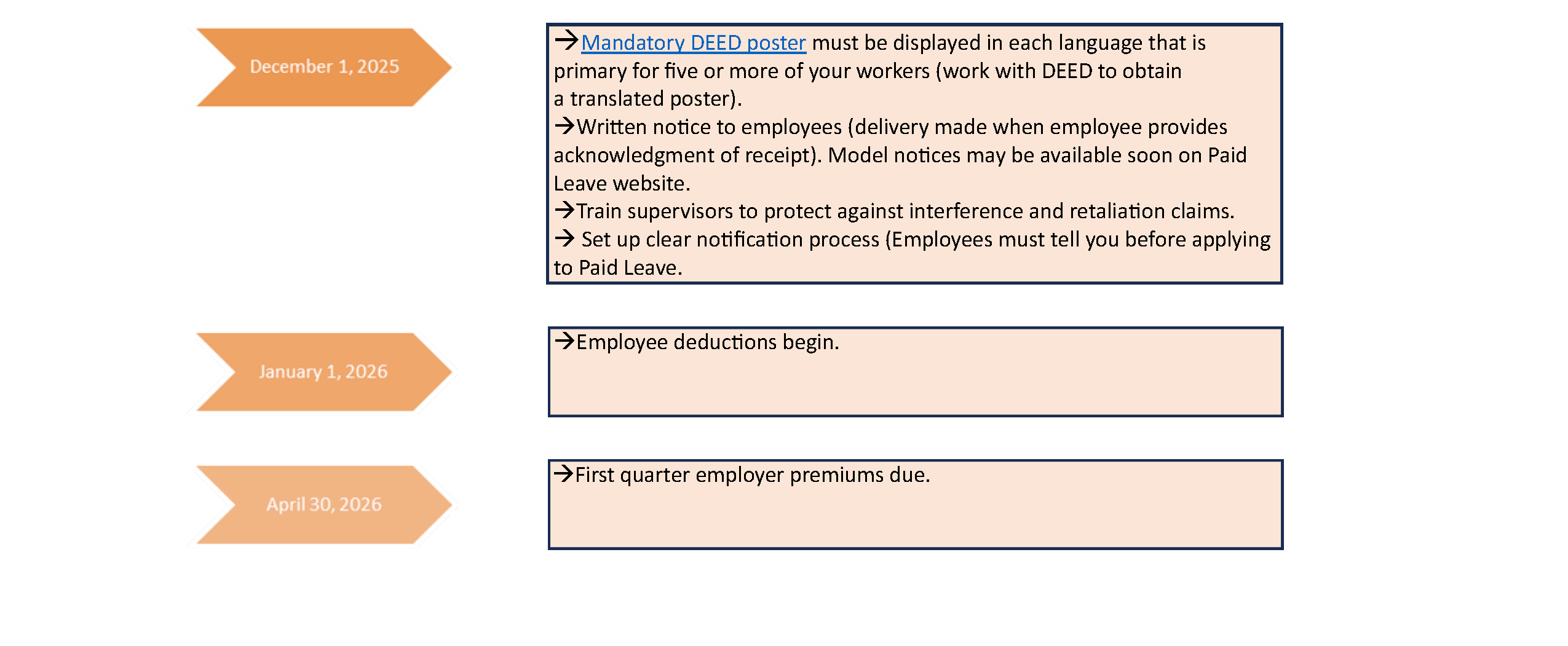
Minnesota is launching a statewide Paid Family & Medical Leave (PFL) program on January 1, 2026 – a sweeping new benefit program that will offer job-protected leave and partial wage-replacement benefits to nearly all Minnesota workers. Though benefits don’t begin until 2026, employers must act now to prepare, with compliance deadlines starting as early as December 1, 2025.

You may already be familiar with the basics — and might even have a solid grasp of what’s coming. But have you done the legwork to prepare? Let’s talk implementation strategies to avoid compliance headaches and unnecessary costs.

Program Snapshot

For a more detailed overview of the program, please refer to our previous article, Minnesota’s New Paid Family and Medical Leave Law.

Keep in Mind

Eligibility: If you are under the State plan (which is the default), the Minnesota Department of Employment and Economic Development (DEED) will review employee applications and determine eligibility. However, if you’ve opted into a private plan, then your employer or private insurance provider will handle the eligibility review instead.

Benefit Amount: This is a partial wage replacement benefit that will provide payment for up to 90% of the average weekly wage, up to a maximum weekly benefit of $1,423 (2026).

How Much Leave Is Available? Employees may be eligible to take up to 20 weeks of paid leave per benefit year — combining 12 weeks for medical leave and 12 weeks for family leave, but not to exceed 20 weeks total.

Premiums: The premium rate for 2026 is 0.88% of employee wages, with up to 50% of that cost eligible to be allocated to employees. Employers must include the employee’s share of the premium in the required notice to current employees — which is due no later than December 1, 2025.

So far, the trend among employers has been to pass along the full 50% to the employees, although some may choose to cover the entire premium themselves.

Public vs. Private Plans: If you choose to opt out of the State plan by offering a private plan with benefits that are at least as generous as the State plan — submit your request as soon as it is ready. Employers can request an Equivalent Plan Substitution through their Paid Leave Administrator account. Applications are reviewed on a rolling basis and the portal is now open. The State is suggesting that if you want a private plan to be approved and in place by January 1, 2026, your application should be submitted no later than November 10, 2025.

Taxation Considerations

Premiums: Employers may write off the amount they are required to pay into the Minnesota Paid Leave program as an excise tax, and if they choose to cover more than that minimum, the extra amount can also be written off as a regular business expense. For employees, any portion of the premium that they pay themselves is treated just like ordinary wages: it shows up on their Form W-2 and does not lower their taxable income. When an employer picks up more than the required share, that extra payment is considered additional income to the employee and is therefore subject to income and payroll taxes. If the employees itemize deductions on their federal income tax return, they may deduct this additional contribution by the employer as state income tax, subject to applicable limitations.

Taxation of Benefits: Minnesota Paid Leave benefits are generally taxable, but benefits received under family leave will be treated differently than those under medical leave. Family leave benefits are not considered wages and are not subject to employment taxes, but are reported as income. Medical leave benefits are split: half will be treated as wages (subject to income tax withholdings, Social Security, and Medicare taxes), and the other half will not be taxable as wages. Applicants for these benefits will have the option to withhold state and federal taxes from their weekly benefit.

Understanding the tax treatment of these benefits is critical for employers as it affects payroll reporting, W-2 preparation, and business tax deductions. Proper handling will ensure compliance with the tax laws and help prevent reporting errors. For more information on taxes and paid leave, please visit DEED’s published guidance.

Coordination with Existing Leave Laws:

Adding a new leave entitlement means your policies must work together — or you risk extended absences and higher costs.

If your policies are not updated, employees could stack leave benefits, extending their time off well beyond what is contemplated by this State program. To avoid these costly consequences: (i) run leave concurrently where allowable (e.g., FMLA, MN Pregnancy and Parenting Leave); (ii) align your plan years to avoid confusion and resetting of eligibility at inopportune times (note that adjusting FMLA plan year requires 60 day notice); and (iii) clarify which benefits (e.g., PTO, ESST, STD) may be used to supplement PFL income.

The bottom line is employers have options to manage the impact of this new law – but action is needed. Coordinating these leave policies will be key to cost control and workforce planning.

What Should I Be Doing Over the Next 8 Months?

Minnesota’s PFL law is a game-changer — not just for employees, but for how employers manage leave, payroll, and compliance. The timeline may feel distant, but waiting too long could mean operation disruptions and higher costs that could otherwise be avoided.

Start planning today to ensure a smooth transition and avoid being caught unprepared.

For questions, please reach out to any member of our Employment team.

Minnesota R&D Tax Credit Now Partially Refundable

On June 14, 2025, Minnesota Governor Tim Walz signed H.F. 9 into law, modifying the state’s R&D Tax Credit to make a portion refundable for the first time.

The R&D Tax Credit, officially known as the Credit for Increasing Research Activities, reduces Minnesota income or franchise tax for companies engaged in qualified research and development (“R&D”) activities performed in the state. For taxable years beginning after December 31, 2016, the Minnesota R&D credit equals:

  • 10% of excess qualifying expenses over a base amount, up $2 million, and
  • 4% of excess qualifying expenses above $2 million.

Qualifying expenses mirror those under the federal R&D credit, defined in Section 41 of the Internal Revenue Code, as modified in Minnesota Statutes 290.068, but only for research performed in Minnesota. Examples of qualifying expenses include R&D related wages, supplies and research contracted outside your business.

What’s Changing

Previously, any credit exceeding the current-year tax liability could be carried forward for up to 15 years. Under the revised statute, taxpayers may instead elect to receive a partial refund of unused credits.

Effective Date: Changes apply to tax years beginning after December 31, 2024

Refund Calculation: The refundable amount equals the excess of the credit amount multiplied by the refundability rate (Refundable Amount = Unused Credit x Applicable Refundability Rate).

Refundability Rates:

  • 19.2% for tax years beginning after December 31, 2024, and before January 1, 2026
  • 25% for tax years beginning after December 31, 2025, and before January 1, 2028
  • For tax years beginning after December 31, 2027, the refund rate will be the lesser of 25% or a projected rate published annually by December 27, designed to cap total refunds at $25 million per year.

Election Required: Taxpayers must make the election on their timely filed return (extensions included). Once chosen, the election is irrevocable for that year.

Carryforwards Remain: Any unused, non-refunded credit continues to carry forward for up to 15 years.

Key Takeaway

The partial refund feature offers an immediate cash benefit for companies with little or no current Minnesota tax liability. With the election binding for each filing year, careful planning is needed to determine whether a refund or carryforward provides greater long-term value.

If you have questions about Minnesota’s R&D Tax Credit or how these changes may affect your business, please feel free to reach out to any member of our Tax team.

Schemes or Separate Acts? Dexon’s Lesson on the Duty to Defend

Kyle Kroll recently published an article, “Schemes or Separate Acts? Dexon’s Lesson on the Duty to Defend,” in MSBA’s Bench + Bar. The article takes a detailed look at an insurer’s duty to defend, recent application of Minnesota law, and practical considerations following the Eighth Circuit’s decision in Dexon Computer, Inc. v. Travelers Property Casualty Company of America.

Read more about the case and the implications of the decision in full: Bench & Bar of Minnesota.

Transformation and New Purpose: How Courts Are Applying Fair Use After Goldsmith v. Warhol

This article was first published with the ABA, Section of Litigation, Intellectual Property Committee, at this link.

In May 2023, the U.S. Supreme Court’s decision in Andy Warhol Foundation for the Visual Arts, Inc. v. Goldsmith[1] reshaped the understanding of the primacy of “transformative” use in copyright law. The case centered on whether Andy Warhol’s orange silkscreen artistic adaptation of Lynn Goldsmith’s photograph of Prince was sufficiently transformative to favor application of the fair use defense.

The Supreme Court ruled that Warhol’s use, although transformative in some ways, did not dictate that the purpose and character of Warhol’s use favored the defense. Rather, because Warhol’s purpose was substantially similar to Goldsmith’s original purpose—both were commercial in nature—the first fair use factor did not favor Warhol despite his expression. The Supreme Court thus clarified that transformation by adding expression or meaning is not necessarily dispositive of the first fair use element as some courts had held or implied.

Since the Goldsmith decision, appellate courts have focused more closely on whether a new work truly has a further purpose or different character, as well as the purpose and nature of the use (especially if it is commercial). These early decisions show that courts are seemingly hesitant to find that the first fair use factor favors the defense.

Philpot v. Independent Journal Review[2]

The Fourth Circuit was the first federal appellate court to apply Goldsmith in depth. In its Philpot opinion, the Fourth Circuit addressed whether the use of a photograph of musician Ted Nugent in a news article constituted fair use. The court applied the Goldsmith ruling and reversed the district court’s grant of summary judgment to the defendant. In doing so, the court highlighted that the defendant “did not alter or add new expression to the Nugent Photo beyond cropping the negative space,” which was “less of a case for ‘transformative use’ than the Andy Warhol Foundation [had].” In addition, both the original photograph and its new use in the defendant’s article served the same commercial purpose: “to depict ‘The Nuge’” for profit. Thus, the first fair use element did not favor the defense.

Griner v. King[3]and Designworks Homes, Inc. v. Columbia House of Brokers Realty, Inc.[4]

Shortly after Philpot, the Eighth Circuit applied Goldsmith to a case involving use of the “Success Kid” meme in an advertisement for now-former Congressman Steve King (IA-4). King’s Committee had posted a version of the meme on his website and social media accounts when seeking donations. The Eighth Circuit discussed Goldsmith in depth and affirmed the jury’s determination that the fair use defense did not apply. In particular, the Eighth Circuit emphasized that it was undisputed the Committee’s use was “purely commercial” because the use solicited campaign donations. This commercial purpose was similar to the purpose in copyrighting the image of “Success Kid,” and the Committee’s use did not have a further purpose or different character. Thus, the first factor did not weigh in favor of fair use.

Subsequently, the Eighth Circuit issued a decision in Designworks Homes, affirming summary judgment in favor of real estate agents and associated defendants who included copyrighted floorplans in resale listings that such use constituted fair use. In contrast to King, the defendants in Designworks Homes used the floorplans for informational purposes for potential buyers, whereas the designs themselves had been originally purposed on facilitating construction of the homes that later went up for resale. “Use of the designs thus yielded end products with functional and aesthetic benefits, while use of the floorplans identified and advertised those products and benefits.” Although both uses had a connection to commerce, the subsequent floorplan uses did not displace the original designs or any derivative works in the market. Thus, the Eighth Circuit agreed that the first fair use factor favored the defense.

Hachette Book Group, Inc. v. Internet Archive[5]

Following King, the Second Circuit affirmed summary judgment that the Internet Archive’s simple conversion of print books to digital formats was copyright infringement and not fair use. The court held that the conversion—which did not provide criticism, commentary, or new features or information—did not qualify as transformative, citing the Goldsmith decision. The Second Circuit explained that merely shifting a work to a new format is not transformative. Mere repackaging does not equate to a distinctly new, let alone transformative, character and purpose. However, the Second Circuit departed from the district court and held that the Internet Archive’s use was not commercial because the archive distributes digital books for free as a nonprofit entity and did not profit directly from any such use. Although the Internet Archive generally collects donations on its site, the connection between the use at issue and the donations was too attenuated. Still, the absence of any transformation showed the first factor did not favor fair use.

Keck v. Mix Creative Learning Center, L.L.C.[6]

After Hatchette Book Group, and in a slightly different application of Goldsmith, the Fifth Circuit affirmed summary judgment for the defendant that the sale of art kits teaching children to recreate certain artists’ works was transformative and entitled to a fair use defense. The court emphasized that while the kits had some commercial purpose, their educational function significantly altered the context in which the original works were copied; “the art kits had educational objectives, while the original works had aesthetic or decorative objectives.” This case highlights that when the new work serves a distinct and non-commercial purpose—such as education—it may still be considered transformative, even if it generates profit.

CONCLUSION

As these cases show, the Goldsmith decision appears to have narrowed the role that transformation plays in the fair use analysis. Courts will now scrutinize whether the new work serves a purpose similar to the original, in addition to whether it introduces new meaning or expression. Creators may face greater challenges in arguing that their adaptations qualify as fair use, particularly when the new work serves a commercial purpose.

[1] 598 U.S.C. 508 (2023).

[2] 92 F.4th 252 (4th Cir. 2024).

[3] 104 F.4th 1, 10 (8th Cir. 2024).

[4] 126 F.4th 589 (8th Cir. 2025).

[5] 115 F.4th 163 (2d Cir. 2024).

[6] 116 F.4th 448 (5th Cir. 2024).