arrow-double-right arrow-noline-right arrow-lrg-left arrow-lrg-right arrow-med-down arrow-med-left arrow-med-right arrow-med-up arrow-sml-right checkmark close close-sml contact-card event-clock linkedin menu minus outbound-link phone plus print search-lrg search-sml twitter Winthrop-mark

From Lottery to Launch: What Comes Next for Minnesota Cannabis Licensees

On June 5, 2025, the Minnesota Office of Cannabis Management (“OCM”) held its first lottery for applicants seeking cannabis business license types that are available in limited quantities. This marks the first grant of potential licenses to 249 applicants for cultivator, manufacturer, retailer, and mezzobusiness licenses.  A second lottery for retail licenses is scheduled for late July.  In addition, over the coming weeks, applicants for “uncapped” license types—such as the popular microbusiness license—will continue to receive word about preliminary license approval.

These lotteries mark the most significant milestones to date for aspiring cannabis entrepreneurs seeking to become legitimate licensed cannabis businesses. However, additional regulatory and operational hurdles loom, even after preliminary licenses are awarded. Retail licensees and endorsement holders must now tackle zoning compliance, secure suitable property, and navigate local municipal regulations before passing a state inspection and ultimately opening their doors to their cannabis business—all of which must be completed in 18 months.

Securing Property

Acquiring property for a new business is already difficult, but for licensees with retail privileges, Minnesota’s regulations require an additional layer of regulation and complications.

First, preliminary licensees need to determine where they will be allowed to operate. Although municipalities cannot wholly prohibit cannabis businesses in their respective jurisdictions, local governments do have the authority to limit the time, place, and manner of cannabis business operations via ordinance.

Next, preliminary licensees need to pay close attention to all lease provisions they sign. Due to the federal illegality of cannabis, standard contract clauses that would be acceptable in other industries could be problematic for a cannabis business. Many template leases were drafted to prohibit the type of behavior cannabis businesses now require—including, for example, provisions limiting odor and prohibiting (federally) illegal activity.

Lastly, cannabis entrepreneurs need to be aware of the many statutory and regulatory requirements that impact whether a space will be suitable for their retail or cultivation needs. Minnesota law contains express requirements regarding security enhancements, lighting, display limitations, and delivery and customer entry points, in addition to other standard building codes.  Such necessary leasehold improvements may require hefty investment by licensees to ensure compliance, and tenants should be aware of lease terms that may impact their ability to make essential improvements to the space they are renting.

Municipal Approval

Once a licensee has secured a property, the next step requires thoughtful planning and intentional collaboration with local government. Retail cannabis businesses must register with the city, town, or county in which the business is located. However, Minnesota law allows municipalities to limit retail cannabis businesses to “no fewer than one registrations for every 12,500 residents,” which, in many parts of Minnesota, effectively limits retail businesses to only one active registration per town.

In addition to municipal registrations, licensees may need to obtain conditional use permits (CUPs) to establish that their intended operation is permissible in the chosen location. This process may involve public hearings, city council meetings, and other close coordination with city planners and zoning officials.

Thus, in order to swiftly navigate a patchwork of varying municipal processes, licensees will require positive, collaborative relationships with municipal governments to understand and navigate any hurdles posed by local ordinances and state regulations. The attorneys at Winthrop & Weinstine, P.A. understand the complex intersection of real estate, regulation, and municipal government relations, and are prepared to guide preliminary licensees through the process of becoming licensed cannabis businesses—from site selection to business opening and beyond.
Tariffs Ruled Unlawful but Still in Force — 5 Things General Counsel Should Do Now

On May 29, 2025, the U.S. Court of International Trade (CIT) ruled that the tariffs imposed by President Trump under the International Emergency Economic Powers Act (IEEPA) exceeded the statutory authority granted to the executive branch. The court found that trade imbalances and related economic concerns do not constitute the “unusual and extraordinary threat” required to justify use of IEEPA, rendering the tariffs unlawful.

However, the U.S. Court of Appeals for the Federal Circuit has issued a stay, allowing the tariffs to remain in effect while an appeal to the CIT ruling proceeds. The next key event is a hearing scheduled for June 5, 2025, at which the court will consider arguments related to the stay and the merits of the appeal.

Strategic Priorities for General Counsel

  1. Prepare for Potential Duty Recovery
    Ensure your company has preserved documentation of all tariff payments on covered imports. If the CIT’s ruling is ultimately upheld, companies could be eligible for significant refunds, but only if their records are in order and claims are timely filed.
  2. Evaluate Contract Exposure and Supply Chain Strategy
    Review procurement and manufacturing agreements that may be impacted by tariff relief. Now would be a good time to reassess supplier diversification, pricing structures, and risk allocation provisions in anticipation of future shifts in trade policy.
  3. Monitor Legislative Action to Curb Executive Tariff Authority
    The Trade Review Act of 2025, introduced by Senators Maria Cantwell (D-WA) and Chuck Grassley (R-IA), seeks to limit presidential tariff powers by requiring congressional approval for tariffs lasting beyond 60 days and requiring the President to notify Congress within 48 hours prior to enacting such tariffs. If enacted, this legislation could create a more stable policy environment, but law departments should track its progress closely and tailor response plans accordingly.
  4. Advise Executive Leadership on Scenarios and Implications
    General Counsel should brief executive teams on the potential business impacts of both outcomes (continued tariffs or a court-ordered rollback). Consider preparing internal memoranda, board updates, or public disclosure language as appropriate.
  5. Engage Outside Trade Counsel Strategically
    Trade specialists can help preserve refund rights, evaluate compliance exposure, and guide tactical responses depending on how the appeal unfolds. Proactive engagement is especially critical if your company is a high-volume importer.

If you have any questions or would like to assess how these developments may impact your business, evaluate refund opportunities, or develop a customized trade compliance strategy, please feel free to reach out to any member of our Corporate team.

Legislative Top 5 – May 23, 2025

Regular Session Ends

The Minnesota Legislature adjourned the 2025 Regular Session on Monday night, but a special session looms on the horizon as legislators failed to pass a complete budget. Despite meeting through the weekend and on Monday, little progress was made to get to final resolution. Each caucus held a press conference or media availability on Monday, and while their specific messages differed, each pointed fingers at others as the reason for the deadlock. Of course, the blame game matters little to those who count on the legislature to get their work done.

Several Bills and Budgets Passed

A complete list of passed laws is available on the Office of the Revisor of Statute’s website. Significant policy and budget bills that were passed include:

  • Agriculture, Broadband and Rural Development Budget and Policy (H.F. 2446)
  • State and Local Government and Elections Budget and Policy (S.F. 3045)
  • Cannabis Policy (S.F. 2370)
  • Housing and Homelessness Budget and Policy (S.F. 2298)
  • Judiciary Policy and Budget (H.F. 2432)
  • Legacy Finance (H.F. 2563)
  • Veterans and Military Affairs Budget and Policy (S.F. 1959)
  • Pensions (S.F. 2884)
  • Unemployment Insurance Funding for School Workers (H.F. 1143)
  • Human Services Policy (H.F. 2115)
  • Workers Compensation Advisory Council Recommendations (H.F. 3228)

Most of the Budget Didn’t Pass

If the legislature is unable to pass a complete budget in a special session by June 30, the following budget jurisdictions may face a shutdown:

  • Commerce
  • Education (K-12, Higher Education)
  • Energy
  • Environment / Department of Natural Resources
  • Health / Human Services
  • Department of Employment and Economic Development (DEED)
  • Transportation
  • Taxes
  • Capital Investment

Special Session Expectations

Governor Walz has expressed his hope to have the budget passed by June 1, which is when layoff notices would begin to be sent pending a government shutdown. The current budget expires after June 30, and any agencies for which a budget has not been passed by that date would face a shutdown beginning on July 1. The Governor has stated that he will call a special session after agreement is reached on all of the budget areas, with the expectation that the special session will be 1-3 days in length.

What Progress Has Been Made

Despite a deadline imposed by leadership of 5:00 p.m. on Wednesday, May 21, for work to be completed on all outstanding budget bills, many of the bills are still being negotiated. Most of the negotiations are taking place behind closed doors. Following are updates that have been made publicly available:

  • Taxes – A working group has been holding public meetings and exchanging offers. They have yet to find agreement.
  • K-12 Education Policy – Agreement has been reached on various K-12 policy provisions. Further information can be found here: Education Finance – 5/22/2025 (mn.gov) Negotiations continue on additional issues.
  • Jobs/Workforce/Labor – Agreement has also been found for these areas. While final language is not available, summaries of the agreement and detailed information can be found here: Workforce, Labor, and Economic Development Finance and Policy – 5/22/2025 (mn.gov)
  • Human Services – Held one public meeting but has not reached agreement.
  • Commerce – A signed agreement among working group members has been posted on social media, but details have not been publicly released.
  • Higher Education – A signed agreement among working group members has been posted on social media, but details have not been publicly released.

Legislative Top 5 – May 16, 2025

Governor and Legislative Leaders Agree to Budget Targets

On Thursday of this week, the Governor and legislative leaders announced that they had reached agreement on budget targets, a copy of which can be found here. While this deal is welcome, it comes too late for any realistic hope that the budget work will be completed by the constitutional adjournment deadline of Monday, May 19, at midnight. Conference committees still need to work through many smaller issues, both spending- and policy-related. A special legislative session will be necessary to finish the Legislature’s work.

Health Care for Undocumented Immigrants

The Governor and legislative leaders have been negotiating for weeks — a major sticking point in these negotiations was whether to eliminate undocumented immigrants from eligibility for MinnesotaCare, the state’s health insurance program for low-income residents. Republicans supported the elimination and DFLers generally opposed it. While MinnesotaCare eligibility for undocumented immigrants began January 1, 2025, the budget agreement reached by the Governor and legislative leaders yesterday would end this eligibility on December 31, 2025. However, coverage for undocumented children will continue.

Budget Agreement Opposed

Passing undocumented immigrants health care into law was touted as a major accomplishment of the 2023-2024 DFL Trifecta, so its current elimination is controversial. Speaker Emerita Melissa Hortman (DFL-Brooklyn Park), who signed the budget agreement, acknowledged that it was a very emotional issue for her caucus. House and Senate members of the People of Color and Indigenous Caucus held their own press conference and passionately opposed eliminating health care for undocumented immigrants. It remains to be seen how this opposition will impact passage of the omnibus budget bills and the implementation of the budget agreement.

Tax Bill Update

With only three days left in the legislative session, neither the House nor the Senate have held a floor debate or passed an Omnibus Tax Bill. The House Omnibus Tax Bill, H.F. 2437, was scheduled to be heard on the House Floor on Tuesday, but it was pulled at the last minute. Since tax bills must originate in the House, the Senate is unable to pass its version of the bill, S.F. 2374.  It is likely that the Omnibus Tax bill will be addressed in a special session.

Special Session and 2026 Legislative Session

Legislative leaders have indicated that they hope to hold a special session on Thursday, May 22, to pass any omnibus bills that aren’t approved by Monday’s deadline. Also, it was announced this week that the 2026 Legislative Session will convene on February 17, 2026. We’ll see you there!

Legislative Top 5 – May 9, 2025

Budget Status Summary

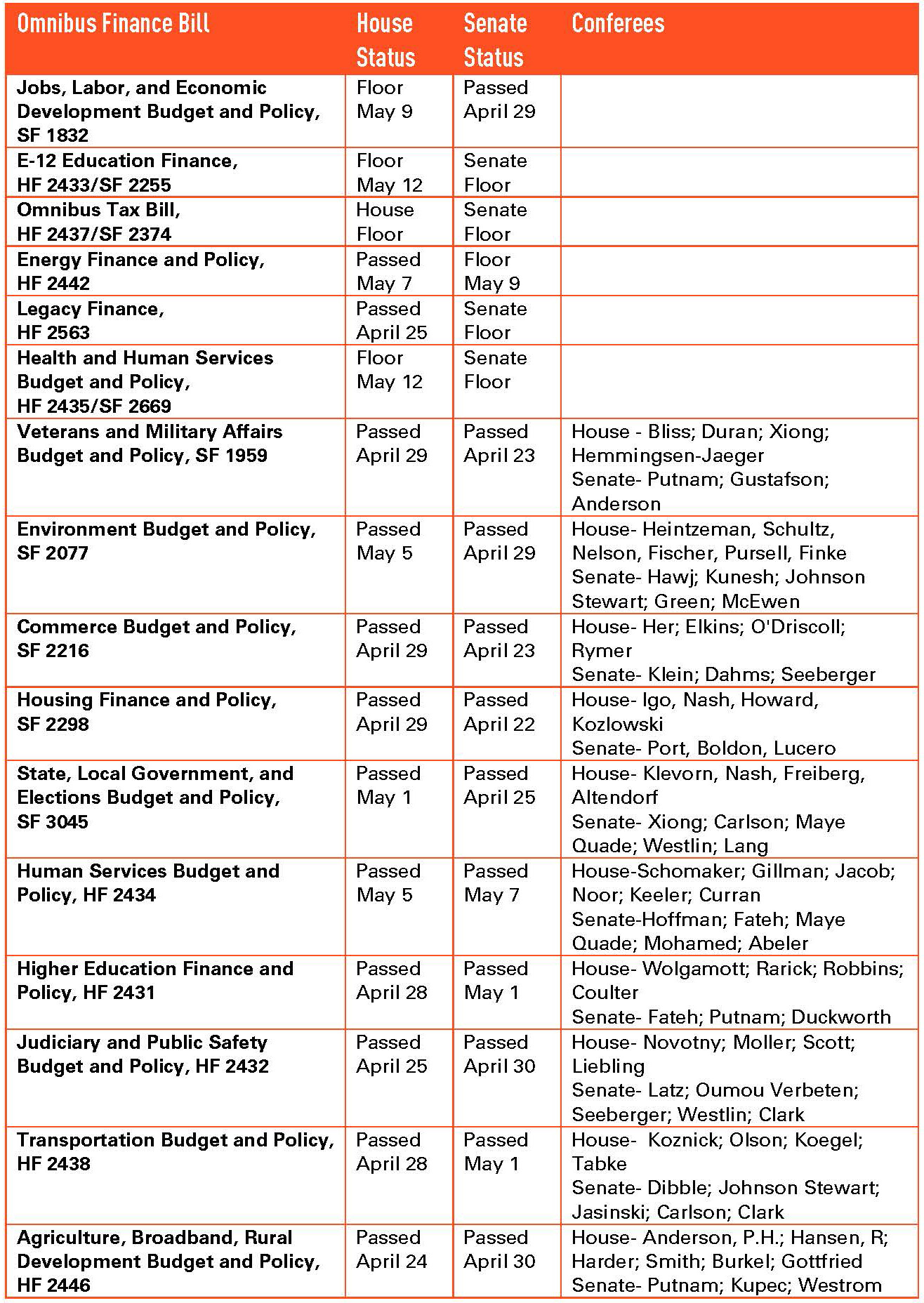
With the end of the 2025 legislative session fast approaching, legislators are working to approve the omnibus finance bills necessary to implement a FY 2026-2027 Biennial Budget. Legislative leaders and the Governor continue to work behind closed doors on global targets with rumors swirling that a deal is within grasp. However, as you can see from the chart below, the House and the Senate have yet to pass a number of major finance bills as of this writing (May 9).

Non-Controversial House Tax Bill

With the House tied at 67-67 between Republicans and DFLers, it should come as no surprise that the House Tax Committee this week passed a non-controversial Omnibus Tax Bill. The bill is a collection of no- or low-cost provisions and policy tweaks across tax types advocated for by various stakeholders and interest groups. Working with only a $40 million target for FY 2026-2027, the Tax Committee’s options were limited.

Senate Tax Bill Includes Revenue Raisers

While the House pieced together a bill that could pass a tied chamber, the Senate used a higher budget target to assemble a bill that raised new revenue, combined with cuts to certain tax spending. The Senate bill raises $317 million in general fund revenue and includes $48 million in reductions to aids, credits, and other expenditures to equal a $365 million budget target. The main sources of revenue include a new social media excise tax, an increase in the net investment income tax rate, and a lowering of the net operating loss deduction limit. The Senate cuts Local Government Aid, County Aid, the Film Credit, and the Sustainable Forest Incentive Payment Program.

Changes to Employer Mandates in Play

Changes to employer mandates are part of the negotiations for global budget targets. Modifying employer mandates, which passed during the DFL trifecta’s majority in 2023 and 2024, has been a priority for the business community and Republicans this legislative session. While Republican leaders are attempting to negotiate a more workable definition of “family” under the new paid family leave law, a bipartisan group of Senators this week passed off the Senate Floor key changes to the new earned sick and safe time (ESST) law. The Senate Bill, which still must pass the House, exempts farms with five or fewer employees from the mandate along with all businesses with less than four employees.

Senate Releases Bonding Framework

The Senate Capitol Investment Committee on Thursday held a hearing on a $1.35 billion Bonding Bill. The proposal, released as a spreadsheet, primarily included initiatives from the Walz Administration along with the University of Minnesota and the MNSCU systems. The proposal did include a $459 million placeholder for local projects but it did not name the projects.

General Counsel Checklist: Tariffs and SEC Disclosures

As global trade tensions escalate following the Trump administration’s proposed sweeping tariffs on imports, public companies face renewed pressure to ensure that securities disclosures adequately capture evolving risks. The unpredictability of these developments, combined with their potentially material impact, requires careful evaluation of disclosure practices — particularly in the risk factors and forward-looking statements sections in their quarterly and annual reports.

Although many calendar year issuers updated their Form 10-Ks to address tariff concerns earlier this year, the scope and detail of the administration’s tariff plans have sharpened since then.  Companies directly exposed to global supply chains or importing significant product volumes should assess whether subsequent quarterly reports on Form 10-Q merit further updates. This includes not only risk factors disclosures, but also disclosures in the Management’s Discussion and Analysis (MD&A) section, where known trends and uncertainties must be discussed.

Private companies planning initial public offerings or public companies contemplating equity financing issuances should anticipate similar challenges, as registration statements will be scrutinized for sufficient disclosure regarding tariff exposure and the potential impact on the results of operations and financial position. General Counsel and Investor Relations teams should also prepare for heightened investor and analyst focus on tariffs during earnings calls, which may demand careful messaging to avoid misstatements and mitigate litigation risks.

While the SEC has not issued specific guidance on tariff-related disclosure to date, prior guidance on recent macroeconomic events, including guidance on COVID-19 and Russia’s invasion of Ukraine, have stressed the importance of reliance on robust disclosure controls and candid communication about all relevant risks, both actual and potential. Companies are well-advised to avoid innovating or minimizing these risks and instead adhere to established disclosure frameworks designed for volatile and uncertain conditions.

Below is a “mini-checklist” that General Counsel and CFOs can use to begin thinking about how to frame risk exposure to tariffs in their upcoming SEC filings:

  • Risk Factors:
    • Assess Material Changes: How have tariffs impacted your existing risk factors?  If there are material changes to any of the existing disclosures, revise them to reflect the new post-tariff commercial landscape.
    • Avoid Hypothetical Language: Have tariffs already impacted the company?  If so, frame your disclosures around actual, materialized events rather than potential risks.
    • Tailor Disclosures: Ensure risk factors are specific to the company’s circumstances, detailing how tariffs affect operations, supply chains, or financial performance.
    • Consider Indirect Impact: Other than direct risk exposure, what types of indirect or “second-level” impact could tariffs have on the company’s operations, employees, assets, or other investments in the affected countries?
    • Don’t Forget About Governance: Separate and apart from financial disclosures, how might new and future tariff policies impact governance and management processes?  Has the board’s role in risk oversight changed? Have new committees of the board of directors been formed? Have new management positions been created and, if so, how might that impact your exposure to key employee retention risk?
  • Management’s Discussion and Analysis (MD&A):
    • Discuss Known Trends: Address how tariffs have impacted or are expected to impact the company’s financial condition, results of operations, and cash flows.
    • Operational Adjustments: What changes have been implemented in sourcing, manufacturing, or pricing strategies in response to tariffs?
    • Forward-Looking Information: What are management’s expectations regarding how tariffs will affect future performance, including potential mitigation strategies?
  • Financial Statements:
    • Evaluate Accounting Implications: Consider whether tariffs have led to impairments, changes in inventory valuation, or other accounting adjustments that should be reflected in the financial statements.
    • Subsequent Events: Determine if tariff-related events occurring after the balance sheet date require disclosure as subsequent events.
  • Earnings Releases and Calls:
    • Consistent Messaging: Ensure that public statements about the impact of tariffs are consistent with prior disclosures in SEC filings to avoid misleading investors.
    • Cautionary Language: Use appropriate cautionary statements when discussing forward-looking information related to tariffs.  How should your safe harbor language in the forward-looking statements disclaimer be updated to reflect tariff-related risks?  To the extent possible, ensure consistency in these disclaimers across previously filed 10-Qs, 10-Ks, and investor presentations.

We are assisting our clients across industries to evaluate disclosure adequacy, develop risk disclosure language, and prepare for stakeholder communications. Feel free to reach out to us if you need help developing customized, tailored disclosures for your SEC reports.

Legislative Top 5 – May 2, 2025

State of Affairs

With the constitutionally-mandated end of session just over two weeks away (Monday, May 19), much work remains to be done in order to pass a two-year budget. The first conference committee appointments have just been made, but no conference committees have even had an opportunity to schedule a meeting yet, and several bills have not yet passed off both floors. Further, a global budget agreement has yet to be made between the Governor and leaders from the House and Senate. Until that happens, conferees won’t be able to make final decisions on their budgets. Tax and bonding bills remain elusive, with neither body releasing one as of today. If the legislature fails to pass a complete budget by Midnight on May 19, a special session will have to be called to complete the work. Minnesota’s current budget expires on June 30, and if there is no budget in place at that time, Minnesota will face a government shutdown. There is still a path to avoid a special session, but time is starting to run short.

Education and Workforce Bills Highlight Difficulties

As the tied House of Representatives has passed most budget bills, many committee co-chairs have acknowledged that the bill would have looked very differently if left to their own devices, however the co-chairs were able to work together effectively to pass a bipartisan bill. Despite this cohesion, some bills have stumbled. After passing out of both the Education and Ways and Means committees, DFL members of the Rules Committee initially refused to calendar the education omnibus bill earlier this week, explaining that their caucus needed more time. The bill has since been calendared (it is scheduled for the floor on Monday), but it serves as a good reminder that a tied House can prove difficult to navigate. Likewise, after only being released last night, the House Workforce and Labor Omnibus bill was pulled from today’s Ways and Means agenda with no explanation or timeline for future action.

Earned Safe & Sick Time Changes

A bipartisan bill to make modest changes to Minnesota’s new Earned Safe and Sick Time (ESST) law has made its way to the Senate floor. S.F. 2300, authored by Sen. Judy Seeberger (DFL-Afton), would, among other minor changes, make adjustments to the effect on employers who offer a more generous leave policy. A key provision to limit the application of the law on small businesses of a certain size was removed at the last minute in the Rules Committee. The law currently affects all businesses with more than one employee, and the Seeberger bill would not change that.

Heintzeman Wins Special Election

Republican Keri Heintzeman of Nisswa won the Tuesday, April 29 Special Election for Minnesota Senate District 6 with 60.27% of the vote. In this strongly Republican-leaning district, she easily defeated DFLer Denise Slipy, who received 39.59%. The special election was prompted by the resignation of former Republican Senator Justin Eichorn, who stepped down in March following his arrest in a Federal sting operation related to the attempted solicitation of a minor. Senate District 6 encompasses parts of Cass, Crow Wing, and Itasca counties, including cities such as Brainerd, Grand Rapids and Nisswa.

Craig Jumps into U.S. Senate Race

Democratic U.S. Representative Angie Craig announced on Tuesday that she intends to run for the U.S. Senate Seat being vacated in 2026 by incumbent Democratic Senator Tina Smith. Craig joins Lieutenant Governor Peggy Flanagan and former State Senate Minority Leader Melisa Lopez Franzen in vying for the DFL endorsement. Craig’s run could open up a competitive race for her 2nd Congressional District seat. Former DFL State Senator Matt Little has already announced his candidacy and State Senator Matt Klein (DFL-Mendota Heights) is expected to announce his candidacy in the next few weeks. Former Minneapolis DFL Vice Chair Mike Norton has also said he plans to run for Craig’s seat. On the Republican side, Craig’s two-time Republican opponent Tyler Kistner is expected to announce that he will run for the seat. Several other prominent names, including current legislators, are also rumored to be considering a run.

Legislative Top 5 – April 25, 2025

It’s All Budget Bills

Following a weeklong break for Passover and Easter, the legislature is back to work and quickly moving omnibus bills through the legislative process. Finance committees had to pass their two-year budget recommendations before break. This week, those bills have been passing through the Senate Finance Committee and the House Ways and Means Committee, with each body even passing a handful of them off the floor. The expectation is that budget bills will be mostly passed out of each body a week from now, allowing conference committees to start meeting and negotiating a final budget.

With the tied House of Representatives, there are a few budget bills that have not yet been agreed to by both co-chairs. Those committees passed a shell bill to Ways and Means, and once the co-chairs have an agreement, they will meet in their committee of jurisdiction to walk through the bill, take testimony, and entertain possible amendments. After that, the language that is agreed to by the committee will be amended into the bill waiting in Ways and Means. Bills that have not been agreed to include the Health and Workforce Development bills.

Governor Delivers State of the State

Governor Tim Walz delivered his State of the State address on Wednesday of this week to a joint session of the House and the Senate. In a speech that lasted less than 30 minutes, the Governor touted his accomplishments for the last six years, took President Trump to task for “chaos” in Washington, D.C., and implored Republican legislators to collaborate with him to balance the state budget.

Governor Walz characterized his biennial budget proposal as protecting past ambitious investments “by embracing a spirit of responsibility and addressing some long-term budget challenges so that future leaders don’t have to make impossible choices.” In the GOP response, Republican leaders reminded the media that DFLers “squandered” an $18 billion surplus and then pledged to work with the Governor and DFL legislators to balance the budget without raising taxes.

Elon Musk’s X Sues Minnesota Over Deepfakes Law

Elon Musk’s social media company, X (formerly Twitter), has filed a federal lawsuit against Minnesota, challenging the constitutionality of the state’s 2023 law that criminalizes the dissemination of AI-generated deepfakes intended to influence elections. Minnesota’s law prohibits the knowing distribution of deepfakes within 90 days of an election if the content is intended to sway the election outcome or damage a candidate’s reputation.

In its lawsuit, X contends that the law infringes upon First Amendment rights by being overly vague, leading to potential over-censorship of protected political speech. The Minnesota Attorney General’s Office has acknowledged the lawsuit and stated that it is reviewing the complaint.

Special Election to Fill Eichorn Seat

The Minnesota Senate District 6 special election is scheduled for Tuesday, April 29 to fill the vacancy left by Republican Justin Eichorn, who resigned on March 20 following his arrest on federal charges related to attempting to solicit a minor for sex. Republican Keri Heintzeman of Nisswa secured the GOP nomination by winning 46.77% of the vote in a crowded primary field of eight candidates in an April 15th Primary. DFLer Denise Slipy of Breezy Point ran unopposed in the DFL primary.

Lots of Effort, Little to Show

Members of the Minnesota House of Representatives have already introduced 3,250 bills as of today. This is despite the fact that the House started weeks late, and the first bills weren’t officially introduced until February 6. The Senate has introduced a slightly higher number of bills—3,445 bills as of today. Adding these together, 6,695 bills have been introduced. Why is this interesting? On April 22, just the fifth bill of legislative session was presented to the Governor for his signature. A list of the bills presented to the Governor can be found here.

Legislative Top 5 – April 4, 2025

Deadlines!

It has been a busy week at the State Capitol. In both the House and Senate, committees raced to meet the first and second bill deadlines of Friday, April 4 (collectively), while finance committee chairs in both bodies met behind closed doors to work on omnibus finance bills. The Senate DFL majority released budget targets last Friday, March 28, and the Republicans and DFLers in the tied House released agreed-upon targets a day later. A comparison of these targets can be found here.

Data Center Update

A new data center bill was introduced in the House, H.F. 2928, establishing new regulatory requirements for the siting and operation of large-scale data centers in this state, including provisions governing water use, energy use and cost allocation, and environmental review. The bill also requires data centers to pay an annual fee, to be used for weatherization and energy conservation programs in low-income households. Rep. Patty Acomb (DFL–Minnetonka), the bill’s author, said the bill was shaped by similar laws enacted in Indiana, Nevada, and Texas, and reflected lessons learned by Virginia from its more “hands-off” approach. The bill was laid over for possible inclusion in an omnibus energy bill.

Social Media Tax Proposed

 As Minnesota faces a looming budget deficit, Senate Tax Chair Ann Rest (DFL-New Hope) is proposing a new tax on social media companies (S.F. 3197) to raise additional revenue. Though the Minnesota Department of Revenue estimates the tax would only impact 15 companies, many businesses worry that they may be inadvertently caught up in the legislation. Others worry that as technology changes over time, the lines between social media companies and others may become nearly indistinguishable and that they may face a new tax liability. House Republicans continue to argue that the state should not impose new taxes this year. Stay tuned for additional updates.

Upcoming: Budgets, then Break

In both the House and Senate, committee budgets will likely be released as early as this weekend, as each must be passed out of their respective committees by noon on Friday, April 11. Passage of the Senate bills seem simple at this point as compared to the House, where Republican and DFL co-chairs must quickly find agreement. Following committee passage of the omnibus finance bills, a legislative break will begin. There will be no committee meetings or floor session from noon on April 11 until noon on April 21. Pending any surprising news, our weekly “Top 5” updates will also be on break during that time.

Special Session Talk Expands

 While many have speculated that a special session may be needed to finish the budget-making process this year, conversations have also begun on the potential need for a late summer or fall special session to address funding needs brought on by changes at the federal level. Cuts to various agencies and programs could bring about such activity, most notably with respect to the potential cuts to the Medicaid program.

FinCEN Exempts U.S. Companies from CTA Reporting — But Legal Uncertainty Remains

Key Development: FinCEN Limits CTA Reporting to Foreign Entities — For Now

On March 21, 2025, the Financial Crimes Enforcement Network (FinCEN) issued an interim final rule (IFR) that significantly narrows the reporting requirements under the Corporate Transparency Act (CTA). Under the IFR, only foreign entities registered to do business in the United States are required to report beneficial ownership information (BOI) to FinCEN.

FinCEN accomplished this by revising the current regulation and removing the term “domestic reporting company” from the definition of entities required to report and instead placing domestic entities within the list of exemptions. The result is that U.S.-formed companies (e.g., corporations, LLCs) are now, according to FinCEN, excluded from the CTA’s reporting obligations.

Statutory Conflict: Why Uncertainty Remains

Although FinCEN has issued this regulatory change, the underlying statute—the Corporate Transparency Act—was not amended and still explicitly requires reports from domestic reporting companies. FinCEN’s rule contradicts the statute and creates uncertainty; there is a likelihood of legal challenges to this reinterpretation—particularly in an environment where courts are no longer required to defer to agency interpretations that contradict clear statutory text. In other words, the IFR does not override the law enacted by Congress. Accordingly, its effort to exempt domestic entities may be struck down by the courts.

Our Recommendation: File If Prepared, Monitor If Not

Given this uncertainty, we believe it is prudent for businesses to consider the risks of noncompliance with the CTA, particularly if they have already incurred costs collecting beneficial ownership information.

  • If you have already gathered BOI and are ready to file, we recommend moving forward with filing. It may help avoid future penalties if the IFR is overturned or revised.
  • In addition, you may elect to wait and monitor legal developments—but do so understanding the current conflict between the CTA and the IFR

Current Reporting Landscape: Foreign Entities Must Still Comply

FinCEN’s interim final rule redefines “reporting company” to include only foreign entities formed under the laws of a foreign country and registered to do business in a U.S. state or tribal jurisdiction.

These entities must still comply with the CTA and meet updated filing deadlines:

  • Foreign entities registered before publication of the rule must file their BOI reports within 30 days of publication.
  • Foreign entities registered after publication must file their BOI reports within 30 days of effective registration.
  • FinCEN has confirmed that U.S. persons do not need to report BOI, even if they are beneficial owners of a foreign reporting company.

What Should You Do Now?

  • Domestic companies: While FinCEN’s rule says no reporting is required, the statute suggests otherwise. If you are prepared, filing may reduce risk. If not, continue to monitor the legal landscape closely.
  • Foreign companies: You must comply with the revised BOI reporting rules and deadlines unless you qualify for a specific exemption.
  • Everyone: Be aware that this interim rule may change again following public comment or future litigation.

Key Takeaways

  • FinCEN’s interim rule excludes domestic companies from CTA BOI reporting, but the statute still says otherwise.
  • Legal challenges are expected, and a future ruling could reinstate domestic reporting requirements.
  • We recommend filing for domestic entities that are ready, especially those that have already invested in compliance efforts.

Need Assistance? Contact our team for tailored guidance on your CTA reporting obligations or to assess your risk exposure in light of recent developments.

Please note that the firm will not monitor compliance, file beneficial ownership reports, or report changes to beneficial ownership unless expressly agreed to in writing.

We encourage those who may be subject to the CTA to engage a corporate compliance services provider experienced in FinCEN reporting. Please contact your Winthrop attorney or other legal counsel for referrals.